

 Français (France)
  Nederlands (nl-NL)
 The petroglyphs of Wadi Rum in Jordan form an extensive collection of rock carvings found on sandstone cliffs and isolated rock surfaces across the desert landscape. Created by engraving or pecking into the stone, these images depict animals, hunting scenes, human figures and various symbolic marks. They reflect the presence and activities of different communities that travelled through or lived in the region over long periods. Accompanying inscriptions written in several ancient scripts provide additional information about these populations. Today, the petroglyphs are regarded as an important source for understanding past societies and the caravan routes that once crossed southern Jordan.
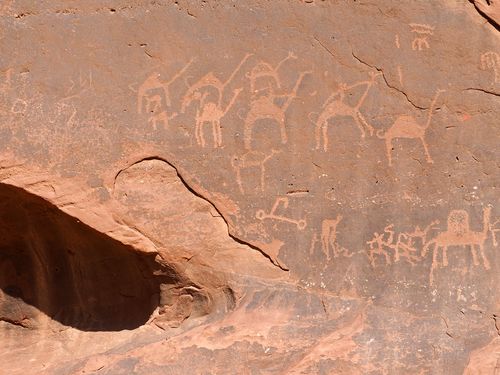
Wadi Rum • Petroglyphs
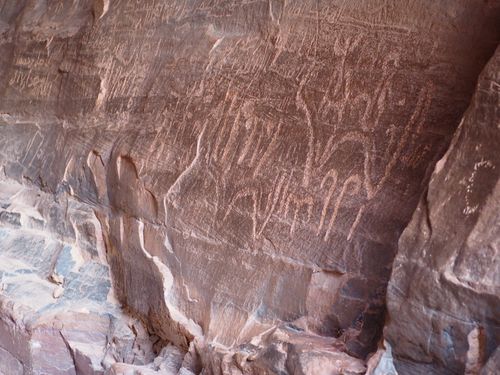
Wadi Rum • Petroglyphs
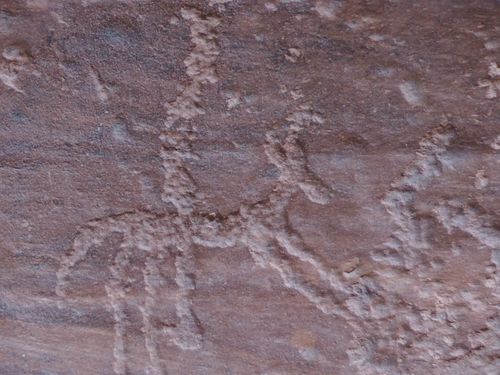
Wadi Rum • Petroglyphs
Monument profile
Petroglyphs
Monument category: Petroglyphs
Monument family: Archaeological
Monument genre: Archaeological site
Geographic location: Wadi Rum • Jordan
Construction period: before the 6th century BC
This natural site in Wadi Rum is inscribed on the UNESCO World Heritage List since 2011 and is part of the serial property "Wadi Rum Protected Area".See the UNESCO natural sites featured on this site
• Links to •
• List of videos about Wadi Rum on this site •
Wadi Rum, spectacular desert • Jordan
• References •
UNESCO: Zone protégée du Wadi Rum
Historical Context of the Petroglyphs of Wadi Rum
The petroglyphs of Wadi Rum, located in southern Jordan, form an extensive corpus of rock carvings created over several millennia on the sandstone surfaces of the desert landscape. Unlike monuments built during a single historical period by a centralized authority, these engravings represent the cumulative record of different populations that travelled through or inhabited the region. Their historical significance lies not in a single act of construction but in a long process of cultural expression that reflects the political, social and economic dynamics of ancient Arabia and the broader Near Eastern world.
Wadi Rum occupies a strategic position between the Arabian Peninsula and the Levant. For thousands of years the region served as a corridor linking trade networks that connected southern Arabia with the Mediterranean. Caravans transporting incense, spices and other valuable goods crossed the desert along established routes. These movements of traders, pastoral groups and travellers created the social context in which the petroglyphs emerged. The engravings served multiple purposes, including marking routes, commemorating individuals, expressing cultural identities or documenting aspects of daily life.
Social and Political Environment of Their Creation
The creation of the petroglyphs cannot be attributed to a single ruler or state authority. Instead, they were produced by a variety of communities whose presence in the desert was shaped by broader political structures. Nomadic and semi-nomadic tribes moving through the region left engravings depicting animals, hunting scenes and human figures. These images illustrate aspects of pastoral economies and tribal life that were closely connected to seasonal migration and resource management.
During the first millennium BCE and the early centuries of the Common Era, the region came increasingly under the influence of organized political entities such as the Nabataean Kingdom. The Nabataeans controlled important trade routes that passed through southern Jordan and northern Arabia. Although Wadi Rum itself did not develop into a major urban center like Petra, its location along caravan routes ensured that travellers and merchants frequently passed through the area. The inscriptions and images carved into the rock surfaces reflect this circulation of people and ideas.
These engravings therefore represent a decentralized cultural practice rather than a monument commissioned by a sovereign authority. Nevertheless, they reflect broader political and economic developments. The expansion of trade networks, the consolidation of regional powers and the interaction between nomadic tribes and settled kingdoms all contributed to the circumstances in which these carvings were produced.
Historical Events and Cultural Continuity
Unlike fortified cities or monumental temples, the petroglyphs of Wadi Rum were not directly shaped by warfare, sieges or deliberate architectural transformations. However, the region in which they were created experienced numerous political changes that influenced patterns of settlement and mobility. The Nabataean Kingdom flourished between the third century BCE and the first century CE, developing an advanced trading system that linked Arabia with the Roman world. During this period, caravan traffic intensified and the desert routes passing through Wadi Rum gained greater economic importance.
After the Roman annexation of Nabataea in the first century CE, the region became part of the Roman province of Arabia Petraea. Roman administration introduced new infrastructure, including roads and military outposts designed to control trade and maintain stability along frontier territories. Although these developments did not directly alter the petroglyphs themselves, they contributed to a continued flow of travellers who may have added inscriptions or images to the existing rock surfaces.
Over the following centuries, successive political powers—including Byzantine authorities and later Islamic administrations—exercised varying degrees of influence over the region. Throughout these changes, desert populations maintained their mobility and cultural traditions. The petroglyphs therefore represent a rare continuity of expression across different historical periods, recording traces of human presence in an environment that remained relatively unchanged.
Global Context of Rock Art Traditions
The petroglyphs of Wadi Rum also belong to a wider global tradition of rock art that extends across many continents. From the Sahara and the Arabian Peninsula to Central Asia and Europe, prehistoric and ancient societies created images on stone surfaces to record aspects of their environment and beliefs. These engravings often appeared in landscapes used for seasonal migration, hunting or trade, where natural rock formations provided accessible surfaces.
During the periods when many of the Wadi Rum engravings were produced, other parts of the world were also witnessing the development of monumental cultural expressions. In the Mediterranean region large stone temples, cities and inscriptions were being constructed by organized states, while in other areas communities continued to produce symbolic imagery directly in the landscape. The petroglyphs of Wadi Rum therefore represent an alternative form of monumentality, one based not on built structures but on the transformation of natural rock surfaces into cultural markers.
Evolution and Reinterpretation Over Time
Over centuries the rock surfaces of Wadi Rum accumulated layers of images and inscriptions. Some panels contain engravings created during different historical periods, resulting in overlapping compositions that reveal successive phases of activity. This gradual accumulation can be compared to a visual archive in which different generations added their own contributions.
In later historical periods the significance of these engravings changed as the desert routes declined in economic importance. However, the petroglyphs remained part of the cultural landscape known to local Bedouin communities. Oral traditions and regional knowledge sometimes associated particular rock formations or carvings with local narratives or historical memories.
During the nineteenth and early twentieth centuries, European explorers and archaeologists began documenting the inscriptions and images of Wadi Rum. Their studies revealed the diversity of scripts present at the site, including Thamudic, Safaitic and Nabataean forms of writing. These discoveries contributed significantly to the understanding of ancient Arabian languages and nomadic societies.
Cultural Role in the Modern Era
In contemporary Jordan the petroglyphs of Wadi Rum are recognized as an important component of the country’s cultural heritage. The desert landscape itself has become internationally known for its dramatic geological formations and historical associations. The engravings are now studied by archaeologists, historians and linguists seeking to reconstruct patterns of human activity in the region.
The site also plays a role in the cultural identity of local communities. Bedouin groups who have long inhabited the area maintain traditions related to desert navigation and pastoral life. The rock carvings are often interpreted as evidence of a deep historical connection between people and landscape, illustrating how generations of travellers interacted with the desert environment.
Tourism has become an increasingly important aspect of Wadi Rum’s contemporary significance. Visitors are drawn both by the natural scenery and by the traces of ancient cultures preserved in the rock art. Guided tours frequently include stops at locations where clusters of petroglyphs can be observed, providing insight into the region’s long human history.
Conservation and Modern Challenges
The preservation of the petroglyphs presents several challenges. Because they are carved into exposed rock surfaces, the engravings are vulnerable to natural erosion caused by wind, sand and temperature fluctuations. Over long periods these environmental processes can gradually reduce the visibility of the images.
Human activity also poses potential risks. Increased tourism can lead to accidental damage when visitors touch or climb on rock panels containing engravings. In some cases modern graffiti has appeared near ancient carvings, highlighting the need for careful management of archaeological sites within popular tourist areas.
Efforts to protect the cultural and natural landscape of Wadi Rum have gained international recognition. The area has been designated as a protected heritage landscape, emphasizing the importance of safeguarding both its geological formations and its archaeological remains. Conservation programs include documentation of rock art panels, monitoring of environmental impacts and public awareness initiatives aimed at encouraging responsible visitation.
Today the petroglyphs of Wadi Rum stand as enduring witnesses to thousands of years of human movement through the desert. Rather than representing a single historical event or ruler, they form a collective monument shaped by countless individuals who left their marks on the sandstone surfaces of the region. Through these engravings, the desert landscape preserves a unique historical record of cultural interaction, mobility and adaptation in one of the most distinctive environments of the Middle East.
Architectural Characteristics of the Petroglyphs of Wadi Rum
The petroglyphs of Wadi Rum in southern Jordan represent a distinctive form of architectural expression in which the landscape itself becomes the structural framework of the monument. Unlike conventional architecture composed of built structures, the site consists of engraved images and inscriptions carved directly into sandstone cliffs, rock faces and isolated boulders scattered across the desert. The architectural significance of these carvings lies in their deliberate placement within the natural formations of Wadi Rum, creating a cultural landscape where geological features function as the structural support and spatial organization of the monument.
These engravings form an extensive network of rock surfaces transformed into visual archives. Over centuries, successive groups engraved figures, symbols and inscriptions that collectively constitute a monumental environment distributed across the desert terrain. The resulting architectural form is therefore not a single structure but a dispersed system integrated into the geological framework of the region.
Technological Practices and Methods of Engraving
The creation of the Wadi Rum petroglyphs relied on engraving techniques that demonstrate practical knowledge of stone surfaces and tool use. Craftsmen produced the images through a combination of incision and pecking methods. Using pointed tools made of harder stone or metal, they struck the sandstone repeatedly to remove small fragments of the surface. This technique allowed them to create outlines, figures and inscriptions with controlled depth and visibility.
The technological process required careful assessment of the stone’s texture and hardness. The sandstone formations of Wadi Rum are relatively soft compared with harder igneous rocks, making them suitable for engraving while still maintaining durability over long periods. Artisans exploited these properties to create grooves deep enough to remain visible despite gradual weathering.
Some engravings were produced through linear incision, in which a sharp tool cut continuous lines into the rock. Others were formed through pecking, where repeated impacts created a sequence of small depressions outlining a figure. The resulting textures vary across the site, reflecting different technical traditions and periods of production. In certain cases the engraved surfaces were lightly smoothed to enhance contrast and clarity.
These techniques represent a practical adaptation to the desert environment. The absence of sophisticated building materials did not limit the capacity for architectural expression. Instead, the stone landscape itself became the medium through which artistic and communicative structures were established.
Materials and Geological Framework
The principal material involved in the creation of the petroglyphs is the sandstone that dominates the geological formations of Wadi Rum. This sedimentary rock, shaped over millions of years by erosion and tectonic activity, forms cliffs and rock towers that provide expansive surfaces suitable for engraving.
One notable characteristic of this sandstone is the presence of a dark natural patina created by oxidation and long-term exposure to the desert climate. When engravers removed this outer layer, the lighter-colored stone beneath became visible, producing a strong visual contrast. This contrast enhanced the legibility of the images and inscriptions, especially under the intense sunlight typical of the region.
The durability of the sandstone contributes to the longevity of the engravings. Although the desert environment subjects the rock to temperature fluctuations, wind abrasion and occasional rainfall, the depth of the carved lines allows many motifs to remain identifiable after centuries. The combination of accessible carving surfaces and long-term stability explains why this region contains such a large concentration of rock engravings.
The architectural aspect of the site therefore relies heavily on the geological stability of these formations. Cliffs and vertical rock faces serve as natural walls, while isolated boulders function as freestanding surfaces analogous to sculptural monuments.
Artistic Influences and Cultural Expression
The visual language of the petroglyphs reflects the cultural diversity of the populations that produced them. The engravings include depictions of animals such as camels, ibex and horses, as well as human figures, hunting scenes and symbolic markings. These motifs illustrate daily activities associated with pastoral life and caravan travel.
Stylistic differences among the images suggest the presence of multiple artistic traditions. Some figures are rendered with minimal detail using simple linear outlines, while others display more complex forms with anatomical features and dynamic postures. These variations indicate that the site was used over long periods by different cultural groups.
Inscriptions carved near the images provide additional evidence of cultural interaction. Several ancient writing systems appear across the rock surfaces, including scripts associated with North Arabian and Nabataean linguistic traditions. The presence of these inscriptions indicates that Wadi Rum functioned as a communication space where travellers recorded their identities, movements or affiliations.
This combination of images and texts creates a layered visual environment that reflects cultural exchanges across the desert trade routes. The artistic elements therefore illustrate both local traditions and broader regional influences.
Spatial Organization and Architectural Layout
The spatial organization of the petroglyphs is closely linked to the topography of Wadi Rum. The engravings are not evenly distributed throughout the desert but appear in clusters where natural rock formations provide accessible and prominent surfaces. These clusters often occur along ancient routes that once connected trade networks between the Arabian Peninsula and the Levant.
Vertical rock walls frequently contain multiple panels of engravings arranged at varying heights. In some locations the carvings extend across several meters of rock surface, forming dense visual compositions that resemble mural-like displays. Elsewhere, isolated motifs appear on smaller rock faces or detached boulders positioned along pathways.
The organization of these engravings reflects practical considerations related to visibility and accessibility. Surfaces facing open valleys or natural corridors were particularly suitable for engraving because they could be easily seen by travellers passing through the landscape. In this sense the architectural layout functions as a form of environmental communication, transforming the desert terrain into a network of visual markers.
The absence of built structural elements such as arches, domes or colonnades does not diminish the architectural coherence of the site. Instead, the cliffs and rock towers serve as the structural framework, while the engravings operate as decorative and symbolic components embedded within this natural architecture.
Dimensions and Quantitative Characteristics
The dimensions of individual petroglyphs vary widely. Some inscriptions measure only a few centimeters in height, while larger animal figures may reach several tens of centimeters. In certain areas entire panels containing dozens of engravings extend across rock surfaces several meters wide.
The cumulative scale of the site is significant. Thousands of engravings have been documented throughout the Wadi Rum region, making it one of the most extensive concentrations of rock art in the Arabian Peninsula. The density of images in certain sectors demonstrates that these locations were repeatedly used as engraving surfaces over long periods.
Another notable characteristic is the layering of images produced by successive generations of engravers. In some panels, earlier figures are partially overlapped by later inscriptions or drawings. This accumulation creates a stratified visual record of artistic activity spanning centuries.
Structural Characteristics and Distinctive Features
What distinguishes the petroglyphs of Wadi Rum from many other forms of rock art is the scale of the landscape that hosts them. The monumental sandstone formations create a natural architectural environment in which the engravings appear integrated with towering cliffs and expansive desert vistas.
The vertical orientation of many rock surfaces provides protection from sand accumulation and water runoff, helping preserve the engravings. In addition, the desert climate, characterized by low humidity and limited vegetation, reduces biological growth that might otherwise obscure the images.
Another distinctive feature is the relationship between the engravings and ancient travel routes. The placement of carvings near pathways or water sources suggests that they may have functioned partly as markers for travellers. In this way the architectural structure of the site is intertwined with the geography of movement through the desert.
Recognition and Conservation Challenges
The architectural importance of the Wadi Rum petroglyphs lies in their integration with the natural landscape and their testimony to long-term human interaction with the desert environment. Together with the surrounding geological formations, the engravings contribute to the cultural value of Wadi Rum as a historic desert landscape.
International recognition of the area emphasizes both its natural and archaeological significance. However, the open nature of the site presents challenges for preservation. Because the engravings are exposed directly on rock surfaces, they remain vulnerable to erosion, wind abrasion and temperature variation.
Human activity can also affect the condition of the petroglyphs. Increased tourism has brought greater attention to the site, but it also requires careful management to prevent damage from physical contact or unauthorized markings. Conservation efforts therefore focus on documentation, visitor awareness and the protection of sensitive rock panels.
Despite these challenges, the petroglyphs continue to form a remarkable architectural landscape where natural geology and human expression intersect. The sandstone cliffs of Wadi Rum function simultaneously as structural supports, visual canvases and historical records, creating a dispersed monument that reflects centuries of cultural activity in the desert environment.