

 Français (France)
  Nederlands (nl-NL)
 Wat Phou Temple in southern Laos is an extensive ancient religious complex associated with enduring spiritual traditions. Positioned along a route between lowlands and a revered elevation, it reflects how sacred locations shaped political and ritual development in the region. Its remains indicate long periods of occupation, illustrating shifts in belief systems and territorial organisation. Today, Wat Phou is recognised as a major heritage site connected to Lao cultural identity and ongoing devotional practices. It attracts both visitors and worshippers, highlighting the continuity of its symbolic function.

Monument profile
Wat Phou temple
Monument categories: Hindu Temple, Buddhist temple
Monument family: Temple
Monument genre: Religious
Cultural heritages: Hindu, Buddhist
Geographic location: Wat Phou • Laos
Construction period: 11th century AD
This monument in Wat Phou is inscribed on the UNESCO World Heritage List since 2001 and is part of the serial property "Vat Phou and Associated Ancient Settlements within the Champasak Cultural Landscape".See the UNESCO monuments featured on this site
• Links to •
• Dynasties that contributed to the construction of the monument •

• List of videos about Wat Phou on this site •
Wat Phou: From Pre-Angkorian Heritage to Khmer Temple
• Sources •
Digital Sources
- UNESCO World Heritage Centre - Information on the listing of Wat Phou.
- Champa Meuang Lao - In-depth details on Wat Phou, its history, and cultural significance.
Books and Publications
- Higham, C. (2001). "The Civilization of Angkor". University of California Press - A reference on the civilizations of Southeast Asia and their monuments.
- Baptiste, P., & Zéphir, T. (2006). "Treasures of Vietnamese Art, Champa Sculpture from the 5th to the 15th Centuries". National Museum of Asian Arts - Details on artistic influences in the region.
History of Wat Phou Temple
Wat Phou, located in southern Laos, stands as one of the oldest sacred complexes in mainland Southeast Asia. Its long occupation reflects the dynamics of political authority, religious change and territorial organisation over more than a millennium. The site illustrates how sacred landscapes could serve both religious devotion and state formation, linking natural features, ritual practice, and power.
Founding context and political motivations
The origins of Wat Phou date to the early Khmer world, long before the rise of Angkor. The location was selected for reasons that combined geography, symbolism and geopolitical ambition. The nearby mountain, believed to embody divine presence, made the area spiritually valuable. Establishing a cult site here helped legitimise local rulers in a period of competition among emerging centres in the Mekong Basin.
Wat Phou was therefore conceived not merely as a religious facility but as a political statement. Its creation implied control over trade routes linking the river plains to upland territories and demonstrated the ability of elites to organise labour and ritual. The site anchored royal authority in divine sanction, reflecting a wider Southeast Asian pattern in which sacred mountains, temples, and kingship were closely intertwined.
Development under Khmer influence
Between the ninth and twelfth centuries, Wat Phou expanded significantly under the influence of Khmer rulers who projected authority across the region. The site became part of a network of sanctuaries tied to larger centres, and its architecture and inscriptions took on forms associated with the empire. This phase corresponded to a global trend in which major states invested in monumental sacred sites to consolidate legitimacy and manage territory.
The temple was originally dedicated to Shiva, reflecting the dominant cult of Khmer royalty. Its organisation, aligned with the mountain and a natural spring, reinforced cosmological meanings that connected landscape and divinity. Wat Phou functioned as a pilgrimage centre and a marker of Khmer presence, illustrating how sacred geography could extend imperial authority.
Religious transformations and adaptation
From the thirteenth century onward, Theravāda Buddhism gradually displaced earlier cults. Instead of abandoning the complex, local practitioners reinterpreted it. Sculptures, shrines, and ritual spaces were adapted to new beliefs, and Wat Phou evolved into a Buddhist pilgrimage site. This continuity through change is central to its history: despite major doctrinal shifts, the temple remained active.
This adaptation illustrates broader Southeast Asian patterns in which earlier Hindu structures were repurposed rather than erased. Wat Phou’s physical layout, already organised for ritual ascent and water symbolism, suited Buddhist devotional practice. The site thus persisted as a spiritual landscape even as political power shifted away from Khmer control.
Integration into Lan Xang and later history
With the rise of the Lao kingdom of Lan Xang in the fourteenth century, Wat Phou was absorbed into a new political frame. The sanctuary became part of the kingdom’s religious geography, linked to expressions of sovereignty and identity. Pilgrimage traditions strengthened, and elites supported its upkeep.
However, periods of instability, including military incursions and fragmentation of regional authority, led to neglect, damage and partial abandonment. Yet local communities continued to venerate the temple, indicating its resilience as a sacred place beyond formal state patronage. As elsewhere in Southeast Asia, religious continuity often outlasted political structures.
Rediscovery and scholarly interest
In the nineteenth and early twentieth centuries, colonial administrators, explorers and scholars documented the site as part of broader research on Khmer civilisation. Wat Phou entered global heritage discourse during this period, echoing a world-wide movement that sought to identify and classify ancient monumental cultures.
Archaeological studies began to disentangle its phases of construction and transformation. This shift marked a dual existence: Wat Phou was both an active ritual site and an object of scientific inquiry. Conservation work slowly accompanied this academic attention, even if resources were limited.
Restoration, national meaning and UNESCO recognition
In the late twentieth century, Wat Phou’s historical and symbolic status became more explicit in national policy. Laos recognised the temple as a key element of cultural identity, associated with continuity and prestige. Efforts were undertaken to stabilise structures, clear vegetation, and open the site to tourism.
This process culminated in inscription as a UNESCO World Heritage property in the early 2000s. The designation emphasised Wat Phou as an exceptional example of a sacred cultural landscape, where natural topography and monumental architecture form a coherent whole. The recognition reinforced its value as both national heritage and international patrimony.
Transformations over time
Throughout its history, Wat Phou has undergone numerous physical and functional changes. Architectural modifications reflected evolving cults, while declines were followed by repair phases. Structures were rebuilt or augmented; inscriptions were added; terraces eroded and were stabilised. External events, such as warfare or shifts in patronage, influenced its upkeep.
The site’s environment also changed. As settlements grew or declined around it, the sacred landscape remained a reference point. Modern tourism reshaped circulation patterns and introduced new stresses, while conservation objectives increasingly dictated interventions.
Contemporary role and cultural significance
Today, Wat Phou functions simultaneously as a pilgrimage destination, tourist attraction and emblem of Lao historical identity. Annual festivals bring practitioners from across the region, reinforcing its role as a living religious centre. Visitors encounter both ancient remains and ongoing rituals, illustrating the coexistence of heritage and contemporary devotion.
The temple is used symbolically in narratives about Laos as a place of deep historical continuity, linking ancient civilisations to present-day nationhood. This political dimension mirrors global trends in which heritage sites serve as markers of cultural legitimacy.
Conservation challenges and future outlook
Conservation remains a complex task. Stone decay, invasive vegetation, climatic impacts and visitor pressure threaten the structures. Stabilising terrace walls, managing water flows, and controlling access are continual concerns. Restoration programmes attempt to balance preservation with respect for ritual uses, requiring cooperation between authorities, communities and international partners.
Wat Phou’s long history shows that adaptation is intrinsic to its survival. The challenge today lies in maintaining authenticity while enabling living practices and economic benefits. As a World Heritage property, the temple must navigate global expectations for preservation alongside local needs for pilgrimage and identity affirmation.
Architecture of Wat Phou Temple
Overall conception and relationship to the landscape
The architecture of Wat Phou is inseparable from its setting on the lower slopes of a mountain overlooking the Mekong plain. Instead of imposing a symmetrical plan on flat ground, the builders organised the complex along a rising north–south axis that follows the natural slope. Terraces, stairways, causeways and reservoirs structure a continuous ascent from the plain towards a sanctuary aligned with a sacred spring. This vertical progression is one of the most distinctive features of Wat Phou and reflects a sophisticated understanding of “sacred urbanism”, in which topography, water and ritual movement are carefully integrated.
The site is conceived as a sequence of thresholds: entrance from the plain, processional causeway between water basins, intermediate terraces with large rectangular buildings, then the final climb to the upper sanctuary. Each level reflects a different degree of ritual intimacy and architectural density, creating a graduated experience rather than a single monumental façade.
Materials and construction techniques
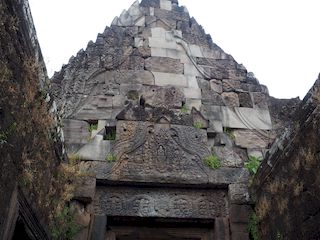
As in much Khmer architecture, Wat Phou relies primarily on sandstone and laterite. Sandstone, quarried in the region, is used for visible and sculptural elements: walls, door frames, columns, lintels and decorative details. Blocks are carefully cut and laid with tight joints, usually without mortar, relying on weight, precision and occasional tenons to ensure stability. Roofs and interior ceilings employ corbelled systems, with horizontal courses progressively projecting inward until they meet, rather than true arches.
Laterite, a porous iron-rich stone, is employed for foundations, core walls and terrace structures. Its lighter weight and ease of extraction made it practical for large volumes that did not require fine carving. The combination of a laterite core with a sandstone facing allowed builders to balance structural strength, cost and aesthetic quality. This dual-material system is a key technological feature of Wat Phou and other major Khmer sites.
Timber would originally have been used for roofs, doors and possibly gallery structures, although it has largely disappeared. The surviving masonry nevertheless reveals the logic of the original mixed construction: stone for permanence and sacred representation, wood for lighter superstructures and functional elements.
Spatial organisation and circulation
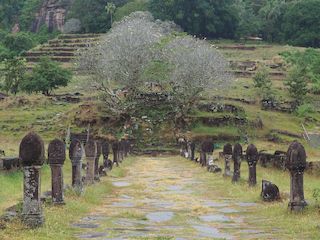
The plan of Wat Phou is strongly axial. From the plain, an entrance aligns with a long processional causeway bordered by stone markers, often described as lotus-bud boundary posts. This causeway crosses the lower part of the sacred landscape and leads towards two large rectangular buildings on either side, sometimes called “palaces” or ceremonial halls. Their exact function remains debated, but they clearly framed the processional approach and provided spaces for preparation, gathering or offerings.
Beyond these structures, the ground begins to rise, and a succession of stairways and landings marks the climb towards the upper sanctuary. Each terrace is supported by substantial retaining walls in sandstone and laterite, forming a stepped platform system. The staircases are relatively steep, emphasising both the physical and symbolic effort of ascent. At the highest level stands the main sanctuary, a relatively compact but significant structure directly associated with the mountain and the spring. The entire composition reads as a ritual journey from the human domain of the plain to a zone of heightened sacred presence.
Hydraulic design and environmental control
One of the most remarkable aspects of Wat Phou’s architecture is the integration of water. At the lower level, two large rectangular basins flank the axis. They collected and managed water during the rainy season, while creating reflections of the surrounding architecture and reinforcing the symbolic association with cosmic oceans. Channels and small dykes directed flows into and out of these reservoirs, showing a sophisticated understanding of drainage and storage in a monsoon climate.
Higher up, the natural spring emerging from the mountain is central to the sanctuary’s design. The main shrine is aligned so that water could be channelled into or near the inner sanctum, forming the basis of libation and purification rituals. This hydraulic connection between the mountain, the spring, the temple and the basins demonstrates a high level of technological adaptation. Systems of carved channels, spouts and hidden conduits ensured that water was both controlled and displayed, linking natural processes to religious practice.
Structural stability and adaptation to slope
Constructing on a slope required careful attention to stability. Engineers at Wat Phou relied on a combination of massive terrace walls, stepped foundations and controlled drainage to secure the complex. Laterite cores provided compressive strength, while sandstone retaining faces gave durability and resistance to erosion. The terraced arrangement distributes loads across the hillside rather than concentrating them at a single point, reducing the risk of landslides.
Stairways are anchored into these terraces, and their treads often incorporate slight inclinations and drainage features to manage runoff. The absence of high freestanding towers, in contrast to some lowland Khmer temples, reflects a pragmatic response to the hillside context. The architecture seeks balance and horizontality within each terrace, while the vertical dimension is expressed by the succession of levels rather than by extremely tall structures.
Decorative language and artistic influences
The decorative programme of Wat Phou follows Khmer conventions while adapting them to local circumstances and changing religious uses. Sandstone lintels above doorways show sculpted motifs with vegetal scrolls, guardian figures and scenes drawn from Hindu mythology in the earlier phases, particularly related to Shiva and associated deities. Later interventions introduced Buddhist imagery, creating a layered iconography.
Columns, pilasters and cornices combine geometric mouldings with stylised foliage, reflecting the wider artistic vocabulary of the Angkorian world. However, the scale and density of decoration at Wat Phou are generally more restrained than at some major temples in present-day Cambodia, perhaps due to regional resources, subsequent alterations or local preferences. The effect is less one of overwhelming ornament and more of measured articulation, with key zones emphasised while large wall surfaces remain relatively plain.
Distinctive features and notable elements
Several architectural features distinguish Wat Phou within the broader corpus of Khmer religious sites. The long processional causeway, with its rhythmic sequence of boundary posts, creates a powerful visual corridor that draws the eye towards the mountain. The paired rectangular buildings flanking this axis are relatively rare in this arrangement and underline the ceremonial importance of the approach.
The relationship between the main sanctuary and the mountain cliff is also specific. Natural rock formations behind and above the temple were integrated into the sacred topography, and certain shaped rocks were interpreted symbolically in earlier religious contexts. This explicit fusion of built and natural forms, combined with the spring, gives Wat Phou a particularly strong identity as a mountain sanctuary.
In terms of dimensions, the overall cultural landscape extends over hundreds of hectares, while the constructed core occupies a more compact but carefully orchestrated area. The basins, causeway length and cumulative height difference between plain and sanctuary contribute to a sense of grandeur that exceeds the scale of the individual buildings.
International recognition and conservation issues
Architecturally, Wat Phou is significant as an early example of a fully developed Khmer temple-mountain concept adapted to a steep natural site. Its combination of axial planning, terracing, hydraulic engineering and sculptural articulation has been recognised as exceptional, contributing to its inscription as a World Heritage property. The ensemble demonstrates how technical knowledge, religious symbolism and landscape design converged in premodern Southeast Asia.
Conservation challenges are closely tied to the temple’s materials and setting. Sandstone is vulnerable to weathering, biological growth and salt crystallisation; laterite can disintegrate under sustained moisture; and terrace walls are at risk of movement due to soil instability and heavy rainfall. Visitor pressure adds further stress, particularly on stairways and narrow terraces. Modern conservation initiatives focus on stabilising structures, improving drainage, managing vegetation and organising visitor circulation, while respecting the site’s status as a living place of worship.
Through these efforts, Wat Phou continues to serve as both an outstanding architectural document and a dynamic religious and cultural landscape, illustrating the long-term resilience and adaptability of monumental design in the Mekong region.