

 Français (France)
  Nederlands (nl-NL)
 The Hassan II Mosque in Casablanca is one of the most iconic landmarks of modern Morocco. Inaugurated in 1993, it stands out for its scale and its central position in the city’s urban landscape. Located by the Atlantic Ocean, it is dominated by a minaret rising over 200 meters, visible from far away. The mosque has become a symbol of national pride as well as a cultural and religious reference recognized worldwide.

Monument profile
Hassan II mosque
Monument category: Mosque
Monument family: Mosque, Minaret or Madrasa
Monument genre: Religious
Cultural heritage: Islamic
Geographic location: Casablanca • Morocco
Construction period: 20th century AD
• Links to •
• List of videos about Casablanca on this site •
Casablanca • Hassan II Mosque, Symbol and Excess
The Hassan II Mosque in Casablanca: A Monument of Power, Faith and Modernity
Political and social context of construction
The decision to build the Hassan II Mosque in Casablanca cannot be separated from the political and social climate of Morocco during the second half of the 20th century. King Hassan II, who ruled from 1961 until his death in 1999, sought to consolidate his authority in a period marked by social unrest, economic hardship, and political challenges. The 1970s and 1980s were decades of tension, with popular protests, demands for reform, and waves of emigration reflecting the strain on Moroccan society.
Against this backdrop, the monarch launched a series of prestige projects to reinforce the monarchy’s legitimacy and to present Morocco as a nation capable of great achievements. The construction of a monumental mosque was at once a spiritual and a political gesture: it asserted Hassan II’s role as Amir al-Mu’minin (Commander of the Faithful), while also reinforcing Casablanca’s status not only as the economic capital of Morocco but also as a potential spiritual and cultural center.
The financing of the mosque was presented as a national subscription, with citizens asked to contribute regardless of their social status. While this approach was justified as a collective effort symbolizing unity, it also sparked controversy, as the funds came during a period of economic austerity when many Moroccans struggled with unemployment and poverty. This duality—pride in national achievement and resentment at the financial burden—has remained one of the defining aspects of the mosque’s history.
In the international context, Hassan II was also motivated by rivalry and emulation. During the 1980s, the Muslim world witnessed the construction of several colossal mosques, including the Faisal Mosque in Islamabad, inaugurated in 1986, and large expansions of the holy mosques in Mecca and Medina. By launching the Hassan II Mosque, Morocco positioned itself in this global competition for religious prestige and cultural influence.
Major historical events and the site
Unlike many historic mosques, the Hassan II Mosque does not occupy a site with centuries of layered history. Instead, it was deliberately built on reclaimed land at the edge of the Atlantic Ocean, transforming a stretch of Casablanca’s shoreline into a monumental esplanade. There were no battles, sieges, or dynastic changes associated with this specific location. However, the very decision to build on the sea was itself symbolic. According to accounts, Hassan II wished that the mosque should “rise above the water,” so that the faithful could pray with “the ocean as witness.” This vision translated into one of the most distinctive features of the mosque: its foundation partly over the Atlantic.
The mosque’s construction began in 1986, with the laying of the foundation stone on July 12. Over the next seven years, an estimated 10,000 workers and artisans contributed to the project, culminating in the official inauguration on August 30, 1993, coinciding with the king’s 60th birthday. No wars or regime changes intervened in this process, but the mosque itself became a marker of Hassan II’s reign and a legacy that survived him.
Global context and monumental trends
The late 20th century was a period of renewed investment in monumental religious architecture across much of the Muslim world. The oil boom of the 1970s and 1980s fueled projects of unprecedented scale in the Arabian Peninsula and beyond. In countries from Saudi Arabia to Pakistan, rulers commissioned vast mosques as expressions of religious devotion, but also as political statements.
The Hassan II Mosque fits into this trend. Its scale, with a prayer hall capable of holding 25,000 worshippers and an esplanade for over 80,000 more, placed it among the largest mosques in the world at the time of its completion. Its 210-meter minaret became the tallest in existence, symbolizing Morocco’s aspiration to rank alongside the great religious powers of the Islamic world. At the same time, its partial accessibility to non-Muslims distinguished it from most other mosques and underscored Morocco’s desire to project an image of openness and cultural dialogue.
Transformations and evolution of the monument
Since its inauguration, the mosque has not undergone fundamental architectural changes, but it has required continual maintenance and restoration due to its maritime location. The sea air, humidity, and salt corrosion threaten both the structural elements and the intricate decorative surfaces. Restoration campaigns have been periodically launched to repair zellij tilework, carved stucco, and cedar wood ceilings, while modern protective measures have been introduced to safeguard the reinforced concrete foundations from erosion.
In terms of usage, the mosque has remained a functioning place of worship, hosting daily prayers and large religious gatherings, particularly during Ramadan and the two major Islamic feasts. However, it has also taken on a cultural and touristic role. Guided visits, cultural events, and exhibitions are regularly organized, making it one of the rare mosques in Morocco open to non-Muslim visitors. This dual role has gradually transformed the mosque from a purely religious site into a hybrid space of worship, heritage, and tourism.
The mosque in modern Casablanca
The Hassan II Mosque dominates Casablanca’s skyline, redefining the city’s identity. Historically, Casablanca had been associated with its port, industry, and modernist urban planning. With the completion of the mosque, the city acquired a new symbol: the minaret, visible for kilometers along the coast and from the sea.
The mosque has become a focal point for national pride, representing both Morocco’s Islamic identity and its modern aspirations. It serves as a venue for large-scale religious celebrations and also as a tourist attraction, visited by hundreds of thousands each year. Its role in shaping Morocco’s international image is significant, as it often appears in travel literature, cultural documentaries, and international media.
At the same time, it remains a subject of debate. For some Moroccans, it is a masterpiece of craftsmanship and devotion, embodying centuries of tradition. For others, it symbolizes the heavy costs imposed on society during its construction, at a time when resources could have been used to address social needs. This dual perception makes the mosque not only a religious monument but also a political text etched in stone.
Conservation and challenges
The preservation of the Hassan II Mosque poses ongoing challenges. Its location over the Atlantic exposes it to saltwater erosion, while Casablanca’s urban pollution and high visitor traffic increase wear on its surfaces. Authorities have established regular maintenance programs, combining traditional craftsmanship with modern engineering techniques. Periodic closures of certain sections are sometimes necessary for restoration.
Although it is not currently listed as a UNESCO World Heritage site, the mosque is recognized nationally as a protected monument and is often discussed in international heritage circles. Its architectural uniqueness and cultural importance make it a strong candidate for eventual inclusion on global heritage lists, but its relatively recent date of construction has so far limited such recognition.
Conclusion
The Hassan II Mosque is more than a religious building. It is a product of the political ambitions of a monarch, the skills of thousands of artisans, and the aspirations of a nation seeking its place in the modern world. Rooted in Islamic tradition yet open to international influences, it reflects both Morocco’s heritage and its modern identity. Its history is inseparable from the reign of Hassan II, whose vision of grandeur and symbolism continues to shape the monument’s legacy. At once admired and debated, the mosque remains a central marker of Casablanca’s landscape and Morocco’s contemporary history.
The Architecture of the Hassan II Mosque in Casablanca: Craft, Engineering and Urban Theater
Design intent and maritime setting
Conceived by architect Michel Pinseau and inaugurated in 1993, the Hassan II Mosque was designed to operate at two scales at once: as a state-of-the-art engineered structure on a harsh Atlantic edge, and as a showcase for Moroccan craft traditions. Its siting on a platform projecting over the ocean turns the building into an urban promontory: a mineral esplanade fronts a vast hypostyle prayer hall, while a soaring minaret—about 210 metres tall—pins the composition in the skyline and serves as a coastal landmark.
Technological and architectural innovations
The maritime site dictated an unusual structural strategy for a contemporary mosque. Foundations rely on deep piles and a protective seawall system that buffers swell and spray. The primary frame is reinforced concrete—portals, shear walls and chained arches—dimensioned for ocean winds and long spans. The minaret’s concrete core acts as a stiffening spine, resisting lateral loads and stabilising the tower’s high centre of gravity.
Environmental control was treated as architecture, not merely services. The interior volume and its tall arcades promote stack effect and cross-ventilation from sea breezes; thermal mass in walls and floors dampens heat swings. A signature device—the mechanically retractable roof over the prayer hall—opens the building to the sky for major gatherings, transforming the interior into a court and accelerating air renewal. At the summit, a directional light aligned with the qibla updates the minaret’s traditional role as an orienting signal.
Materials and methods of construction
The project is a living catalogue of Moroccan materials worked at monumental scale. Exterior and interior claddings combine hard local stones—marbles, granites and limestones—selected for weathering resistance and for their ability to take fine tooling. Large exterior doors and exposed fittings are in bronze and treated alloys, specified for corrosion control in a saline environment. Inside, the decorative programme mobilises historic crafts at industrial intensity: zellij mosaics laid in dense geometric fields; carved stucco (plaster) with deep relief; calligraphic bands; and an extraordinary sequence of cedar-wood ceilings from the Middle Atlas, hand-carved and polychromed. Cedar’s dimensional stability and lightness make it ideal for spanning decorated soffits without excessive dead load.
Construction combined heavy civil works with precision fit-out. Complex coffering and polylobed arches required bespoke formwork and staged pours. Prefabricated façade modules rationalised repetition while preserving artisanal surfaces. Many decorative elements were pre-assembled off site into transportable panels, then aligned on tight tolerances—an approach that reconciled artisanal variability with engineering accuracy.
Influences and artistic language
The mosque synthesises lineages from across the western Islamic world. The plan typology and rhythmic arcades echo Maghrebi and Andalusi precedents; polylobed arches and muqarnas-like transitions recall Nasrid and Marinid models; geometric zellij fields and non-figurative stuccowork express the region’s aniconic grammar. Yet the whole is unmistakably late-20th-century in ambition: a telescoping of craft into megastructure, a retractable roof grafted onto a historical typology, and a tower scaled to modern infrastructural benchmarks. Collaboration between Moroccan master artisans and international engineering teams produced a hybrid language—vernacular technique deployed with contemporary logistics.
Spatial organisation and structural logic
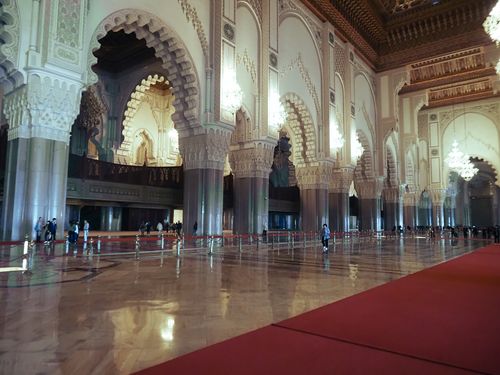
Spatially, the complex is legible and processional. From the wide seafront esplanade, one enters through a sequence of porches into the hypostyle hall organised on a clear column grid. The forest of columns carries tiers of pointed and polylobed arches, setting up deep shadow strata and acoustic dampening. Galleries on an upper level—including a women’s balcony—overlook the main floor and knit the perimeter into a continuous ambulatory. The mihrab niche, richly worked in stucco and tile, anchors the qibla wall as a visual and devotional focus.
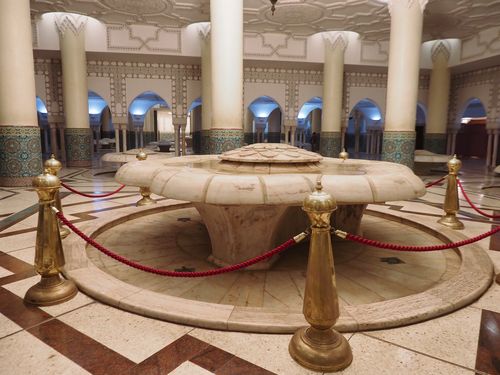
Service spaces and ablution halls occupy semi-basement levels, thickening the podium and separating ritual flows from tourist circuits. The minaret stands slightly to the side of the hall rather than axially in front of it; this offset stabilises the ensemble compositionally and structurally, reducing wind-induced torsion on the main roof diaphragm.
Stability, ventilation and urban design
Structural stability, environmental comfort and urban staging were conceived together. The plinth doubles as coastal engineering and public space, creating a promenade that reconciles city and sea. The mosque’s volumes step and terrace, breaking wind while preserving long views. At night, a layered lighting strategy articulates façades, arcades and the minaret, extending the monument’s presence into the nocturnal city and reinforcing wayfinding along the corniche.
Dimensions and notable facts
Order-of-magnitude figures convey the ambition: the prayer hall accommodates roughly 25,000 worshippers, with the esplanade holding tens of thousands more during major festivals. The minaret, at about 210 metres, has often been cited among the tallest in the world. The operable roof opens in minutes to reveal the sky—an engineering gesture that turns climate moderation into a ritual event. The build reportedly mobilised around 10,000 artisans and workers, scaling up historic crafts to a national project and helping sustain craft lineages through a new generation.
One oft-recounted detail concerns the minaret’s directional beam trained toward the holy cities, updating a symbolic function with contemporary optics. Another, more structural than anecdotal, is the persistent negotiation with the Atlantic: durability specifications for concrete cover, stainless fixings and wood finishes were elevated to maritime standards uncommon in religious architecture.
Recognition and conservation challenges
The mosque’s architectural importance lies as much in its systems integration as in its iconography: it demonstrates that a modern mega-project can be an engine for craft rather than a substitute for it. While not listed as a World Heritage site, it is nationally protected and widely referenced in discussions of late-20th-century Islamic architecture.
Conservation is a continuous discipline rather than a periodic campaign. Salt-laden air accelerates reinforcement corrosion and attacks porous stones; maintenance regimes therefore focus on protective coatings, vigilant monitoring of concrete carbonation, re-pointing of joints, and cyclical conservation of stucco and cedar surfaces. Urban growth brings vibration, traffic pollution and pressure on the seafront setting; tourism brings footfall wear and the need to balance visitor access with liturgical sanctity. The very features that define the project—its oceanic exposure, operable roof and crafted skins—are those that require sustained investment in expertise and upkeep.
Conclusion
Architecturally, the Hassan II Mosque operates as a total work: structure, climate, ritual choreography and ornament locked into a single, legible system. It amplifies the Maghrebi repertoire through modern engineering, while staging Casablanca’s edge as civic theatre. The result is a building that reads at the scale of a city and at the scale of a hand-cut tile: a late-20th-century synthesis in which engineering ambition and artisanal intelligence are made mutually indispensable.