

 Français (France)
  Nederlands (nl-NL)
 Cefalù Cathedral is a prominent religious monument located in the town of Cefalù on the island of Sicily. Established during the Norman period, it reflects the historical importance of the city within medieval Mediterranean networks. The cathedral has long served both religious and civic functions and remains an active place of worship. Today it is widely recognized as a major cultural landmark and forms part of a broader heritage ensemble illustrating Sicily’s historical development. Its presence contributes significantly to the cultural identity and historical continuity of the region.
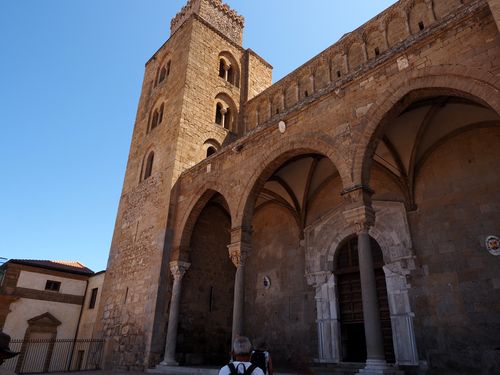
Cefalù • Cathedral of Cefalù: facade
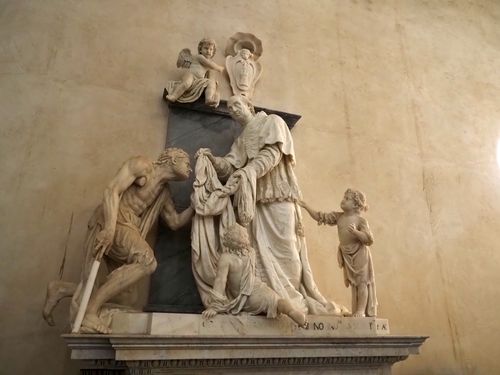
Cefalù • Cathedral of Cefalù: statue of Gioacchino Castelli Vescovo
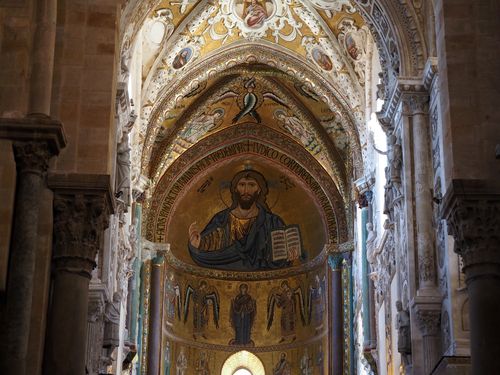
Cefalù • Cathedral of Cefalù: Christ Pantocrator
Cathedral of Cefalù
Historical Development of Cefalù Cathedral
Cefalù Cathedral, located on the northern coast of Sicily, represents one of the most significant monuments of the Norman Kingdom established in southern Italy during the twelfth century. Founded under the reign of King Roger II, the cathedral was conceived not only as a religious institution but also as a political statement reflecting the consolidation of Norman authority over a culturally diverse Mediterranean territory. Its history illustrates the interaction between dynastic ambition, ecclesiastical organization, and broader geopolitical transformations affecting Sicily across centuries.
Political and Social Context of Construction
The foundation of the cathedral dates to around 1131, shortly after Roger II was crowned King of Sicily in 1130. At that time, Sicily had recently emerged from centuries of Byzantine and Islamic administration before coming under Norman control. The new monarchy governed populations composed of Latin Christians, Greek-speaking communities, and Muslim inhabitants. Establishing legitimacy within such a complex society required visible expressions of authority capable of transcending cultural divisions.
According to medieval tradition, Roger II ordered the construction of the cathedral following a vow made during a violent storm at sea from which he narrowly escaped. While this narrative emphasizes religious devotion, the political implications were substantial. The cathedral formed part of a broader royal strategy aimed at strengthening centralized authority through monumental patronage.
Cefalù occupied a strategic coastal position between Palermo and Messina. By elevating the town through the creation of an episcopal center supported directly by the crown, Roger II reinforced royal influence over northern Sicily. The cathedral was intended to function partly as a dynastic mausoleum, further emphasizing its connection to royal legitimacy.
Relations between the Norman monarchy and the papacy also shaped the project. Roger II sought recognition of his kingship while maintaining strong control over ecclesiastical institutions within his kingdom. Monumental church construction therefore served diplomatic as well as religious purposes, demonstrating loyalty to Latin Christianity while affirming royal autonomy.
Major Historical Events and Dynastic Changes
Following Roger II’s death in 1154, Sicily entered periods of political transition under successive dynasties. Control passed to the Hohenstaufen rulers, later to the Angevin monarchy, and eventually to the Crown of Aragon. Each transition altered administrative priorities and economic conditions affecting ecclesiastical institutions across the island.
Although Cefalù Cathedral was spared large-scale wartime destruction, broader conflicts influenced its development. Planned elements of Roger II’s original vision remained incomplete, partly due to shifting royal attention toward other monumental foundations such as Monreale Cathedral.
During the later Middle Ages, the cathedral continued to function as an episcopal seat and religious center for the surrounding territory. Periodic maintenance and adaptation reflected evolving liturgical practices rather than reconstruction after warfare.
Between the sixteenth and eighteenth centuries, under Spanish and later Bourbon rule, the building underwent internal modifications associated with Counter-Reformation reforms. New furnishings and decorative additions responded to changing religious sensibilities while preserving the medieval structure.
Global Context at the Time of Construction
The construction of Cefalù Cathedral occurred during a period of extensive monumental activity throughout Europe and the Mediterranean world. The twelfth century witnessed the expansion of Romanesque architecture across Western Europe as monarchies and ecclesiastical institutions consolidated authority.
Norman rulers elsewhere, particularly in England and northern France, sponsored large ecclesiastical complexes that expressed political stability through architectural permanence. Meanwhile, Byzantine artistic traditions remained influential across the eastern Mediterranean, and Islamic courts continued developing major urban religious architecture.
The Norman Kingdom of Sicily occupied a unique position connecting these cultural spheres. Skilled craftsmen circulated across political boundaries, allowing artistic and technical exchange uncommon elsewhere in Europe. Cefalù Cathedral thus emerged within a broader international movement in which monumental religious construction reinforced emerging state structures.
Transformations and Urban Development
Over the centuries, the cathedral became the defining element of Cefalù’s urban organization. The square in front of the façade gradually evolved into the principal civic and religious space of the town. Administrative buildings, residences, and commercial activities developed around this focal point.
Architectural transformations occurred particularly during the early modern period. Baroque interventions introduced decorative adjustments reflecting contemporary aesthetic preferences. However, nineteenth-century restoration movements sought to recover the perceived medieval character of the monument. Later additions considered incompatible with the Norman structure were partially removed or modified.
These restoration campaigns corresponded to a wider European reassessment of medieval heritage during the nineteenth century, when historical monuments increasingly came to be valued as national cultural assets rather than solely religious institutions.
Contemporary Role and Cultural Importance
Today, Cefalù Cathedral remains an active place of worship while also serving as one of Sicily’s most recognizable historical landmarks. Religious ceremonies continue to structure local community life, particularly during important liturgical celebrations and patronal festivities.
The monument contributes strongly to regional identity. For Cefalù, it represents continuity between medieval origins and modern urban life. At the national level, the cathedral illustrates the historical significance of the Norman Kingdom in shaping southern Italy’s cultural landscape.
Tourism has further reinforced its international visibility. Visitors are drawn not only by religious significance but also by the historical narrative embodied in the building. The cathedral therefore functions simultaneously as sacred space, historical monument, and cultural reference point.
Conservation Status and Modern Challenges
Cefalù Cathedral forms part of the UNESCO World Heritage property dedicated to the Arab-Norman Palermo and the cathedral churches of Cefalù and Monreale. This designation recognizes the exceptional cultural synthesis achieved during the Norman period in Sicily.
Preservation efforts address several environmental and structural challenges. Proximity to the sea exposes building materials to salt-laden air and humidity, accelerating stone deterioration. Increasing visitor numbers require careful management to limit wear on interior surfaces and decorative elements.
Conservation policies involve collaboration between ecclesiastical authorities, heritage institutions, and national preservation agencies. Restoration programs emphasize minimal intervention and respect for historical materials, particularly regarding mosaics and masonry structures.
Conclusion
Cefalù Cathedral represents a durable expression of Norman political ambition and Mediterranean cultural exchange during the twelfth century. Founded as both religious institution and royal statement, it endured successive dynastic transitions while maintaining its central role within the city. Adapted through liturgical reform, restoration campaigns, and modern heritage management, the monument continues to bridge medieval state formation and contemporary cultural identity. Its preservation illustrates the lasting relevance of monumental architecture as a witness to historical continuity in the Mediterranean world.
Architectural Analysis of Cefalù Cathedral
Cefalù Cathedral represents one of the most accomplished architectural achievements of the Norman Kingdom of Sicily during the twelfth century. Conceived under royal patronage, the structure combines Western Romanesque construction principles with Byzantine artistic traditions and architectural concepts influenced by the Islamic Mediterranean. Its design reflects technical pragmatism adapted to local geography while simultaneously serving symbolic and ceremonial purposes. The monument demonstrates how architectural innovation in Norman Sicily emerged from the interaction of diverse cultural and technical traditions rather than from a single stylistic lineage.
Technological and Architectural Innovations
The cathedral’s construction relied on advanced masonry organization typical of large Romanesque projects yet adapted to Sicilian environmental conditions. Builders employed massive load-bearing walls capable of sustaining considerable vertical weight while ensuring long-term stability. The structure demonstrates careful management of thrust distribution through the relationship between the central nave and the lateral aisles.
One of the most significant innovations lies in the controlled balance between monumentality and structural restraint. Instead of adopting full stone vaulting across the nave, the builders chose a timber roof system. This decision reduced lateral pressure on supporting walls and minimized the need for extensive external buttressing. In a region exposed to seismic activity, such flexibility improved structural resilience.
The cathedral’s placement at the base of a rocky escarpment also reflects architectural planning integrated with landscape conditions. The massif behind the building acts as a natural protective barrier while reinforcing visual dominance when approached from the sea. Orientation and elevation allowed the structure to function as both religious landmark and territorial marker.
Ventilation strategies were integrated into elevation design. Clerestory openings positioned high above the nave promote air circulation, while thick masonry walls moderate temperature fluctuations. Light enters progressively through controlled apertures, balancing illumination with thermal protection suited to Mediterranean climate conditions.
Materials and Construction Methods
Local limestone forms the principal construction material. Quarried near Cefalù, it provided durability while allowing precise cutting for ashlar masonry. The regularity of stone courses indicates organized quarry extraction and skilled stoneworking teams operating under centralized supervision.
Mortar composed primarily of lime ensured cohesion while allowing limited structural movement. This elasticity helped absorb environmental stress caused by humidity and seasonal temperature variation. Exterior surfaces were left largely exposed, emphasizing the mass and clarity of construction rather than relying on extensive applied decoration.
The wooden roof structure of the nave represents an important technical choice. Timber beams span large distances while maintaining manageable weight. Decorative painted elements added later enhanced visual richness without compromising structural efficiency.
The mosaic program within the apse required specialized technical preparation. Byzantine craftsmen applied tesserae made from glass, stone, and gold leaf onto layered plaster surfaces. The reflective quality of these materials compensates for limited natural light, transforming the sanctuary into a luminous focal point.
Architectural and Artistic Influences
Cefalù Cathedral embodies a deliberate synthesis characteristic of Norman Sicily. The overall basilican plan and fortress-like façade derive from Romanesque traditions introduced by Norman rulers familiar with architectural models from northern Europe and southern Italy.
The twin towers flanking the façade emphasize authority and permanence. Their asymmetrical detailing suggests successive construction phases while reinforcing the defensive imagery associated with Norman political symbolism.
Byzantine influence dominates the sanctuary area. The monumental Christ Pantocrator mosaic follows eastern iconographic conventions, transforming the apse into a theological and visual center aligned with Orthodox artistic traditions. Greek craftsmen active within the royal court contributed significantly to this program.
Islamic artistic influence appears more subtly through geometric sensibilities and decorative refinement visible in cloister ornamentation and spatial rhythm. Sicily’s multicultural society enabled artisans trained under previous Islamic administration to participate in royal building projects.
Rather than merging styles superficially, the cathedral integrates them structurally and symbolically. Western massing, Byzantine imagery, and Mediterranean decorative logic coexist within a coherent architectural language.
Spatial Organization and Structural Composition
The cathedral follows a longitudinal basilica layout composed of a central nave flanked by two aisles separated by rows of reused classical columns. These spolia elements demonstrate continuity with earlier Roman architectural traditions while providing structural efficiency.
The nave rises significantly above the aisles, creating a hierarchical spatial progression toward the eastern sanctuary. Arches resting on columns transfer loads toward thick perimeter walls, maintaining equilibrium across the structure.
The transept remains relatively restrained compared with northern European cathedrals. This compact configuration corresponds to spatial constraints imposed by the surrounding terrain and urban fabric.
Beneath the choir lies a crypt supported by columns and vaulting systems designed to stabilize the elevated sanctuary. This vertical layering maximizes functional use while reinforcing structural solidity.
The cloister adjoining the cathedral introduces a contrasting architectural atmosphere. Slender paired columns support arcades decorated with sculptural capitals displaying vegetal and figurative motifs. The refinement of this space contrasts with the austere exterior massing.
Dimensions and Notable Characteristics
The cathedral extends approximately seventy meters in length, with a substantial width across the transept area. The façade towers dominate the urban skyline and historically served as navigational reference points visible from maritime approaches.
A notable architectural characteristic is the partial incompletion of certain planned elements. Historical evidence suggests that aspects of Roger II’s original program were modified after political priorities shifted elsewhere within the kingdom.
Legend associates the cathedral’s construction with the king’s survival during a maritime storm. This narrative contributed to the symbolic relationship between the monument and the surrounding sea, reinforcing its visibility from coastal routes.
The reuse of ancient columns within the nave represents both practical economy and ideological continuity linking Norman authority with classical heritage.
International Recognition and Conservation Challenges
The architectural importance of Cefalù Cathedral contributes directly to its inclusion within the UNESCO World Heritage listing dedicated to Arab-Norman Palermo and the cathedral churches of Cefalù and Monreale. The designation recognizes the exceptional integration of multiple Mediterranean traditions within a unified architectural framework.
Preservation challenges arise primarily from environmental exposure. Marine humidity and salt-laden winds accelerate stone erosion and mortar degradation. Tourism pressure also requires careful management to protect interior surfaces and mosaic decoration.
Conservation strategies emphasize minimal intervention and compatibility with historical materials. Continuous monitoring programs address structural stability, moisture infiltration, and mosaic preservation. Restoration campaigns prioritize maintaining original fabric rather than reconstruction.
Architectural Significance
Cefalù Cathedral stands as a synthesis of engineering pragmatism and royal ambition expressed through architecture. Its structural solutions demonstrate adaptation to climate, terrain, and available materials, while its artistic program reflects one of the most sophisticated cultural exchanges of the medieval Mediterranean.
Through its balanced proportions, hybrid construction techniques, and integration of diverse artistic traditions, the cathedral represents a defining achievement of twelfth-century architecture. The building continues to illustrate how Norman Sicily transformed political diversity into architectural coherence, producing a monument whose technical and artistic qualities remain influential within the historical landscape of Europe.