Français (France)
  Nederlands (nl-NL)
 00:00 • intro | 01:02 • flower market | 03:39 • other markets | 04:58 • Chinatown | 06:27 • streetfood
Personal creation from visual material collected during my trip Laos and Bangkok (2022)
Map of places or practices in Bangkok on this site
• Use the markers to explore the content •
Bangkok, Markets and the Culture of Street Food
A Capital Discovered Through Trade and Flavour
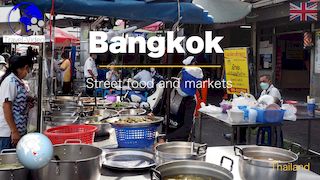
Bangkok can be understood as much through its markets, food stalls and commercial streets as through its temples and modern avenues. In the Thai capital, public space remains deeply animated by daily trade, meal preparation and the constant movement of residents. This video approaches the city through places where work, urban traditions and popular cuisine meet.
Covered markets, open-air stalls, specialist districts and street kitchens create a lively urban landscape that reveals another side of Bangkok. Far from official monuments, these spaces show the city through everyday habits and through its remarkable social diversity.
The Flower Market and Specialist Commerce
The sequences devoted to the flower market highlight the importance of supply networks in a metropolis of this scale. Pak Khlong Talat, Bangkok’s best-known flower market, receives large quantities of fresh flowers used in temples, ceremonies, family celebrations and domestic life.
Garlands of jasmine, orchids, roses, lotus flowers and many other arrangements demonstrate the important place of flowers in Thai culture. They are used for religious offerings, decoration and numerous social rituals. The market therefore illustrates the close link between commercial activity and cultural practice.
The video also allows viewers to observe the rhythm of trade, the organization of stalls and the visual richness created by colour and abundance.
Other Markets and Urban Diversity
Beyond the flower market, Bangkok contains countless neighbourhood markets, food halls, wholesale areas and specialist shopping streets. These places meet the daily needs of a large population while preserving highly dynamic forms of direct commerce.
Thai markets often combine fresh produce, prepared dishes, clothing, household goods and small services within the same space. This flexibility helps explain their continuing success despite urban modernization and the growth of shopping malls.
The images devoted to other markets show that Bangkok does not revolve around one single commercial centre, but around many local centres distributed across the metropolis.
Chinatown and Street Food Traditions
The visit to Chinatown Bangkok introduces another essential side of the capital. This historic district, shaped by Chinese communities established over generations, has long played an important role in trade, craftsmanship and gastronomy.
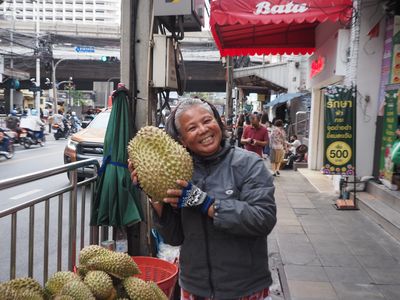
Its streets are especially famous for street food. Here the term refers to a complex urban reality: family-run kitchens, regional recipes, specialist stalls, evening activity and a constantly changing offer. Stir-fried noodles, grilled foods, tropical fruits, soups and desserts are often prepared only a few steps from passing customers.
Street food in Bangkok is not simply a visitor attraction. It remains a genuine part of urban life: quick, accessible and often of high culinary quality.
What the Video Makes Especially Clear
Videos built from carefully selected and animated photographs are particularly effective for dense urban scenes such as markets. They make it easier to observe products, stall layouts, cooking gestures and the variety of signs and displays without the confusion of a hurried walk.
Image transitions also help convey changing atmospheres: the relative calm of a specialist market, the busier flow of commercial streets, the bright evening energy of Chinatown and the immediate contact between cooks and customers.
This format also helps viewers understand that cities can be read through colours, textures, routines and social exchanges, even when presented through still images in motion.
Another Gateway to Bangkok
Through its markets and street food culture, Bangkok reveals itself as an energetic, inventive and deeply lived city. The video offers a concrete introduction to this urban world, while the related detailed pages provide further insight into the history of markets, floral traditions and Thai street cuisine.

Audio Commentary Transcript
The city of Bangkok is famous for its markets and street food vendors. In addition to the many neighborhood markets which are often nocturnal, there is the large flower market and also the floating market, which we did not have the opportunity to visit. We didn't stay long enough to explore them all, but here's a little insight into this important commercial activity in this great city.
Chinatown, founded at the same time as the city of Bangkok in 1792, was for the past two centuries the main commercial center of the city. However recent developments in the city have shifted economic activities elsewhere, reducing Chinatown to a showcase of Chinese culture, primarily gastronomic culture.

Music:
- - YouTube video library - Dissappointment, (© Dissappointment by Kevin MacLeod is licensed under a Creative Commons Attribution 4.0 license. https://creativecommons.org/licenses/by/4.0/
- Source: http://incompetech.com/music/royalty-free/index.html?isrc=USUAN1100481
- Artist: http://incompetech.com/)
- - YouTube video library - People Watching
Disclaimer: Despite its appropriateness, copyright issues prevent the use of thai traditional music in "Bangkok, Street food and markets • Thailand", hence the use of royalty-free music. Despite our careful selection, some might regret this decision, which is necessary to avoid potential lawsuits. Although difficult, this decision is the only viable solution.
Due to Vimeo's copyright control system, which does not correctly filter content, and their rigid policy, we have decided to transfer all our videos to YouTube. While we have appreciated our collaboration with Vimeo for many years, this decision is necessary to ensure the continuous and uninterrupted availability of our content. Thank you for your understanding and continued support.