Français (France)
  Nederlands (nl-NL)
 Bangkok’s flower market is one of the city’s most vibrant trading areas, operating day and night. It showcases an impressive range of fresh flowers supplied for religious offerings, hotels, shops, and local households. The market reflects the strong cultural importance of flowers in Thailand, where they represent devotion, beauty, and respect. Beyond its commercial role, it remains a lively social space that highlights the resilience of traditional markets within a rapidly modernizing urban environment.
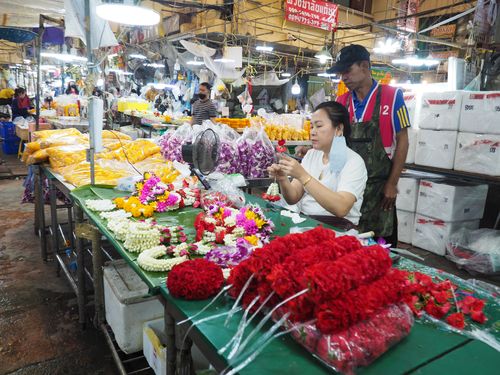
Bangkok • Flower market
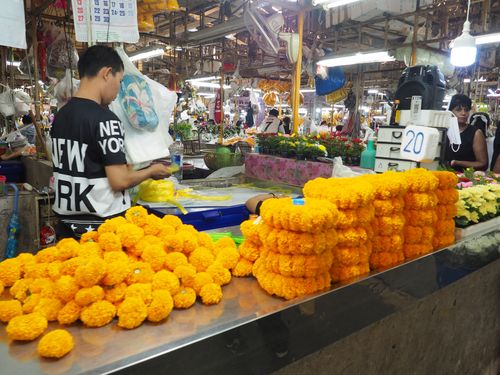
Bangkok • Flower market
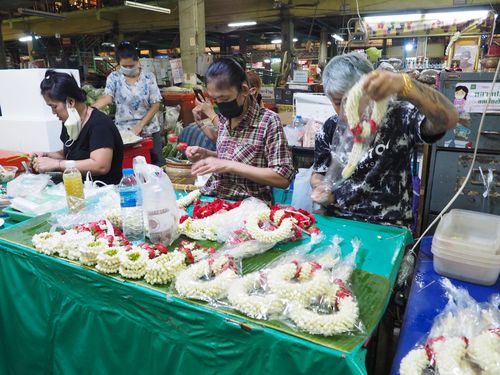
Bangkok • Flower market
Tradition profile
Flower market
Tradition category: Flower market
Tradition family: Traditional markets and fairs
Tradition genre: Trade and Local Creativity
Geographic location: Bangkok • Thailand
• Links to •
• List of videos about Bangkok on this site •
Bangkok, Street food and markets • Thailand
Bangkok, the Grand Palace • Thailand
Bangkok, Wat Phra Chetuphon temple • Thailand
Bangkok, boat trip on the khlongs • Thailand
Bangkok’s Flower Market: Evolution of a Living Urban Heritage
From River Trade to Market Settlement
Bangkok’s Flower Market, locally known as Pak Khlong Talad, traces its roots to the 19th century, when the Chao Phraya River served as the main artery of commerce in the Siamese capital. The area, located in today’s Phra Nakhon district, originally hosted a floating market for fruits, rice, and fish during the reign of King Rama IV (1851–1868). The first permanent stalls appeared in the late 19th century, as merchants began to settle along the canals leading to the river. Flower trading emerged gradually, linked to the growing urban demand for offerings used in Buddhist temples, royal ceremonies, and domestic rituals. By 1880–1890, the market had already become an essential distribution hub between agricultural provinces such as Nakhon Pathom and Ratchaburi and the expanding metropolis.
Formal Recognition and Early Expansion
The transformation from a food market into a flower market occurred during the reign of King Rama V (1868–1910), a period of urban modernization and administrative reform. In 1901, the Bangkok Municipality formally recognized Pak Khlong Talad as an official market area, centralizing several smaller floating markets under government supervision. By the 1920s, flower trading had outpaced food sales, and around 1935 the market was reorganized to include approximately 200 permanent stalls, half of which were dedicated to floral products. This institutionalization coincided with a period of economic growth and infrastructure development, including new road and bridge connections that replaced some of the older canal routes.
Economic Growth and National Distribution
The decades following World War II saw the market evolve into a large-scale wholesale center. The city’s population doubled between 1950 and 1970, and the demand for flowers tripled according to municipal records. Northern provinces such as Chiang Mai, Lamphun, and Chiang Rai became major suppliers of roses, orchids, and chrysanthemums, transported daily to the capital. By the 1960s, an estimated 40 tons of fresh flowers passed through the market each day, rising to 400 tons by the end of the century. Covering more than 8,000 square meters, Pak Khlong Talad turned into a critical node in Thailand’s horticultural economy, contributing about 1.2% of the agricultural GDP by 1985.
Infrastructure and Functional Modernization
Modernization efforts accelerated during the 1980s, when the Bangkok Metropolitan Administration (BMA) upgraded the market’s facilities. Drainage systems, permanent roofs, and night-time lighting were introduced, creating one of Asia’s few markets operating 24 hours a day. The introduction of refrigeration units in 1999 extended the shelf life of imported orchids and carnations, many of which were re-exported to Japan, Singapore, and Hong Kong. By the early 2000s, more than 3,000 vendors were active in the market, generating an estimated annual turnover exceeding 500 million baht.
Renovation and Contemporary Role
The most significant renovation took place in 2016, during the early reign of King Rama X, when the BMA modernized 2,500 square meters of covered space, improved waste management, and created a visitor information center to accommodate increasing tourist traffic. Today, over 60,000 visitors per week frequent the market, making it one of the busiest flower markets in Southeast Asia. Despite urban redevelopment pressures, Pak Khlong Talad continues to operate as a symbol of Bangkok’s living heritage — a meeting point of commerce, culture, and continuity. Its endurance across more than a century demonstrates how traditional urban markets can adapt to modernization while preserving their social and economic relevance.
Bangkok’s Flower Market: A Social Ecosystem in Constant Motion
Community-Based Organization and Gender Roles
Pak Khlong Talad, Bangkok’s Flower Market, functions not merely as a center of trade but as a dense social organism. Around 6,000 people work there daily, forming a micro-society that reflects the broader urban structure of Thailand’s capital. The workforce is predominantly female — approximately 70% of traders and assistants — which illustrates the strong participation of women in Thailand’s informal economy. Family ownership is the prevailing model: most stalls are inherited through generations, with children often learning flower selection, sorting, and arrangement techniques from parents. This system of apprenticeship maintains a collective expertise and reinforces the continuity of small-scale entrepreneurship within an increasingly urbanized environment.
Informal Economy and Market Dynamics
The market operates largely within a semi-formal economy. Roughly 80% of all transactions are conducted in cash, without electronic invoices or digital receipts. This cash-based structure ensures flexibility and immediate liquidity, enabling traders to adapt rapidly to fluctuations in supply and demand. Activity peaks during major religious festivals such as Songkran (Thai New Year) and Makha Bucha, when demand for flowers can triple. According to a 2022 survey by the Bangkok Metropolitan Administration (BMA), weekly flower volumes may exceed 1,000 tons, representing a turnover of more than 30 million baht. Prices are negotiated daily based on freshness, origin, and seasonality, creating a fluid, competitive environment that relies as much on personal trust as on market regulation.
Cultural Significance and Symbolic Practices
Flowers hold profound symbolic value in Thai society. In Pak Khlong Talad, this symbolism permeates the rhythm of daily transactions. Nearly 60% of flowers sold are intended for religious or ceremonial use — offerings in temples, garlands for spirit houses, and decorations for weddings and funerals. Each flower carries a specific meaning: jasmine expresses maternal love, lotus represents purity and spiritual enlightenment, while marigold conveys good fortune. These associations create a cultural framework in which the act of purchasing flowers extends beyond consumption; it becomes a ritual of devotion and respect. The market thus operates as an interface between the spiritual and the economic, merging faith, aesthetics, and livelihood.
Social Interaction and Urban Cohesion
Operating 24 hours a day, Pak Khlong Talad fosters continuous human interaction. It serves as both workplace and meeting place, where negotiation, conversation, and hospitality intertwine. Relationships among sellers are based on mutual trust and reciprocal aid, particularly during high-demand periods when labor needs intensify. Migrant workers from northern and northeastern provinces — especially from Chiang Mai, Udon Thani, and Khon Kaen — contribute to the market’s cultural diversity. Researchers often describe the site as an “urban commons”, where multiple social layers coexist: rural producers, urban middlemen, street vendors, tourists, and hotel buyers. Through these encounters, the market functions as a melting pot of regional identities within the broader Bangkok metropolis.
Digitalization and Modern Challenges
The early 2020s introduced new transformations. Approximately 20% of vendors now use online platforms such as LINE, Facebook Marketplace, or dedicated delivery services to reach customers beyond the physical market. Younger generations — often more tech-savvy and educated — integrate digital marketing and photography into their business models, reshaping the traditional image of Pak Khlong Talad. However, modernization brings challenges: rising rental costs, estimated to have increased by 40% between 2015 and 2024, threaten the survival of small family stalls. The shift toward e-commerce also risks weakening the personal relationships that have historically sustained the market’s social fabric.
A Mirror of Thai Urban Society
Viewed sociologically, Bangkok’s Flower Market encapsulates many of the dynamics of contemporary Thai society: female entrepreneurship, intergenerational labor, religious symbolism, and adaptation to globalization. It remains a space where tradition and modernity interact on a daily basis, maintaining equilibrium between economic pragmatism and cultural continuity. Far from being a static relic, Pak Khlong Talad is a living social ecosystem that continues to evolve while preserving its collective memory. Its perpetual activity — a fusion of scent, color, and conversation — embodies the resilience of urban communities that thrive through cooperation rather than competition.
 Links to the main sections of the site