Français (France)
  Nederlands (nl-NL)
 00:00 • intro | 00:29 • Wat Phra Chetuphon Vimolmangklararm Rajwaramahaviharn, | 01:16 • murals | 02:02 • Phra Maha Chedi Si Rajakarn, royal stupas | 03:40 • Phra Rabiang, courtyard surrounded by Buddhas | 04:29 • Reclining Buddha, Phra Phuttha Saiyat
Personal creation from visual material collected during my trip Laos and Bangkok (2022)
Map of places or practices in Bangkok on this site
• Use the markers to explore the content •
Bangkok, Wat Phra Chetuphon and One of Thailand’s Great Royal Temples
A Major Sanctuary in Historic Bangkok
In the old centre of Bangkok, Wat Phra Chetuphon Wimon Mangkhalaram Rajwaramahawihan, widely known as Wat Pho, ranks among the most prestigious religious complexes in Thailand. Located near the Grand Palace, this vast royal monastery combines temples, courtyards, galleries, stupas and pavilions within a monumental setting that reflects the central place of Buddhism in Thai history.
The site is known not only for architecture and worship, but also for its intellectual role. It long served as a centre of traditional learning, especially in medicine and education. The video approaches this sanctuary through several perspectives: monumental scale, refined decoration and religious symbolism.
Murals and Decorative Richness
The sequences devoted to murals show that Wat Pho is not simply a place of devotion, but also an artistic environment of remarkable density. Painted walls, decorated ceilings, inlaid doors and gilded details create a carefully composed visual world.
The mural cycles depict Buddhist narratives, cosmology, moral scenes and historical themes. They were designed both to beautify the buildings and to transmit teachings. In many Thai temples, interior decoration plays an essential role, and Wat Pho offers one of Bangkok’s most distinguished examples.
The video makes especially visible the precision of patterns, the variety of colours and the atmosphere created by repeated ornamental forms.
Royal Stupas and Dynastic Memory
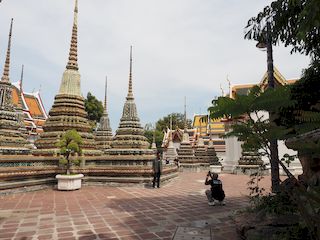
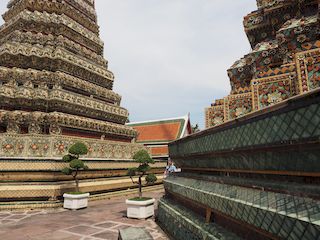
Among the most significant features of the complex are the Phra Maha Chedi Si Rajakarn, a group of large royal chedis erected in memory of rulers of the Chakri dynasty. Their elegant silhouettes covered with coloured ceramics form one of the temple’s strongest visual landmarks.
These commemorative monuments demonstrate the close relationship between monarchy and religion in Thai history. Royal patronage of major monasteries helped affirm political legitimacy while also generating religious merit.
Their presence within the complex shows that Wat Pho belongs both to the spiritual heritage of the country and to the institutional memory of the kingdom.
Phra Rabiang and the Reclining Buddha
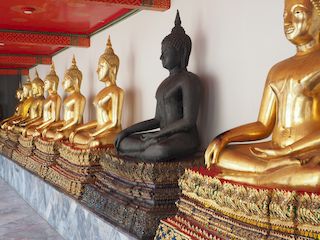
The video then moves to the Phra Rabiang, a cloistered court lined with numerous Buddha images. This ordered space, shaped by repetition and symmetry, creates an atmosphere of calm continuity.
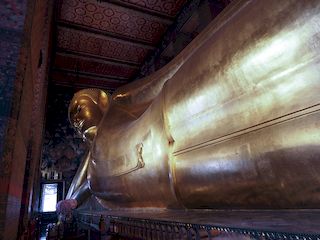
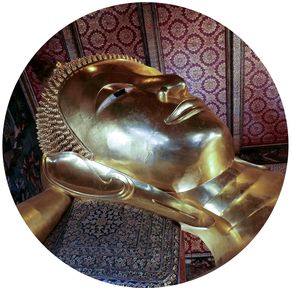
The highlight of the visit is the celebrated Reclining Buddha of Wat Pho, also known as Phra Phuttha Saiyat. This immense reclining image represents the Buddha entering parinirvana, the final release in Buddhist tradition.
Its exceptional scale immediately impresses visitors, yet its importance also lies in symbolic meaning, balanced proportions and the careful treatment of details, especially the decorated feet marked with sacred motifs.
What the Video Makes Especially Clear
Videos created from carefully selected and animated photographs are especially effective for a dense and complex site such as Wat Pho. They allow viewers to move gradually from general views to details: spires, roofs, mosaics, murals, rows of statues and interior volumes.
Image transitions also help explain the overall organization of the monastery, composed of successive courts and multiple buildings. Viewers can better perceive the contrast between bright open spaces and more contemplative halls.
An Essential Monument of Bangkok
Wat Phra Chetuphon remains one of the key monuments for understanding Bangkok and Thai culture. As a royal sanctuary, centre of traditional knowledge and masterpiece of decorative art, it brings together several fundamental dimensions of the country. The video offers a clear introduction, while the related detailed pages allow deeper exploration of its history and architecture.


Audio Commentary Transcript
The Wat Phra Chetuphon Vimolmangklararm Rajwaramahaviharn, commonly known as Wat Pho, stands with grandeur in the historical heart of Bangkok. Founded in the 16th century, this Buddhist sanctuary, among the most revered in the Thai capital, predates even the city's establishment. It has served as a beacon of knowledge and spirituality, providing a sacred space for the education and meditation of monks, thus bearing witness to its rich cultural and religious heritage.
Wat Pho emerges as a sanctuary of spirituality, a majestic complex of intertwined temples, housing elegant viharns (assembly halls), sumptuous stupas, known as chedis in Thailand, and graceful towers called prangs. Each space, wonderfully adorned, is thoughtfully arranged to facilitate sacred rituals and meditation, creating a haven of tranquility in the heart of Bangkok.
Within the sacred precincts of Wat Pho, behind its protective walls, stand four elegant stupas, a tribute to the monarchs of the Chakri dynasty, adorned with refined floral patterns that reflect the spirit and history of Thailand.
In the 19th century, King Rama III bestowed upon Wat Pho temple a magnificent Reclining Buddha, depicted on his deathbed. Measuring 46 meters in length and 15 meters in height, adorned with gold leaf, it stands as one of the most famous and revered representations of the Buddha in Thailand.
Music:
- - YouTube video library - Dreamy Flashback, (© Dreamy Flashback by Kevin MacLeod is licensed under a Creative Commons Attribution 4.0 license. https://creativecommons.org/licenses/by/4.0/
- Source: http://incompetech.com/music/royalty-free/index.html?isrc=USUAN1100532
- Artist: http://incompetech.com/)
- - YouTube video library - Song of Sadhana - Jesse Gallagher
Disclaimer: Despite its appropriateness, copyright issues prevent the use of thai traditional music in "Bangkok, Wat Phra Chetuphon temple • Thailand", hence the use of royalty-free music. Despite our careful selection, some might regret this decision, which is necessary to avoid potential lawsuits. Although difficult, this decision is the only viable solution.