

 Français (France)
  Nederlands (nl-NL)
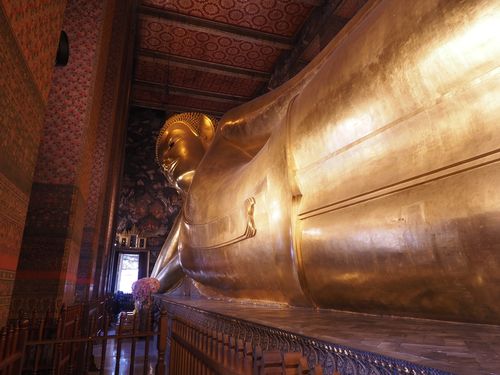
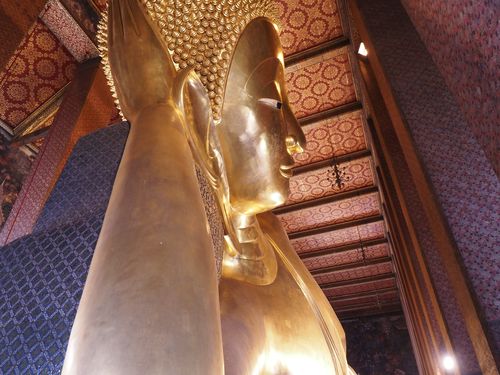
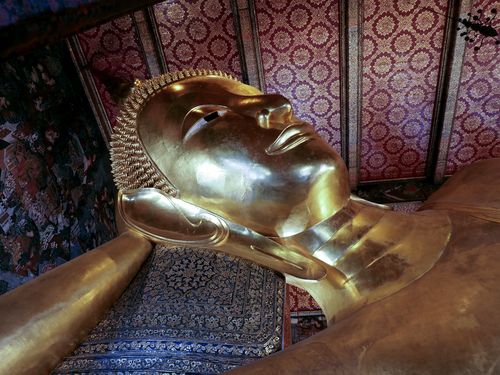
 The Reclining Buddha in Bangkok is located within the grounds of Wat Pho, one of the oldest and most respected temple complexes in the Thai capital. This monumental statue represents the Buddha at the moment of his entry into nirvana, symbolizing the end of the cycle of rebirth. Covered in gold leaf and featuring feet inlaid with symbolic designs, it is one of the most recognizable images of Thai Buddhism. The site attracts large numbers of visitors each year, including worshippers and travelers, and stands as a major element of Bangkok’s religious and cultural heritage.
Monument profile
Grand Reclining Buddha
Monument category: Giant Statues
Monument family: Giant statues or set of statues
Monument genre: Religious
Cultural heritage: Buddhist
Geographic location: Bangkok • Thailand
Construction period: 19th century AD
• Links to •
• List of videos about Bangkok on this site •
Bangkok, Street food and markets • Thailand
Bangkok, the Grand Palace • Thailand
Bangkok, Wat Phra Chetuphon temple • Thailand
Bangkok, boat trip on the khlongs • Thailand
The Reclining Buddha of Wat Pho: historical development of a royal and religious monument in Bangkok
The Reclining Buddha of Wat Pho in Bangkok is one of the most important religious monuments in Thailand and a key symbol of the political and cultural transformation that followed the fall of the old capital of Ayutthaya. Built in the early nineteenth century, the statue reflects the consolidation of royal authority, the reorganization of the Buddhist monastic order, and the effort of the Siamese state to affirm its identity in a rapidly changing regional and global environment.
Political and social context of construction
The origins of Wat Pho predate the foundation of Bangkok. The site existed during the late Ayutthaya period and formed part of the religious landscape of the former capital. The destruction of Ayutthaya by Burmese forces in 1767 marked a profound political and cultural rupture. Many temples were damaged or abandoned, and the royal court was displaced. In the aftermath, the general Taksin established a new center of power at Thonburi, across the Chao Phraya River from present-day Bangkok.
In 1782, the Chakri dynasty was founded by King Rama I, who transferred the capital to Bangkok and began a large program of reconstruction. The rebuilding of temples played a central role in this effort. The Siamese monarchy was traditionally regarded as the protector of Buddhism, and the restoration of religious institutions was essential for political legitimacy. Wat Pho, located near the Grand Palace, was selected as the principal royal temple associated with the new dynasty. Its reconstruction symbolized continuity with the religious traditions of Ayutthaya.
The creation of the Reclining Buddha took place during the reign of King Rama III in the 1830s. This period was marked by increasing contact with Western powers. British and French expansion in Southeast Asia posed a growing threat to the independence of regional kingdoms. Rama III responded by strengthening internal institutions, promoting religious education, and supporting the construction and restoration of temples.
The enlargement of Wat Pho and the construction of the Reclining Buddha were part of a broader royal program. The temple was transformed into a center of public learning, where inscriptions and illustrations were installed to transmit knowledge about religion, medicine, literature, and practical sciences. This initiative reflected both a concern for social order and a desire to reinforce Siamese cultural identity in the face of external influences.
Major historical events affecting the site
The site of Wat Pho experienced several historical phases before the construction of the Reclining Buddha. In the late seventeenth century, part of the area was occupied by a fort built by French engineers during a period of diplomatic and commercial relations between Siam and France. This structure was destroyed after the political upheavals of 1688, which ended Western influence at the Ayutthaya court.
Following the fall of Ayutthaya in 1767, the temple entered a period of decline. Many religious sites across the country suffered from neglect or destruction during the wars. When Bangkok became the new capital, Wat Pho was selected for reconstruction under Rama I. The restoration involved the transfer of Buddha images from abandoned temples, particularly those of Ayutthaya and Sukhothai. This process symbolically reunited fragments of the earlier kingdom within the new capital.
During the reign of Rama III, the temple complex was expanded significantly. The construction of the hall housing the Reclining Buddha formed part of a broader transformation of the site. The works lasted more than fifteen years and gave the temple much of its present layout.
Later rulers of the Chakri dynasty continued to maintain and restore the temple. Some additional structures were added, and decorative elements were repaired. In the twentieth century, major restoration campaigns were carried out, particularly around national anniversaries, in order to preserve the temple’s artistic and historical heritage.
Global context at the time of construction
The construction of the Reclining Buddha in the 1830s occurred during a period of profound global transformation. European colonial powers were expanding across Asia, and many neighboring territories were falling under foreign control. Burma had already faced British military campaigns, and French influence was growing in Vietnam and Cambodia.
In this context, Siam sought to maintain its independence by strengthening its internal institutions. Monumental religious construction was one of the means used to reinforce royal authority and cultural cohesion. Temples served not only as places of worship but also as educational and social centers.
At the global level, the nineteenth century was marked by large-scale building programs associated with imperial expansion, national consolidation, and the modernization of states. The construction of monumental religious or civic architecture was a common phenomenon across Europe, Asia, and the Middle East. The Reclining Buddha can be interpreted as part of this broader trend, representing a local expression of state-sponsored monumental construction.
Transformations of the monument over time
Since its completion, the Reclining Buddha has undergone relatively few structural changes. The statue, constructed with a brick core covered in stucco and gold leaf, was designed for durability. Regular maintenance has been necessary to preserve the gilded surface and decorative elements.
The temple complex surrounding the statue, however, has evolved over time. Additional structures were added during later reigns, and periodic restorations were carried out. The growth of Bangkok transformed the urban context of Wat Pho. Once situated in a relatively open royal district, the temple is now surrounded by dense urban development.
In the nineteenth century, Wat Pho also became associated with traditional medicine and massage. The temple’s inscriptions and teaching activities contributed to the development of these practices. This educational function has continued into the modern era, with the temple recognized as a center of traditional Thai medicine.
Present role and cultural significance
Today, the Reclining Buddha is one of the most recognizable monuments in Thailand. It is both a religious shrine and a major tourist attraction. The statue continues to serve as an object of devotion, and the temple remains an active center of worship.
The site is associated with religious ceremonies linked to the Buddhist calendar. It also plays an important role in the transmission of traditional cultural practices, including massage and herbal medicine. The temple’s educational function, established in the nineteenth century, continues to shape its modern identity.
The Reclining Buddha has become a symbol of Bangkok and of Thai cultural heritage more broadly. It appears in travel literature, educational materials, and national imagery, reinforcing its status as a cultural landmark.
Current state of preservation and conservation challenges
The monument is generally well preserved, thanks to regular restoration efforts supported by religious authorities and state institutions. The materials used in the statue, particularly the gold leaf and decorative inlays, require constant maintenance.
However, the site faces several modern challenges. Bangkok’s dense urban environment exposes the temple to pollution, vibrations from traffic, and environmental stress. The large number of visitors also creates pressure on the structures and decorative surfaces.
Conservation policies focus on controlling visitor flow, maintaining the decorative elements, and monitoring structural stability. The inscriptions at Wat Pho, which form part of the temple’s educational heritage, have received international recognition through cultural preservation programs. This recognition has contributed to increased awareness of the site’s historical importance and the need for its protection.
Despite these challenges, the Reclining Buddha remains one of the best-preserved monumental sculptures in Thailand. It continues to embody the political, religious, and cultural ambitions of the early Chakri period, while serving as a living monument within the modern city of Bangkok.
Architecture of the Reclining Buddha at Wat Pho
The Reclining Buddha at Wat Pho in Bangkok is one of the most significant examples of large-scale religious sculpture in nineteenth-century Thailand. Constructed during the reign of King Rama III, the monument reflects the technical capabilities, artistic traditions, and symbolic intentions of early Rattanakosin-period architecture. Its scale, construction methods, and decorative program illustrate the combination of established regional techniques with innovations suited to monumental religious imagery.
Technological and architectural innovations
The Reclining Buddha was conceived as a monumental sculpture rather than a carved stone statue. Its construction relied on a composite technique that allowed artisans to create a figure of exceptional size while maintaining structural stability. Instead of being hewn from a single block, the statue was built using a brick core that defined the basic mass and proportions of the figure. This method reduced weight, allowed flexibility in shaping, and made later repairs possible without dismantling the entire structure.
The pavilion constructed to house the statue demonstrates careful planning in relation to the monument’s scale. The building is elongated, corresponding closely to the length of the statue, and designed with a high interior volume. This vertical space allows warm air to rise and escape, providing natural ventilation. Such passive cooling strategies were essential in the tropical climate of Bangkok, especially in a structure containing a large gilded surface that could reflect and intensify heat.
The roof structure, composed of multiple tiers and projecting eaves, contributes to both ventilation and protection from heavy rainfall. The extended roofline shades the walls and windows, reducing heat gain and protecting decorative elements from direct exposure to the elements. This integration of structural form and climatic adaptation reflects traditional Thai architectural principles applied at a monumental scale.
Materials and construction methods
The statue measures approximately 46 meters in length and about 15 meters in height, making it one of the largest reclining Buddha images in Thailand. Its internal structure consists of brick masonry arranged to create the full volume of the body. This method allowed builders to construct the statue in stages, carefully shaping the torso, limbs, and head.
Once the brick core was complete, a thick layer of stucco was applied. The stucco served both as a finishing material and as a sculptural medium. Artisans modeled the facial features, hands, and drapery details directly into this layer. The use of stucco provided flexibility in shaping subtle curves and smooth surfaces, which were essential for achieving the serene expression characteristic of Thai Buddha images.
The final layer consists of gold leaf applied to the stucco surface. The gold finish not only enhances the visual impact of the statue but also carries symbolic meaning, as gold is traditionally associated with purity and spiritual perfection. The application of gold leaf required a carefully prepared surface and precise techniques to ensure adhesion and durability.
The soles of the Buddha’s feet, each approximately five meters long, are decorated with panels inlaid with mother-of-pearl. This decorative technique involves embedding thin pieces of polished shell into engraved patterns. The resulting surfaces reflect light in subtle iridescent tones, adding a refined visual contrast to the uniform gold of the statue’s body.
The pavilion housing the statue is constructed with masonry walls and a timber roof structure. Wood was traditionally used in Thai temple architecture for its flexibility and resilience in humid conditions. The combination of masonry for the walls and timber for the roof allowed the building to maintain stability while accommodating seasonal variations in temperature and humidity.
Architectural and artistic influences
The style of the Reclining Buddha reflects a synthesis of artistic traditions from earlier Thai kingdoms. The proportions of the body, the smooth contours of the face, and the stylized drapery derive from models established during the Sukhothai and Ayutthaya periods. These earlier styles emphasized elegance, serenity, and symbolic clarity, qualities that are clearly visible in the Wat Pho statue.
At the same time, the decorative environment of the pavilion shows the influence of Chinese artistic motifs. During the reign of Rama III, trade with China was particularly active, and Chinese decorative elements were widely incorporated into temple architecture. Ceramic ornaments, floral patterns, and certain color schemes in the temple complex reflect this cross-cultural exchange.
The combination of Thai sculptural traditions with Chinese decorative influences illustrates the cosmopolitan character of Bangkok in the nineteenth century. Rather than representing a purely local style, the monument embodies a synthesis of regional and international artistic currents, adapted to the symbolic requirements of the Buddhist context.
Spatial organization and structural arrangement
The pavilion of the Reclining Buddha is designed as a long rectangular hall, almost entirely occupied by the statue. The spatial arrangement creates a processional path along the length of the figure. Visitors enter near the head of the Buddha and proceed along the side of the statue, gradually discovering its full scale.
This elongated spatial sequence emphasizes the horizontal dimension of the sculpture. The building’s proportions reinforce the visual impact of the reclining posture, guiding the viewer’s perspective along the body.
Windows are positioned high along the walls, allowing filtered daylight to illuminate the statue without exposing it to direct sunlight. This arrangement produces a soft, even light that enhances the reflective quality of the gold leaf. At the same time, the elevated windows contribute to air circulation, supporting the natural ventilation of the hall.
The roof structure consists of multiple tiers with decorative finials at the ends of the gables. These elements, typical of Thai temple architecture, serve both structural and symbolic purposes. They articulate the silhouette of the building and connect it visually to the broader architectural language of the temple complex.
Notable statistics and construction anecdotes
The Reclining Buddha’s dimensions are among its most striking features. At approximately 46 meters long, it occupies nearly the entire length of its pavilion. The head alone measures several meters in height, and the overall scale of the statue creates a powerful spatial experience.
The soles of the feet are decorated with 108 panels representing auspicious symbols associated with the Buddha. These motifs correspond to traditional lists of sacred attributes and reflect the symbolic dimension of the sculpture.
Along the wall opposite the statue, a row of metal bowls is arranged to receive offerings. The number of bowls corresponds to symbolic numbers in Buddhist cosmology. Visitors often place coins in the bowls as an act of merit-making, creating a distinctive soundscape within the pavilion.
One notable aspect of the statue’s construction is the method of applying gold leaf. Over time, the gold surface requires renewal, and sections of the statue are periodically re-gilded. This process forms part of the temple’s ritual maintenance and reflects the continuing interaction between the monument and its religious community.
International recognition and conservation issues
The architectural significance of the Reclining Buddha contributes to the global reputation of Wat Pho as one of the most important temple complexes in Thailand. The statue represents a culmination of traditional Thai construction techniques applied at monumental scale.
Conservation efforts focus on maintaining the structural integrity of the brick core, the stucco surface, and the gold leaf covering. The tropical climate, high humidity, and constant visitor presence create ongoing challenges. Moisture can affect the stucco layers, while physical contact and environmental conditions can damage the gilded surface.
The urban environment of central Bangkok also presents conservation concerns. Pollution, vibrations from traffic, and fluctuations in temperature can affect both the pavilion and the statue. Regular restoration campaigns are therefore essential to preserve the monument’s appearance and structural stability.
Despite these challenges, the Reclining Buddha remains one of the best-preserved large-scale religious sculptures in Southeast Asia. Its architecture reflects a careful balance between structural practicality, symbolic expression, and climatic adaptation, making it a representative example of nineteenth-century Thai religious construction.