Français (France)
  Nederlands (nl-NL)
 Of Hindu tradition, (with additional Buddhist and Jain influence), the Shishunaga dynasty ruled for approximately 68 years, ± between -0413 and -0345 over all or part of Central India, East India and North India, during the Ancient Period.
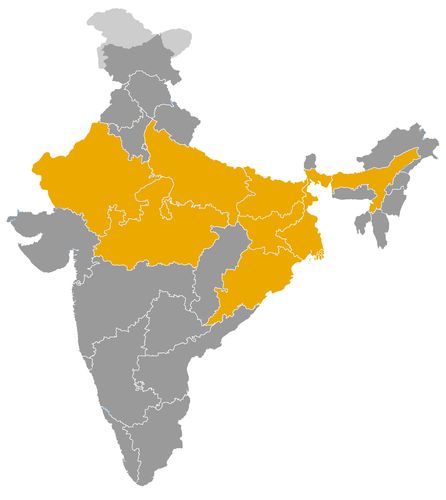
This map illustrates the maximum territory that the Shishunaga Dynasty had reached at its height, covering the current regions of Assam, Bihar, Jharkand, Madhya Pradesh, Odisha, Rajasthan and Uttar Pradesh in India. Its main purpose is to provide a visual aid to understand the geographical extent of this dynasty. However, it's important to note that the contemporary borders of these regions may not necessarily coincide with the historical territories.
The Place and Role of the Shishunaga Dynasty in Indian History
A Transitional Dynasty in the Rise of Magadha
The Shishunaga dynasty occupies an important position in the political history of ancient India. It ruled Magadha after the Haryanka dynasty and before the rise of the Nandas, approximately during the fifth and fourth centuries BCE. Although its chronology is uncertain and partly reconstructed from Buddhist and Puranic traditions, the dynasty represents a crucial stage in the transformation of Magadha from a regional kingdom into the dominant power of northern India.
The Shishunagas did not create an empire on the scale later associated with the Mauryas, but they helped establish the foundations for such imperial expansion. Their importance lies in continuity, consolidation and territorial integration. They inherited a kingdom already strengthened under earlier Magadhan rulers and contributed to its further political centralization, especially through the absorption or weakening of rival states.
Consolidation of Royal Power in Magadha
The political role of the Shishunagas was closely linked to the strengthening of Magadha as a monarchy. Magadha, located in the region of present-day Bihar, had several geographical advantages: fertile lands in the Ganges basin, access to river transport, forest resources, elephants and iron ore from neighbouring regions. These resources gave its rulers the means to develop a stronger army, a more effective administration and a more stable political base than many competing mahajanapadas.
Shishunaga, the founder of the dynasty, is traditionally said to have come to power after the decline of the Haryankas. Whether his accession was the result of a political revolt, an administrative transition or a dynastic replacement remains uncertain. What matters historically is that his rule continued the Magadhan tendency toward expansion and centralization.
Under the Shishunagas, Magadha strengthened its authority over neighbouring regions. The dynasty is especially associated with the weakening or absorption of Avanti, a major rival centred in western and central India. This achievement reduced one of the principal obstacles to Magadha’s supremacy and helped shift the balance of power in northern India.
Rajagriha, Vaishali and the Rise of Pataliputra
The Shishunaga period is connected with several important political centres. Rajagriha, the older capital of Magadha, retained strategic and symbolic importance. Its location among hills gave it defensive value, while its proximity to resources and routes made it a strong early capital.
Vaishali also appears prominently in traditions connected with the Shishunagas. It was associated with the Vajji confederacy and with republican or oligarchic political traditions. The inclusion of Vaishali within Magadha’s sphere reflected the capacity of the monarchy to dominate or incorporate different forms of political organization.
Kalashoka, also known as Kakavarna, is often linked with the growing importance of Pataliputra. The city’s location near major river systems made it exceptionally well placed for administration, communication and military movement. Its later role as the capital of the Nandas and Mauryas shows that its rise during or shortly after the Shishunaga period had long-term consequences. By helping to shift political gravity toward Pataliputra, the dynasty contributed to one of the most important urban developments in ancient Indian history.
Cultural Context of Buddhism, Jainism and Urban Life
The cultural role of the Shishunagas must be understood within the wider intellectual world of the eastern Ganges plain. Magadha and its neighbouring regions were central to the development of Buddhism, Jainism and other ascetic or philosophical movements. These traditions flourished in an environment marked by urban growth, commercial activity and political change.
Kalashoka is traditionally associated with the Second Buddhist Council at Vaishali. The historicity and details of this event remain debated, but the association places the Shishunaga court within a region of intense religious activity. Vaishali, Rajagriha and Pataliputra were not only political centres but also places where monks, merchants, teachers and religious communities interacted.
The dynasty’s cultural impact is not visible through monumental art on the scale later seen under the Mauryas. Its role was more indirect. By maintaining political stability and supporting urban centres, the Shishunagas helped create conditions in which religious institutions, debate and monastic communities could develop.
Economic Foundations of Magadhan Expansion
The economic importance of the Shishunaga period was tied to Magadha’s natural and strategic resources. The fertile plains of the Ganges supported agricultural surplus, while river routes facilitated movement of goods, officials, soldiers and religious communities. Forests and mineral resources strengthened military and administrative capacity.
The expansion toward Vaishali and Avanti also had economic implications. Control over these regions improved access to trade routes linking the Ganges basin with central India and the western parts of the subcontinent. Pataliputra’s position near river junctions made it a natural centre for taxation, transport and political coordination.
This economic base allowed Magadha to develop beyond the scale of an ordinary regional kingdom. The Shishunagas contributed to this process by preserving and enlarging the territorial and administrative framework inherited by their successors.
A Political Legacy Completed by the Nandas and Mauryas
The Shishunaga dynasty was eventually replaced by the Nandas, whose state appears to have been more centralized, militarized and expansive. Yet the Shishunagas should not be seen merely as a minor bridge between greater dynasties. Their historical role was decisive because they helped transform Magadha into the core of future imperial power.
They weakened major rivals, supported the rise of Pataliputra, integrated important territories and maintained the momentum of Magadhan expansion. Their contribution was political through consolidation, economic through control of fertile and strategic regions, and cultural through their place in the urban and religious world of the eastern Ganges plain.
In Indian history, the Shishunagas represent a dynasty of transition with lasting consequences. They did not dominate the whole subcontinent, but they helped prepare the conditions under which the Nandas and Mauryas could build some of the largest states of ancient India.
The Geographical Expansion of the Shishunaga Dynasty in India
A Magadhan Power in the Middle Ganges Basin
The geographical expansion of the Shishunaga dynasty must be understood within the rise of Magadha as the dominant kingdom of northern India. The dynasty ruled approximately during the fifth and fourth centuries BCE, after the Haryanka dynasty and before the Nandas. Its core territory lay in the middle Ganges basin, mainly in the region of present-day Bihar. From this base, the Shishunagas contributed to the enlargement and consolidation of Magadhan power.
Their expansion was not an imperial conquest on the later Mauryan scale. It was rather a decisive stage in the transformation of Magadha from a strong regional kingdom into the central power of the northern plains. The dynasty controlled or influenced several key areas: the old Magadhan heartland around Rajagriha, the northern zone associated with Vaishali, the emerging capital region of Pataliputra, and, according to tradition, the western rival kingdom of Avanti.
The Core Territory around Rajagriha
The oldest centre of Magadhan authority was Rajagriha, located in southern Bihar. This region had already been important under the Haryanka rulers and remained significant under the Shishunagas. Rajagriha was protected by hills and stood near agricultural land, forests, mineral resources and routes leading toward the Chota Nagpur plateau.
This territory gave the Shishunagas a strong political and economic base. The fertile lands of the Ganges basin supported agricultural production, while nearby forests supplied timber and elephants. Access to iron ore from neighbouring regions also strengthened Magadha’s military and administrative capacity. The Shishunagas therefore inherited a territory well suited to state formation.
Control of the Rajagriha region allowed them to maintain continuity with earlier Magadhan rule. It also gave them the resources needed to extend authority over neighbouring states and to compete with other mahajanapadas, the major political units of ancient northern India.
Vaishali and the Northern Expansion of Magadha
One of the important territorial developments associated with the Shishunaga period was the integration of Vaishali and the wider Vajji region into the Magadhan sphere. Vaishali lay north of the Ganges and was known for republican or oligarchic political traditions. Its inclusion marked an important geographical and political expansion beyond the older southern core of Magadha.
Control over Vaishali strengthened Magadha’s position on both sides of the Ganges. It also gave the kingdom better access to the northern plains, routes toward the Himalayan foothills and commercial networks of north Bihar. This northern expansion was significant because it showed the ability of the Magadhan monarchy to dominate regions with different political traditions.
The relationship with Vaishali was therefore not only territorial, but also institutional. By incorporating or subordinating a region associated with non-monarchical forms of government, the Shishunagas contributed to the growing supremacy of centralized royal power in the eastern Ganges plain.
Pataliputra and the Shift toward a Strategic Capital
The Shishunaga period is also linked to the rising importance of Pataliputra. Located near the confluence of major rivers, including the Ganges and the Son, Pataliputra occupied one of the most strategic positions in ancient northern India. It controlled river routes running east and west, as well as land routes leading toward the north, the south and central India.
Kalashoka, the successor of Shishunaga, is often associated with the transfer or strengthening of the political centre at Pataliputra. Whether this shift was fully completed under him or under later rulers, the process was crucial. Pataliputra later became the capital of the Nandas and the Mauryas, which demonstrates the lasting importance of this geographical choice.
By emphasizing Pataliputra, the Shishunagas helped reorient Magadha from a hill-protected kingdom centred on Rajagriha toward a river-based power capable of controlling communications across the Ganges basin.
Avanti and the Western Reach of Magadhan Power
The most important expansion attributed to the Shishunagas was the conquest or absorption of Avanti. Avanti, centred on Ujjain in the Malwa region, had long been one of the major rivals of Magadha. Its position gave it influence over routes linking northern India, central India, western India and the Deccan.
The defeat or integration of Avanti had major geopolitical consequences. It removed one of Magadha’s strongest competitors and extended Magadhan influence toward the west. This expansion linked the eastern Ganges basin more closely with the routes of central India and reduced the balance of power among the great mahajanapadas.
For neighbouring dynasties and states, the fall of Avanti marked a shift in political gravity. Magadha was no longer one powerful kingdom among several comparable rivals. It became increasingly dominant, preparing the way for the broader expansion of the Nandas and later the Mauryas.
Relations with Neighbouring States and Political Rivals
The territorial expansion of the Shishunagas reshaped Magadha’s relations with surrounding powers. To the north, control over Vaishali and the Vajji region weakened republican or confederate polities that had once resisted Magadhan expansion. To the west, the reduction of Avanti removed a major rival and opened wider access to central Indian routes.
To the east, Magadha had already benefited from earlier expansion toward Anga and the lower Ganges region. Under the Shishunagas, this eastern position remained part of the broader Magadhan sphere. The kingdom’s growing scale made smaller states increasingly dependent on its political and military strength.
These relations were not always simple conquest. They involved diplomacy, subordination, incorporation and strategic pressure. The Shishunaga achievement lay in the ability to turn Magadha’s geographical advantages into political dominance.
A Territorial Legacy Continued by the Nandas and Mauryas
The geographical expansion of the Shishunaga dynasty was limited compared with later empires, but its consequences were substantial. By consolidating the Magadhan heartland, extending influence northward to Vaishali, strengthening Pataliputra and neutralizing Avanti, the Shishunagas helped create the territorial framework for the next phase of Indian state formation.
Their rule transformed Magadha into the leading power of northern India. The Nandas inherited a kingdom already positioned for expansion, and the Mauryas later built an empire from the same strategic base. The Shishunaga dynasty therefore occupies an essential place in the geographical history of ancient India: it did not create a pan-Indian empire, but it shaped the political map from which such an empire could emerge.
The Shishunaga, or Shaishunaga, dynasty ruled Magadha in the 5th and 4th centuries BCE. Buddhist and Puranic traditions do not always give the same lists or reign lengths. The chronology below follows a cautious reconstruction, in which the dates are indicative and the succession after Kalashoka remains particularly uncertain.
- Shishunaga (c. 413–395 BCE) • Founder of the dynasty, he is said to have overthrown the last Haryanka king and reorganized the kingdom of Magadha from Rajagriha and Vaishali.
- Kalashoka, or Kakavarna (c. 395–367 BCE) • Son and successor of Shishunaga, he is associated with the shift of the political centre toward Pataliputra and with the tradition of the Second Buddhist Council at Vaishali.
- Bhadrasena (c. 367–365 BCE, uncertain reign) • Mentioned among the sons or successors of Kalashoka, he belongs to a poorly documented phase of succession after his father’s main reign.
- Korandavarna (c. 365–363 BCE, uncertain reign) • His name appears in some dynastic traditions, but his exact political role remains difficult to establish.
- Mangura (c. 363–361 BCE, uncertain reign) • A little-known ruler of the post-Kalashoka phase, he is usually placed among the sons or heirs of Kalashoka.
- Sarvanjaha (c. 361–359 BCE, uncertain reign) • A figure of the later Shishunaga succession, he is known only from divergent traditional lists.
- Jalika (c. 359–357 BCE, uncertain reign) • His possible reign belongs to the period of fragmentation or rapid succession after Kalashoka.
- Ubhaka (c. 357–355 BCE, uncertain reign) • Mentioned in some traditions as one of Kalashoka’s heirs, he is almost without independent historical evidence.
- Sanjaya (c. 355–353 BCE, uncertain reign) • Traditionally placed near the end of the dynasty, he belongs to a phase in which Shishunaga authority seems to have weakened.
- Koravya (c. 353–351 BCE, uncertain reign) • An obscure heir of the line, he is cited in reconstructions that interpret Kalashoka’s sons as successive or nearly contemporary rulers.
- Nandivardhana (c. 351–345 BCE) • Often presented as one of the last Shishunaga kings, he preceded Mahanandin in traditions that extend the dynasty before the Nandas.
- Mahanandin (c. 345–344 BCE) • Last Shishunaga king according to several traditions, he was displaced by Mahapadma Nanda, founder of the Nanda dynasty.
 Links to the main sections of the site