Français (France)
  Nederlands (nl-NL)
 Of Hindu tradition, (with additional Buddhist influence), the Nanda dynasty ruled for approximately 103 years, ± between -424 and -321 over all or part of Central India, East India and North India, during the Ancient Period.
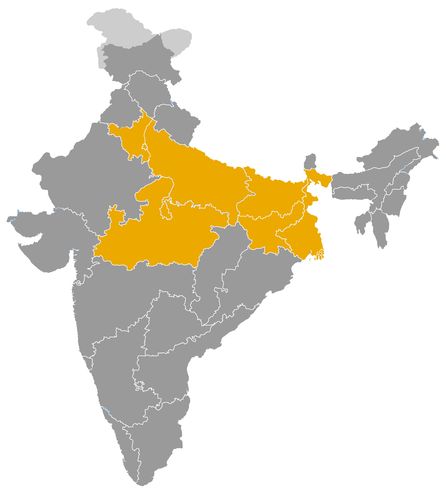
This map illustrates the maximum territory that the Nanda Dynasty had reached at its height, covering the current regions of Bihar, Delhi (NTC), Haryana, Jharkand, Madhya Pradesh, Punjab and Uttar Pradesh in India. Its main purpose is to provide a visual aid to understand the geographical extent of this dynasty. However, it's important to note that the contemporary borders of these regions may not necessarily coincide with the historical territories.
The Nanda Dynasty and the Rise of Centralised Power in Ancient India
A decisive dynasty between regional kingdoms and imperial rule
The Nanda dynasty occupies a significant place in the political history of ancient India, despite the relatively short duration of its rule. It emerged in Magadha, in the middle Gangetic plain, during the fourth century BCE, at a time when northern India was moving from a landscape of competing regional states toward larger and more centralised forms of government. The Nandas inherited the growing strength of Magadha, but they appear to have transformed it into a power of unprecedented scale.
Their historical importance lies not only in their territorial expansion, but also in their contribution to the development of state administration, taxation, military organisation and economic control. In this respect, the Nandas formed a crucial bridge between the earlier mahajanapadas, the great regional polities of ancient India, and the Mauryan Empire that would follow them. The Mauryas are often remembered as the first major imperial dynasty of India, but many of the structures that made Mauryan expansion possible were already strengthened under Nanda rule.
The consolidation of Magadha as the dominant northern power
The political role of the Nanda dynasty was closely linked to the rise of Magadha. Earlier dynasties, especially the Haryanka and Shishunaga rulers, had already expanded Magadhan influence. The Nandas pushed this process further by consolidating royal authority and weakening rival lineages and regional powers. Their capital at Pataliputra gave them a strategic advantage, as the city stood near important river routes that connected eastern India, the Gangetic plain and the routes toward the north west and the Deccan.
Ancient traditions often present Mahapadma Nanda as a ruler who subdued several kshatriya dynasties. Although such accounts may contain exaggeration or later political interpretation, they suggest a major change in the structure of power. The Nandas appear to have challenged older aristocratic networks and replaced them with a stronger monarchy supported by taxation, administration and military force.
This centralisation had long term consequences. It helped transform kingship from a regional and dynastic institution into a more territorial form of rule. The Nanda state was not merely a court or a lineage; it was a political machine capable of mobilising people, wealth and military resources across a large area.
A military system supported by fiscal power
The Nanda dynasty was famous in ancient sources for the size of its army. The numerical figures preserved in literary traditions are probably exaggerated, but they reveal the reputation of the Nandas as rulers of exceptional military strength. Such a force required more than royal ambition. It required a stable revenue system, logistical organisation, access to food supplies, animal resources, weapons and manpower.
The Nanda army served both as an instrument of expansion and as a deterrent. Its reputation extended beyond the Gangetic plain. When Alexander the Great’s forces reached north western India, Greek accounts referred to a powerful kingdom farther east, often associated with the Nandas. The prospect of facing a vast army in the Gangetic region contributed to the image of Magadha as a formidable power.
This military strength also reshaped relations with neighbouring states. Smaller kingdoms and local authorities had to adapt to the presence of a highly centralised and well resourced state. Some may have been annexed, others reduced to tributary status, and others forced into cautious diplomacy.
Economic control and the growth of a fiscal state
The economic impact of the Nanda dynasty was one of its defining features. Ancient traditions repeatedly associate the Nandas with immense wealth. This reputation probably reflects a developed system of revenue collection and the ability of the state to draw resources from agriculture, trade and possibly mining or forest zones.
The middle Gangetic plain was one of the most productive regions of ancient India. Its fertile lands supported dense settlement, while the rivers facilitated transport and exchange. By controlling this region, the Nandas gained access to agricultural surplus on a large scale. This surplus could be converted into revenue, stored, redistributed and used to maintain the army and administration.
The Nanda period also belongs to a broader phase of urbanisation and monetary exchange in northern India. Towns, trade routes and market networks expanded, and the state benefited from this economic activity. The dynasty’s reputation for wealth therefore reflects not only royal accumulation, but also the increasing capacity of ancient Indian states to organise economic life through taxation and administrative control.
Cultural influence through urban society and social change
The cultural impact of the Nandas is less visible than their political and economic influence. They did not leave inscriptions or monumental remains comparable to those of the Mauryan emperor Ashoka. Their cultural role must therefore be understood indirectly, through the environment they helped shape.
The Nanda period was part of a wider transformation in the Gangetic region. Urban centres expanded, social mobility increased, and religious and philosophical movements such as Buddhism and Jainism developed in a world of cities, merchants, rulers and ascetic communities. The strengthening of Magadha contributed to this intellectual and social environment.
Some traditions describe the Nandas as being of non aristocratic or low social origin. Whether historically precise or not, this memory is important because it reflects debates about legitimacy, kingship and social order. The Nandas were remembered not only as powerful rulers, but also as figures who disrupted older assumptions about hereditary status and political authority.
The legacy inherited by the Mauryan Empire
The fall of the Nandas is traditionally connected with the rise of Chandragupta Maurya and his adviser Chanakya. Yet the Mauryan Empire did not emerge from an empty political landscape. It inherited a powerful capital, a centralised state, a fiscal structure, a military tradition and a wide territorial base.
The Nanda dynasty therefore played a foundational role in the history of ancient India. Its rulers strengthened Magadha, expanded the scale of monarchy, developed the fiscal and military resources of the state, and helped prepare the conditions for imperial unification. Their legacy lies in this transitional function: they stood between the age of regional kingdoms and the age of large imperial formations in the Indian subcontinent.
The Geographic Expansion of the Nanda Dynasty and the Power of Magadha in Ancient India
A Magadhan kingdom enlarged into a major northern power
The Nanda dynasty ruled from Magadha in the fourth century BCE, with its political centre at Pataliputra, in the middle Gangetic plain. This region, corresponding mainly to parts of present day Bihar, had already become one of the most powerful areas of northern India before the Nandas came to power. Its fertile soil, river communications, access to timber, elephants, metal resources and commercial routes gave it a strong material base for expansion.
The Nandas inherited this favourable position and extended it further. Their rule marks an important phase in the transformation of Magadha from a dominant regional kingdom into the core of a large territorial state. Although the exact limits of their realm remain uncertain, ancient Indian and Greek traditions agree in presenting them as rulers of a vast and wealthy kingdom. Their influence stretched well beyond the original Magadhan heartland and shaped the political geography that the Mauryas would later inherit.
Control over the middle and eastern Gangetic plain
The most secure zone of Nanda authority was the middle Gangetic plain. This included Magadha itself, with Pataliputra as its capital, and the surrounding territories of present day Bihar. The region was agriculturally rich and densely settled, making it a vital foundation for royal revenue and military mobilisation.
The Nandas also appear to have controlled or strongly influenced neighbouring regions to the east and north east. These may have included areas associated with Anga and parts of the lower Gangetic basin. The conquest of Anga had already strengthened Magadha under earlier rulers, but the Nandas seem to have integrated such territories into a broader system of centralised rule.
This eastern expansion mattered because it gave the dynasty access to riverine trade, agricultural surplus and routes leading toward Bengal and the Bay of Bengal. It also reduced the independence of older regional powers in the Gangetic world. The Nanda state was not simply one kingdom among many; it became the dominant authority in much of the eastern Gangetic zone.
Westward influence across the northern Indian plains
The Nanda realm probably extended westward across a significant part of the Gangetic plain. Ancient traditions describe Mahapadma Nanda as a ruler who subdued several older dynasties and kshatriya lineages. These accounts may be partly symbolic, but they indicate that the Nandas were remembered as conquerors who broke the power of established regional elites.
Their westward influence likely affected territories in the direction of present day eastern Uttar Pradesh and perhaps farther along the routes linking Magadha with the central Ganges basin. This region had once contained important polities such as Kosala and Vatsa. By the Nanda period, many of these older centres had either declined, been absorbed or lost their former autonomy.
The political consequence was significant. The Nandas helped replace the earlier pattern of competing mahajanapadas with a more centralised territorial order. Smaller kingdoms, local aristocracies and republican communities had to confront a state with greater fiscal and military capacity than most of its rivals.
The importance of Kalinga and access to the eastern coast
One of the most important regions associated with Nanda expansion was Kalinga, corresponding broadly to present day Odisha and parts of the eastern coastal zone. Later traditions suggest that the Nandas had authority over Kalinga before it reappeared as an independent power and later became the object of Mauryan conquest.
Control over Kalinga would have given the Nandas access to the eastern seaboard, coastal trade routes and connections between the Gangetic plain and the peninsular regions of India. It also strengthened their ability to project power beyond the inland river valleys of the north.
The nature of Nanda rule in Kalinga is difficult to define. It may not have involved uniform direct administration across the whole region. It could have included military domination, tribute, appointed officials or strategic control over key centres. Even so, the association of Kalinga with the Nandas shows that their ambitions reached beyond the core Gangetic plain and touched areas with distinct regional identities and maritime potential.
Southern and central Indian margins of Nanda influence
The Nandas are sometimes linked with expansion toward central India and the northern Deccan. Such claims must be treated carefully, since the evidence does not allow a precise map of direct Nanda control. However, their state probably exerted influence over routes leading southward from the Ganges basin into forested, mineral rich and commercially important regions.
These southern and central zones were valuable for several reasons. They supplied forest products, metals, elephants and access to long distance trade networks. Influence in these areas would have increased the resources available to the Nanda state and strengthened its military capacity.
For neighbouring powers and local chiefs, the rise of the Nandas meant the arrival of a northern state with exceptional financial and military resources. Some local authorities may have submitted, others may have paid tribute, and others may have maintained autonomy while recognising the political weight of Magadha.
Relations with north western India and the world of Alexander
The Nandas did not directly rule the north western regions reached by Alexander the Great, but their reputation influenced events there. Greek accounts refer to a powerful kingdom farther east, possessing great wealth and a very large army. These descriptions are usually connected with the Nanda kingdom of Magadha.
The fear or expectation of confronting such a power in the Gangetic plain contributed to the strategic atmosphere faced by the Macedonian army. Even without direct contact, the Nandas shaped perceptions in the north west. Their state was known as a formidable power beyond the Punjab, and this reputation affected the decisions of foreign and regional actors.
A territorial legacy prepared for the Mauryas
The geographic expansion of the Nanda dynasty created the conditions for the rise of the Mauryan Empire. Chandragupta Maurya and his successors inherited more than a capital; they inherited a political landscape already reorganised around Magadha. The Nandas had weakened older dynasties, expanded control over the Gangetic plain, projected authority toward Kalinga and extended influence into central Indian routes.
Their territorial expansion was not always uniform or permanent, but it marked a decisive stage in Indian state formation. By enlarging Magadha into a major power, the Nandas transformed relations among neighbouring dynasties and prepared the framework for the first great imperial structure of the subcontinent.
The chronology of the Nanda dynasty is uncertain, and Puranic, Buddhist, Jain and Greco-Roman traditions do not always agree. The sources often mention Mahapadma Nanda followed by eight sons or successors, but the names, order and individual reigns of these later rulers are not securely established; the list below therefore retains only the most historically identifiable rulers.
- Mahapadma Nanda (c. 345–329 BCE) • Probable founder of the Nanda dynasty, he established the power of Magadha after the Shishunagas. Traditions credit him with expanding a strongly centralised kingdom in northern India.
- Dhana Nanda (c. 329–321 BCE) • Last clearly identifiable Nanda ruler, he ruled Magadha at the time of Alexander’s campaign in north-western India. He was overthrown by Chandragupta Maurya, opening the way for the Maurya Empire.
 Links to the main sections of the site