Français (France)
  Nederlands (nl-NL)
 Of Hindu tradition, (with additional Jain influence), the Sangama dynasty ruled for approximately 149 years, ± between 1336 and 1485 over all or part of East India, South India and West India, during the Medieval Period.
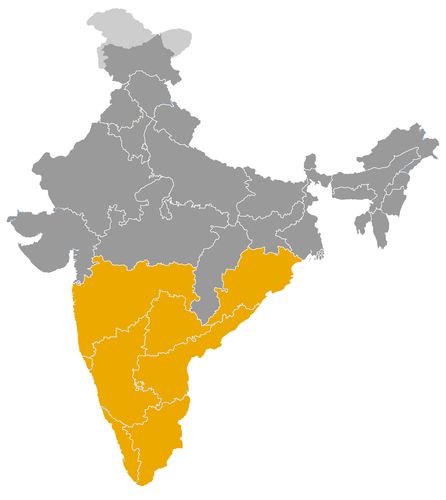
This map illustrates the maximum territory that the Sangama Dynasty had reached at its height, covering the current regions of Andhra Pradesh, Goa, Karnataka, Kerala, Maharashtra, Odisha, Tamil Nadu and Telangana in India. Its main purpose is to provide a visual aid to understand the geographical extent of this dynasty. However, it's important to note that the contemporary borders of these regions may not necessarily coincide with the historical territories.
The Sangama Dynasty and the Formation of the Vijayanagara Empire
A founding dynasty in medieval South India
The Sangama dynasty holds a decisive place in the history of medieval India as the first ruling house of the Vijayanagara Empire. It ruled from 1336 to about 1485 and laid the political, military, economic and cultural foundations of one of the most powerful states in South India. Its importance lies not only in the duration of its rule, but also in the imperial framework it created, which survived the dynasty itself and was later continued by the Saluva, Tuluva and Aravidu dynasties.
The dynasty takes its name from Sangama, regarded as the family ancestor of the founders Harihara I and Bukka Raya I. These two brothers established their power in the Tungabhadra valley, around the city of Vijayanagara, now identified with the archaeological site of Hampi in Karnataka. From this strategic centre, the Sangama rulers built a state that gradually extended its authority over large parts of southern India.
The creation of a new imperial power
The rise of the Sangama dynasty took place during a period of major political change. Older regional powers in South India had weakened, while the Delhi Sultanate and later the Deccan sultanates exerted growing influence over the Deccan and the southern peninsula. In this context, the Sangama rulers created a new political force capable of uniting territories, military chiefs, temple networks, agricultural regions and commercial routes under imperial authority.
The dynasty is sometimes interpreted as a Hindu response to the expansion of Muslim-ruled states. This aspect was important in its political identity, especially through its patronage of temples and religious institutions. However, the Sangama state should not be reduced to a purely religious opposition. It was also a pragmatic military and diplomatic power. Vijayanagara fought the Bahmani Sultanate and other Deccan powers, but it also interacted with them through trade, diplomacy, military recruitment and the circulation of horses, weapons and techniques.
Political organisation and military authority
The Sangama rulers established the basic administrative structure of the Vijayanagara Empire. The sovereign, commonly associated with titles such as raya or maharaya, stood at the centre of royal authority. Around him developed a court, a fiscal administration, a military command and a network of provincial officers. The ruler’s authority was expressed through warfare, temple patronage, public ceremonies and the control of strategic territories.
The empire was not governed everywhere in the same way. Many regions were controlled through local chiefs, military commanders and landholding elites who owed revenue and troops to the imperial centre. This flexible system made it possible to administer large and diverse territories, including parts of Karnataka, Andhra, Tamil regions and coastal zones. It also contained a structural weakness. When the central power was strong, local authorities reinforced the empire. When the centre weakened, these same figures could become increasingly autonomous.
Cultural patronage and religious legitimacy
The cultural role of the Sangama dynasty was substantial. Its rulers mainly patronised Hinduism, supporting temples, Brahmanical institutions and several forms of Hindu worship. They also showed tolerance or limited patronage toward Jain communities, especially in Karnataka, where Jain traditions had long been established. Through this religious policy, the dynasty linked political authority with sacred geography and local elites.
Temples were not only places of worship. They were also economic, social and cultural institutions. They received donations, managed land, organised festivals and supported artisans, musicians, dancers and scholars. By supporting temples, the Sangama rulers strengthened their legitimacy and created durable links between imperial power and regional society.
The dynasty also contributed to the development of several literary and cultural traditions. Kannada, Telugu, Tamil and Sanskrit were all present within the broader cultural world of Vijayanagara. This multilingual environment reflected the diversity of the territories brought under imperial influence and helped shape the later cultural identity of the empire.
The shaping of Hampi and the Vijayanagara style
The most visible legacy of the Sangama dynasty is connected with Hampi. Although many monuments were expanded or transformed under later dynasties, the Sangama rulers established the capital as a major political, religious and economic centre. Vijayanagara developed as an imperial city combining temples, markets, ceremonial routes, waterworks, fortifications and administrative areas.
The architectural style associated with Vijayanagara began to take form during the Sangama period. It is characterised by large temple complexes, pillared halls, mandapas, gateway towers, open courtyards and the close relationship between sacred space and royal authority. Processional streets and temple-centred urban planning helped transform the capital into a symbolic landscape of imperial power.
Economic foundations of Sangama rule
The economic strength of the Sangama dynasty rested on agriculture, irrigation, taxation, trade and craft production. The rulers supported reservoirs, canals and other hydraulic works that helped stabilise agricultural production in areas where rainfall could be irregular. Agricultural surplus sustained the capital, the army, the temples and administrative institutions.
Trade was equally important. Vijayanagara controlled inland routes linking Karnataka, Andhra, Tamil regions and coastal zones. Access to the western coast was especially significant because imported horses from Arabia and Persia were essential for cavalry warfare. Markets also circulated textiles, spices, metals, precious stones, agricultural goods and crafted objects. This commercial activity strengthened the fiscal resources of the state and supported the growth of the capital.
A lasting framework for later Vijayanagara power
From the mid-fifteenth century, the Sangama dynasty gradually weakened. Succession disputes, pressure from neighbouring sultanates and the growing autonomy of military chiefs reduced central authority. In 1485, the last Sangama ruler was displaced by Saluva Narasimha, who founded the Saluva dynasty.
The fall of the Sangama dynasty did not erase its historical importance. It had created the imperial state, established the capital, organised the military and administrative networks, strengthened ties with religious institutions and opened the way for the later expansion of Vijayanagara. Its role in Indian history is therefore that of a founding dynasty whose political and cultural legacy shaped South India for several centuries.
The Geographical Expansion of the Sangama Dynasty in South India
A territorial power founded in the Tungabhadra valley
The Sangama dynasty, the first ruling house of the Vijayanagara Empire, ruled from 1336 to about 1485. Its geographical expansion must be understood as the first major phase in the formation of the Vijayanagara imperial state. The dynasty’s original centre lay in the Tungabhadra valley, around the capital city of Vijayanagara, now identified with Hampi in present-day Karnataka.
This region offered strong strategic advantages. The rocky landscape around Hampi provided natural defence, while the river valley supported irrigated agriculture and access to inland routes linking Karnataka, Andhra and the southern Deccan. From this base, the early Sangama rulers gradually extended their authority over large parts of South India. Their territorial power was not always direct or uniform, but it created the geographical framework on which later Vijayanagara dynasties would build.
Karnataka as the stable heartland of Sangama power
Karnataka formed the political and symbolic core of the Sangama state. The capital, royal enclosures, major temples, fortifications and administrative zones were concentrated in this region. Control over Karnataka gave the dynasty a secure centre from which it could organise military campaigns, collect revenue and manage relations with neighbouring powers.
The areas around Hampi, Anegundi, Hospet, Ballari and Raichur were especially important. The region provided access to agricultural lands, stone resources for monumental building, and routes toward both the western coast and the northern Deccan. The western connections were particularly significant because the import of horses from Arabia and Persia was essential for cavalry warfare. Through Karnataka, the Sangama rulers linked an inland imperial capital to maritime commercial networks.
Expansion into Andhra and the Telugu-speaking regions
Eastward expansion was one of the central features of Sangama territorial policy. The rulers of Vijayanagara sought to control or influence regions corresponding to present-day Andhra Pradesh, especially Rayalaseema, inland Andhra and parts of the coastal zone. Areas associated with Anantapur, Kadapa, Kurnool, Chittoor, Tirupati, Nellore, Vengi and Rajahmundry may be connected, depending on the period, with Vijayanagara expansion, influence or rivalry.
This control was not always stable. Some territories were held more directly, while others were disputed or governed through local chiefs and military officers. The Andhra regions were valuable because of their fortresses, agricultural lands, river valleys and commercial routes leading toward the Bay of Bengal. Their incorporation also increased the importance of Telugu-speaking elites within the empire and contributed to the multilingual character of Vijayanagara.
Telangana and the contested frontier of the Deccan
To the north and northeast, the Sangama dynasty came into contact with territories corresponding to present-day Telangana and the southern Deccan frontier. These areas formed a zone of rivalry between Vijayanagara, the Bahmani Sultanate and other regional powers. The lands near the Krishna and Tungabhadra rivers were especially contested.
The Raichur Doab, located between these two rivers, became one of the most sensitive frontier zones. It was agriculturally valuable, strategically placed and militarily important. Control over this region was repeatedly contested between Vijayanagara and the Bahmani Sultanate. This northern frontier shaped the military policy of the Sangama rulers, who had to maintain fortified positions, organise campaigns and respond to pressure from the Deccan sultanates.
Influence over the Tamil regions
Southward expansion brought the Sangama rulers into the Tamil country. Present-day Tamil Nadu had a long political history shaped by the Chola, Pandya and other regional powers. For Vijayanagara, influence over these regions offered access to fertile plains, major temple centres, old commercial networks and routes toward the far south of the peninsula.
Cities and regions such as Madurai, Srirangam, Kanchipuram, Gingee and Thanjavur were incorporated to varying degrees into the Vijayanagara sphere. As in other parts of the empire, authority was not always exercised through direct administration. The Sangama rulers relied on local chiefs, military governors and temple networks to maintain control. This policy allowed the empire to integrate southern territories, but it also encouraged the later emergence of semi-autonomous regional powers.
Coastal zones and commercial routes
The geographical reach of the Sangama dynasty cannot be understood without the coastlines. On the western side, access to the Kanara, Goa and Malabar coastlines connected Vijayanagara to Indian Ocean trade. These coastal links were vital for the import of horses, which were a strategic resource in warfare against the Deccan sultanates.
On the eastern side, routes and ports in coastal Andhra opened the empire toward the Bay of Bengal. Through these networks circulated textiles, agricultural products, spices, metals, precious stones and prestige goods. Commercial control strengthened the fiscal resources of the dynasty and helped support the growth of the capital. The Sangama state therefore depended not only on military conquest, but also on the ability to connect inland agrarian regions with long-distance trade.
Relations with neighbouring dynasties and states
The expansion of the Sangama dynasty strongly influenced its relations with neighbouring powers. To the north, its main rival was the Bahmani Sultanate. Their conflicts centred on fortresses, fertile lands, frontier towns and access to strategic routes. The Raichur Doab became a recurring point of confrontation and symbolised the unstable balance between Vijayanagara and the Deccan powers.
To the east, the Sangama rulers came into rivalry with the Gajapati rulers of Odisha, especially over Andhra territories and the eastern coastal zones. To the south, the integration of former Pandya and Tamil regions altered local political structures and placed older centres within the Vijayanagara sphere. These relationships were not purely military. Frontiers also served as areas of exchange, where soldiers, merchants, diplomats, artisans, horses and techniques moved between states.
A foundational territorial framework for Vijayanagara
At its height, especially under Deva Raya II, the Sangama dynasty exercised direct or indirect authority over large parts of Karnataka, Andhra Pradesh, southern Telangana and Tamil Nadu, with partial influence or presence toward Goa, Kerala and some disputed eastern margins. This territorial expansion established the basic geography of the Vijayanagara Empire.
When the Sangama dynasty weakened in the fifteenth century, this vast territory became harder to control. External pressure, succession disputes and the growing autonomy of regional commanders prepared the transition to the Saluva dynasty. Even so, the Sangama rulers had created the imperial territorial framework that later dynasties inherited. Their geographical expansion made Vijayanagara one of the decisive powers in medieval South India.
The Sangama rulers governed the first phase of the Vijayanagara Empire. They often bore the title raya or maharaya; the designation of emperors is used here to reflect the imperial framework. The reign dates are indicative and may vary according to historical chronologies.
- Harihara I (1336–1356) • Founder of the Vijayanagara Empire with his brother Bukka Raya I, he established Sangama power in the Tungabhadra valley.
- Bukka Raya I (1356–1377) • He consolidated the emerging state and extended Vijayanagara authority across several regions of southern India.
- Harihara II (1377–1404) • He strengthened imperial administration and expanded Vijayanagara influence toward the coasts and southern regions.
- Virupaksha Raya I (1404–1405) • His brief reign belongs to a phase of dynastic transition after the death of Harihara II.
- Bukka Raya II (1405–1406) • He ruled for a short time before the accession of Deva Raya I.
- Deva Raya I (1406–1422) • He strengthened the empire’s military capacity and continued rivalries with the Deccan sultanates.
- Ramachandra Raya (1422) • His reign was very short and remains poorly documented in Vijayanagara chronologies.
- Vira Vijaya Bukka Raya (1422–1424) • He ruled during a short succession period before the accession of Deva Raya II.
- Deva Raya II (1424–1446) • He was one of the most powerful Sangama rulers and promoted the military, cultural and economic expansion of the empire.
- Mallikarjuna Raya (1446–1465) • His reign was marked by the gradual weakening of central authority.
- Virupaksha Raya II (1465–1485) • He ruled in a context of internal crises, external pressure and declining imperial authority.
- Praudha Raya (1485) • The last Sangama ruler, he was displaced by Saluva Narasimha, who founded the Saluva dynasty.
 Links to the main sections of the site