Français (France)
  Nederlands (nl-NL)
 Of Hindu tradition, (with additional Islamic influence), the Kachwaha dynasty ruled for approximately 819 years, ± between 1128 and 1947 over all or part of North India, during the Medieval Period and the Colonial Period.
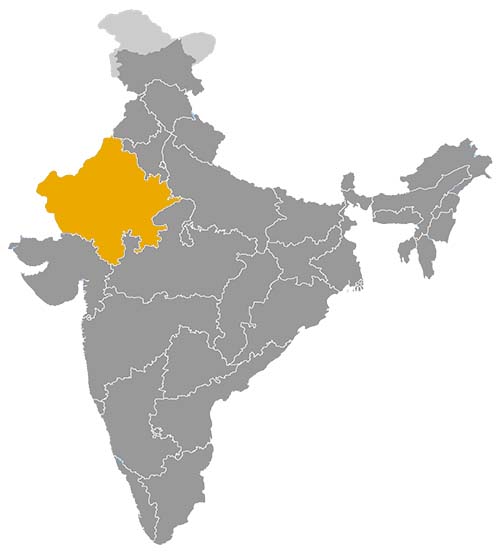
This map illustrates the maximum territory that the Kachwaha Dynasty had reached at its height, covering the current regions of Rajasthan in India. Its main purpose is to provide a visual aid to understand the geographical extent of this dynasty. However, it's important to note that the contemporary borders of these regions may not necessarily coincide with the historical territories.
The Kachwaha Dynasty and Its Political, Cultural and Economic Role in Indian History
A Rajput lineage rooted in the history of Rajasthan
The Kachwaha dynasty occupies an important place in the history of northern India, especially through its rule over Amber and later Jaipur. As a Rajput lineage established in the Dhundhar region of eastern Rajasthan, the Kachwahas developed from a regional warrior house into one of the most influential princely dynasties of India. Their importance did not rest only on territorial power. It also came from their ability to adapt to changing political conditions, to form strategic alliances and to create a court culture that left a lasting mark on Rajasthan.
Like many Rajput houses, the Kachwahas built their legitimacy through genealogy, martial prestige and religious patronage. Their early history is partly shaped by dynastic traditions, but from the medieval period onward their position became increasingly visible around Dausa and Amber. Amber served as a fortified capital, well suited to the political landscape of Rajasthan, where security, lineage authority and control of local resources were essential to survival.
The Mughal alliance and the rise of Kachwaha influence
The political role of the Kachwahas changed significantly in the sixteenth century, when the rulers of Amber entered into a close alliance with the Mughal Empire. Raja Bharmal’s alliance with Emperor Akbar marked a decisive turning point. It integrated the Kachwahas into the imperial system and gave them access to military commands, administrative posts and imperial prestige.
This relationship was not merely symbolic. Kachwaha nobles became important actors within the Mughal state. Bhagwant Das and Man Singh I, in particular, strengthened the dynasty’s position at court. Man Singh I became one of the most prominent Rajput generals of the Mughal Empire and took part in major campaigns across northern and eastern India. Through such service, the Kachwahas extended their influence far beyond their hereditary territory, even though their own kingdom remained centered on Amber.
This alliance also shaped relations with other Rajput dynasties. The Kachwahas gained power and recognition through cooperation with the Mughals, while other Rajput houses, especially the Sisodias of Mewar, often emphasized a more independent stance. The dynasty therefore became an example of Rajput political pragmatism, balancing local identity with imperial service.
From Amber to Jaipur as a transformation of royal power
One of the most important moments in Kachwaha history was the foundation of Jaipur by Jai Singh II in 1727. This decision shifted the center of power from the hill fortress of Amber to a planned urban capital. Jaipur was not only a new residence. It represented a new vision of kingship, administration and economic organization.
The planned layout of Jaipur reflected the ambitions of a ruler who wished to combine political authority, commercial development and intellectual order. The city was designed with broad streets, organized markets, palaces, temples and administrative spaces. This made Jaipur one of the most remarkable urban foundations of early modern India.
The move also reflected changing military and economic realities. Amber had been ideal as a defensive stronghold, but Jaipur was better suited to trade, administration and royal display. The Kachwahas thus transformed their state from a fortress centered kingdom into a more urban and commercially active principality.
Cultural patronage and the prestige of the Jaipur court
The cultural impact of the Kachwaha dynasty was substantial. The rulers of Amber and Jaipur supported architecture, painting, temple construction, court ritual and scholarship. Their palaces, forts and urban monuments became expressions of political legitimacy and artistic refinement. Amber Fort and the palace complexes of Jaipur illustrate the dynasty’s ability to combine Rajput, Mughal and local artistic traditions.
Jai Singh II was especially important as a patron of science and learning. His interest in astronomy led to the construction of monumental observatories, including the Jantar Mantar in Jaipur. These observatories reflected both intellectual ambition and practical concerns, since astronomy was linked to calendars, ritual time, astrology and royal administration.
Religion also played a central role in Kachwaha kingship. The cult of Govind Dev Ji became closely associated with Jaipur and helped connect royal authority with devotional life. Temples and rituals were not only spiritual institutions. They also shaped the symbolic geography of the capital and reinforced the image of the ruler as protector of sacred order.
Economic development through trade, crafts and urban planning
The economic role of the Kachwahas was closely linked to the growth of Jaipur. The city became a major center of trade and craftsmanship. Its planned markets encouraged commercial activity, while the court attracted artisans, merchants, jewelers, painters, metalworkers and textile producers. Over time, Jaipur became known for luxury crafts, gemstones, textiles and artistic production.
The state benefited from land revenue, trade routes and the organization of urban markets. Political stability, even when limited by regional conflicts, helped sustain economic life. During the princely period under British paramountcy, Jaipur retained internal autonomy and continued to invest in public works, education and urban improvement. Although external sovereignty was restricted, the dynasty remained an important administrative force within its territory.
A regional dynasty with influence beyond its borders
The Kachwaha dynasty was not an imperial power in the territorial sense. Its core domain remained concentrated in eastern Rajasthan. Yet its historical role was much wider than the size of its kingdom suggests. Through Mughal service, urban planning, cultural patronage and economic organization, the dynasty influenced the political and cultural landscape of northern India.
Its legacy is most visible in Jaipur, whose architecture, urban structure and religious institutions continue to reflect Kachwaha ambitions. The integration of Jaipur into the Indian Union in 1949 ended the dynasty’s effective sovereignty, but not its historical importance. The Kachwahas remain central to understanding how Rajput states adapted to imperial power, sustained regional identity and created enduring cultural capitals in India.
The Geographic Reach of the Kachwaha Dynasty in India
A regional power established in eastern Rajasthan
The Kachwaha dynasty developed its political authority in the Dhundhar region of eastern Rajasthan, an area that later became closely associated with Amber and Jaipur. Unlike large imperial formations such as the Mughals, the Marathas or the Delhi Sultanate, the Kachwahas did not create a vast continuous empire. Their territorial power was regional, but it was strategically placed. Their lands lay between the arid zones of Rajasthan, the Gangetic plain, the routes to Delhi and Agra, and the commercial corridors leading toward Gujarat and central India.
This position gave the dynasty an importance greater than the physical size of its kingdom. Control over Dhundhar allowed the Kachwahas to participate in the political affairs of northern India while maintaining a distinct Rajput identity. Their territorial history is therefore best understood as the development of a compact but influential state, whose rulers used geography, diplomacy and imperial service to extend their influence beyond their hereditary domain.
Dausa and Amber as early centers of Kachwaha authority
The early Kachwaha state is traditionally linked with Dausa, located east of present day Jaipur. Dausa provided the dynasty with an initial territorial base in a zone of agricultural settlements, hill tracts and regional routes. From there, the Kachwahas gradually strengthened their position in Dhundhar and moved toward Amber, which became their principal capital for several centuries.
Amber was more than a royal residence. Its hilltop setting made it a strong defensive center, while its palace and fortifications became symbols of dynastic authority. The surrounding territory included villages, cultivated lands, estates held by nobles, temples, military outposts and revenue producing areas. The Kachwahas controlled this territory through a combination of direct royal authority, clan networks and local intermediaries.
The kingdom centered on Amber remained geographically limited, but it was cohesive. This gave the dynasty enough stability to survive the pressures created by larger powers in northern India.
Borders shaped by neighboring Rajput states
The expansion of the Kachwahas was constrained by the presence of other powerful Rajput houses. To the west and southwest, the Sisodia rulers of Mewar controlled one of the most prestigious Rajput kingdoms. To the northwest, the Rathores of Marwar dominated the region around Jodhpur. Other neighboring or nearby powers included Bundi and Kota, ruled by Hada Rajputs, as well as Karauli, Bharatpur and the lineages of Shekhawati.
These surrounding states limited the possibility of large territorial expansion. The Kachwahas could not simply absorb the main Rajput kingdoms around them. Instead, their political geography was shaped by shifting alliances, marriages, rivalries, border disputes and military cooperation. Relations with Mewar were especially important because the Sisodias claimed a high status among Rajput lineages and often emphasized political independence. By contrast, the Kachwahas built much of their later power through close cooperation with the Mughal Empire.
This difference influenced Rajput politics for centuries. The Kachwahas were respected for their strength and courtly prestige, but their alliance with the Mughals also distinguished them from dynasties that cultivated a more resistant image.
Mughal service and influence beyond the hereditary kingdom
From the sixteenth century onward, the Kachwahas acquired influence far beyond Amber through their relationship with the Mughal Empire. Raja Bharmal’s alliance with Akbar marked a decisive transformation. His successors, especially Bhagwant Das and Man Singh I, became major figures in the Mughal political and military system.
This did not mean that Bengal, Bihar, Afghanistan or other regions where Kachwaha commanders served became Kachwaha possessions. These territories remained part of the Mughal Empire. However, Kachwaha nobles exercised authority there as imperial generals, governors or military commanders. Man Singh I, for example, played an important role in Mughal campaigns and administration in eastern India. Through such service, the dynasty’s effective political presence extended across a much wider imperial space than its own kingdom.
This imperial role increased the prestige of Amber and strengthened the dynasty’s position among neighboring houses. It also gave the Kachwahas access to revenue, honors and political networks that would have been impossible for a purely local state.
Jaipur as a new territorial and urban center
The foundation of Jaipur by Jai Singh II in 1727 altered the geography of Kachwaha power. Amber remained symbolically important, but Jaipur became the new capital. The move from a hill fortress to a planned city reflected changing priorities. The dynasty needed an administrative, commercial and ceremonial center suited to a more complex state.
Jaipur was built on a planned urban layout, with organized streets, markets, palaces, temples and administrative quarters. This new capital transformed the territorial structure of the kingdom. Power was no longer focused only on a defensive stronghold; it was now also organized around trade, craft production, taxation and urban management.
The city helped the Kachwahas consolidate eastern Rajasthan economically as well as politically. Merchants, artisans, jewelers, textile producers and religious communities contributed to the growth of Jaipur as one of the principal cities of Rajasthan.
Maratha, Jat and British pressure on Jaipur’s territorial limits
During the eighteenth century, the decline of Mughal authority exposed Jaipur to new pressures. The Marathas entered Rajasthan as a major military and fiscal force, often demanding tribute or intervening in regional politics. The Jat kingdom of Bharatpur also became an important neighbor, especially in the eastern Rajasthan and Braj region. These powers restricted Jaipur’s freedom of action and made territorial expansion difficult.
The Kachwahas responded through diplomacy, military alliances and negotiation. Their position remained significant, but the age of independent regional expansion was limited by the rise of stronger mobile powers. In the nineteenth century, British paramountcy stabilized Jaipur’s borders but reduced its external sovereignty. Jaipur continued as a princely state with internal administration, while foreign relations and major political decisions were controlled by the British.
A compact kingdom with a wider political horizon
The geographic extension of the Kachwaha dynasty was therefore not defined by a vast empire, but by a strategically placed and well organized regional state. Its core remained Dhundhar, first centered on Dausa and Amber, then on Jaipur. Its relations with neighboring dynasties were shaped by the limits imposed by other Rajput powers, the opportunities created by Mughal service, and the pressures brought by Maratha, Jat and British expansion.
The Kachwahas show how a dynasty with a relatively compact territory could exercise influence across much of northern India. Their direct rule was regional, but their political reach, cultural prestige and urban legacy extended far beyond the borders of Jaipur.
The Kachwaha rulers of Dhundhar first ruled as rajas of Amber and later as maharajas of Jaipur after the rise of the new capital founded by Jai Singh II. The early dates are indicative and may vary according to genealogical traditions; after Jaipur was integrated into the Indian Union in 1949, the heads of the house were no longer effective sovereigns.
Rajas of Amber
- Sorha Dev (c. 966–1006) • First Kachwaha ruler associated with the establishment of power in the Dhundhar region.
- Dulha Rao (c. 1006–1036) • Consolidated Kachwaha authority around Dausa and Amber according to dynastic tradition.
- Kakil (c. 1036–1039) • His short reign belongs to the early and poorly documented phase of the lineage.
- Hanu (c. 1039–1053) • Maintained Kachwaha authority in Dhundhar during the eleventh century.
- Janddeo (c. 1053–1070) • Continued the territorial consolidation of the house of Amber.
- Pajjun Rai (c. 1070–1094) • Traditional figure in the early Kachwaha succession.
- Malayasi (c. 1094–1146) • His long reign is linked with the durable rooting of the dynasty.
- Vijaldeo (c. 1146–1179) • Ruled during a period of regional formation of Rajput power.
- Rajdeo (c. 1179–1216) • Preserved dynastic continuity after the upheavals of northern India.
- Kilhan (c. 1216–1276) • His traditionally long reign is associated with the stability of Amber.
- Kuntal (c. 1276–1317) • Led the Kachwaha house during a phase of growing political pressure in Rajasthan.
- Jonsi (c. 1317–1366) • Preserved dynastic succession in a fragmented regional context.
- Udaikarn (c. 1366–1388) • Belongs to the medieval period of assertion by the rajas of Amber.
- Narsingh (c. 1388–1428) • Continued Kachwaha rule into the fifteenth century.
- Banbir (c. 1428–1439) • His brief reign preceded a new phase of consolidation.
- Udharn (c. 1439–1467) • Maintained Amber’s power within the Rajput balances of eastern Rajasthan.
- Chandrasen (c. 1467–1503) • Ruled before Amber entered the wider rivalries of the early sixteenth century.
- Prithviraj Singh I (1503–1527) • Raja of Amber, he took part in the Rajput struggles of his time.
- Puranmal (1527–1534) • His short reign belongs to a period of competition between Rajput houses.
- Bhim Singh (1534–1537) • Ruled Amber for a few years in an unstable political context.
- Ratan Singh (1537–1548) • Preceded the rise of rival branches within the Kachwaha house.
- Askaran (1548) • His reign was very short and was quickly followed by that of Bharmal.
- Bharmal (1548–1574) • Raja of Amber, he concluded a major alliance with the Mughal emperor Akbar.
- Bhagwant Das (1574–1589) • Raja of Amber, he served the Mughal Empire and strengthened the prestige of the Kachwaha house.
- Man Singh I (1589–1614) • Raja of Amber and major Mughal general, he expanded the political influence of his dynasty.
- Bhau Singh (1614–1621) • His reign was brief and remained connected with Mughal imperial service.
- Jai Singh I (1621–1667) • Raja of Amber, known as Mirza Raja Jai Singh, he played an important military and diplomatic role under the Mughals.
- Ram Singh I (1667–1688) • Raja of Amber, he inherited a high but delicate position within the Mughal order.
- Bishan Singh (1688–1699) • Raja of Amber, he ruled in the late seventeenth century under Mughal suzerainty.
Raja of Amber and later maharaja of Jaipur
- Jai Singh II (1699–1743) • Raja of Amber and later maharaja of Jaipur, he founded Jaipur in 1727 and developed astronomy, urban planning and administration.
Maharajas of Jaipur
- Ishwari Singh (1743–1750) • Maharaja of Jaipur, he ruled amid succession rivalries and regional tensions.
- Madho Singh I (1750–1768) • Maharaja of Jaipur, he consolidated power after the succession crisis.
- Prithvi Singh II (1768–1778) • Maharaja of Jaipur, his reign unfolded during a period of increasing Maratha pressure.
- Pratap Singh (1778–1803) • Maharaja of Jaipur, he is associated with artistic patronage and the construction of the Hawa Mahal.
- Jagat Singh II (1803–1818) • Maharaja of Jaipur, he ruled during a phase of political and military unrest.
- Mohan Singh (1818–1819, regency) • Regent during a short dynastic transition before the accession of Jai Singh III.
- Jai Singh III (1819–1835) • Maharaja of Jaipur, he ruled under increasing political supervision in the British period.
- Ram Singh II (1835–1880) • Maharaja of Jaipur, he undertook administrative reforms and encouraged the modernization of the city.
- Madho Singh II (1880–1922) • Maharaja of Jaipur, he represented the princely state in British India and patronized public works.
- Man Singh II (1922–1949) • Last sovereign maharaja of Jaipur, he signed accession to India and the state’s integration in 1949.
 Links to the main sections of the site