Français (France)
  Nederlands (nl-NL)
 Of Hindu tradition, (with additional Jain influence), the Kalachuris of Kalyani dynasty ruled for approximately 28 years, ± between 1156 and 1184 over all or part of South India and West India, during the Medieval Period.
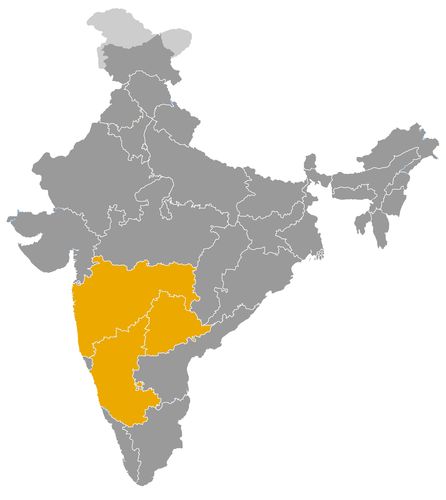
This map illustrates the maximum territory that the Kalachuris of Kalyani Dynasty had reached at its height, covering the current regions of Karnataka, Maharashtra and Telangana in India. Its main purpose is to provide a visual aid to understand the geographical extent of this dynasty. However, it's important to note that the contemporary borders of these regions may not necessarily coincide with the historical territories.
The Kalachuris of Kalyani and Their Role in the History of Medieval India
A short-lived dynasty in the western Deccan
The Kalachuris of Kalyani, also known as the Southern Kalachuris, were a brief but historically significant ruling dynasty of the western Deccan in the twelfth century. Their political centre was Kalyani, present-day Basavakalyan in northern Karnataka. This city had previously been the capital of the Western Chalukyas, one of the major powers of medieval southern India. The Kalachuris therefore rose not from an isolated frontier, but from within the political and administrative framework of an established regional kingdom.
Before their seizure of power, the Kalachuris of Kalyani were feudatories of the Western Chalukyas. Their ascent illustrates a recurring feature of medieval Indian politics: powerful subordinate lineages could take advantage of dynastic weakness and convert delegated authority into sovereign rule. Bijjala II, the most important figure of the dynasty, gradually replaced Chalukya authority at Kalyani and briefly made the Kalachuris the dominant power in a large part of the western Deccan.
Political transition after the weakening of Chalukya authority
The political importance of the Kalachuris of Kalyani lies mainly in their role as agents of transition. Their rule did not last long, but it marked the decline of Western Chalukya supremacy and accelerated the fragmentation of the Deccan. Bijjala II’s rise showed that the Chalukya imperial structure had become vulnerable to ambitious provincial or military elites.
After Bijjala II, the dynasty struggled to maintain the territory it had inherited. Sovideva, Mallugi, Sankama, Ahavamalla and Singhana ruled in a context of internal rivalry, contested legitimacy and pressure from older and emerging powers. The Kalachuri state lacked the long dynastic stability needed to transform control over Kalyani into a durable regional monarchy.
Their political role was therefore not that of a long-standing empire, but that of a disruptive power at a crucial moment. By weakening the old Chalukya order, they opened space for the rise of other dynasties, including the Hoysalas in southern Karnataka and the Seunas or Yadavas of Devagiri in the northern Deccan.
Control over strategic territories in the Deccan
The territory controlled by the Kalachuris of Kalyani lay mainly in northern Karnataka and adjoining areas of the western Deccan. Their authority extended over parts of the former Western Chalukya realm, including regions connected with present-day Karnataka and southern Maharashtra. Kalyani itself was an important administrative and symbolic centre, and its possession gave the dynasty immediate political weight.
However, the Kalachuri hold over this territory was uneven. In the central areas close to Kalyani, their rule was stronger. In more distant provinces, authority depended on the loyalty of local chiefs, military commanders, governors and landed elites. The dynasty inherited an extensive political space, but it did not fully consolidate it. This weakness explains the rapid decline of Kalachuri power after the death of Bijjala II.
Cultural significance through Basava and the Virashaiva movement
The most enduring cultural importance of the Kalachuris of Kalyani is linked to the religious and social movement associated with Basava, also known as Basavanna. He was connected with the court of Bijjala II and became a central figure in the development of Virashaivism, or Lingayatism. This movement emphasized personal devotion to Shiva, the wearing of the individual linga, social participation among devotees and criticism of certain ritual hierarchies.
Kalyani became an important centre of religious debate and literary expression during this period. The vachanas, short devotional compositions in Kannada, gave voice to a direct and socially engaged form of spirituality. They contributed to the development of Kannada literature and to the wider religious identity of Karnataka.
The relationship between the Kalachuri court and the Virashaiva movement was complex. Royal power did not simply create the movement, and later tradition sometimes presents tensions between Basava’s followers and Bijjala’s court. Nevertheless, the Kalachuri period provided the political and urban setting in which this major religious transformation became historically visible.
Economic structures inherited from the Western Chalukyas
The economic basis of the Kalachuris of Kalyani rested largely on institutions inherited from the Western Chalukyas. Their realm drew revenue from agriculture, village networks, local taxes, markets and trade routes across the Deccan. Northern Karnataka and the neighbouring regions contained fertile lands, temple centres and towns that supported political authority.
Land grants played an important role in this economy. Donations to temples, Brahmins and religious institutions helped rulers secure legitimacy and build relationships with local elites. These grants also linked the political centre to rural society, making them both economic and administrative instruments.
Control of Kalyani also gave access to routes connecting Karnataka, Maharashtra and the southern Deccan. These networks supported trade, movement of military forces and circulation of religious communities. Yet the instability of Kalachuri rule limited their ability to develop a long-lasting economic administration. Much of their revenue system depended on the inherited Chalukya framework and on cooperation from regional power holders.
A brief reign with a durable historical imprint
The Kalachuris of Kalyani ruled for only a short period, but their place in Indian history is not marginal. Politically, they marked the collapse of Western Chalukya dominance and contributed to the reorganization of power in the Deccan. Economically, they controlled important agrarian and commercial zones, though without creating a stable long-term state. Culturally, their period is closely associated with one of the most significant religious and literary movements of medieval Karnataka.
Their legacy is therefore twofold. As a dynasty, they were brief and politically fragile. As a historical moment, they were highly important. The Kalachuris of Kalyani stand at the intersection of dynastic conflict, regional fragmentation, religious change and the growth of Kannada devotional literature in medieval India.
The Geographical Expansion of the Kalachuris of Kalyani in the Western Deccan
A dynasty centred on the former Chalukya capital of Kalyani
The Kalachuris of Kalyani, also known as the Southern Kalachuris, exercised power in the western Deccan during the twelfth century. Their political centre was Kalyani, present-day Basavakalyan in northern Karnataka. This city had previously been the capital of the Western Chalukyas, and its possession gave the Kalachuris immediate access to an established administrative, military and symbolic centre. Their geographical expansion was therefore not the result of a long process of frontier conquest, but rather of a takeover within an already organized regional kingdom.
The dynasty’s territorial authority began with Bijjala II, originally a powerful feudatory of the Western Chalukyas. As Chalukya authority weakened, Bijjala gradually converted subordinate power into effective sovereignty. The Kalachuris thus controlled territories that had formerly belonged to the Western Chalukya sphere, especially in northern Karnataka and adjoining areas of the western Deccan. Their rule, however, was short and uneven, and their territorial reach varied according to local loyalty, military pressure and the survival of Chalukya claims.
Northern Karnataka as the strongest territorial base
The most secure area under Kalachuri control was northern Karnataka. This region formed the political heartland around Kalyani and contained important administrative centres, temple sites, market towns and agrarian zones. Control over this area allowed the dynasty to command the main routes connecting the Karnataka plateau with Maharashtra, the Krishna basin and the wider Deccan.
Northern Karnataka was not only a geographic base, but also a source of legitimacy. Since Kalyani had been the capital of the Western Chalukyas, ruling from this city allowed Bijjala II and his successors to present themselves as heirs to an existing political order. The Kalachuris did not need to create a new administrative geography from nothing. They could rely, at least initially, on officials, military households, local elites and fiscal networks inherited from the previous regime.
Yet this inherited structure was also fragile. Some provincial authorities and local chiefs remained attached to the Chalukya line or pursued their own autonomy. As a result, Kalachuri control was stronger near Kalyani and weaker in the outer provinces of the former Chalukya realm.
Influence over southern Maharashtra and the northern Deccan routes
To the north and north-west, Kalachuri influence extended into parts of southern Maharashtra. These areas were important because they lay on routes linking Kalyani with the northern Deccan and the region later dominated by the Seunas, or Yadavas of Devagiri. The ability to influence or control these corridors had military and economic value, since they connected agricultural lands, fortified settlements and trade routes.
The Kalachuris probably did not exercise uniform control over all these northern territories. Their presence depended on the submission of local authorities and the continued effectiveness of military command. In regions farther from Kalyani, their power was more vulnerable to shifts in allegiance. This weakness became increasingly evident after Bijjala II, when the dynasty’s successors struggled to preserve the territorial structure they had inherited.
The southern frontier and the rise of the Hoysalas
The southern limits of Kalachuri authority brought the dynasty into contact with the Hoysalas, who were rising in southern Karnataka. The decline of the Western Chalukyas and the temporary dominance of the Kalachuris created an opportunity for the Hoysalas to expand their influence northward. This made the southern frontier of the Kalachuri realm a zone of political competition.
The Kalachuris of Kalyani were primarily centred in northern Karnataka and did not establish lasting control over the southern Hoysala heartland. Their ability to project power southward was limited by internal instability and the short duration of their rule. The Hoysalas, by contrast, used the weakening of the Chalukya and Kalachuri structures to strengthen their regional position. The rise of Hoysala power was therefore closely connected to the fragmentation of the political order in which the Kalachuris briefly held the centre.
Relations with the Seunas of Devagiri in the north
The Seunas, or Yadavas of Devagiri, were another major power affected by the territorial instability of the twelfth-century Deccan. Located to the north of the Kalachuri sphere, they benefited from the weakening of the Western Chalukyas and from the inability of the Kalachuris to maintain durable control over the northern Deccan.
The areas between southern Maharashtra and northern Karnataka became strategically important. They linked Kalyani to Devagiri and formed a frontier of influence between competing powers. While the Kalachuris inherited some authority in these zones, they could not prevent the gradual rise of the Seunas. As Kalachuri rule fragmented, the Yadavas expanded their own influence and became one of the dominant dynasties of the northern Deccan.
The Chalukya legacy as both resource and obstacle
The territorial expansion of the Kalachuris was inseparable from their relationship with the Western Chalukyas. On one hand, the Chalukya legacy gave them an existing capital, administrative structures and a network of dependent territories. On the other hand, Chalukya legitimacy did not disappear immediately. Former Chalukya supporters, regional commanders and local elites could resist Kalachuri authority or shift allegiance when the dynasty showed weakness.
This explains why the Kalachuris of Kalyani were able to take power quickly, but not to consolidate it permanently. Their geographical extension was broad enough to disturb the balance of the western Deccan, yet too unstable to form a lasting empire. After Bijjala II, the political centre weakened, and the old Chalukya order partially reasserted itself before giving way to newer regional powers.
A strategic but unstable territorial formation
The geographical expansion of the Kalachuris of Kalyani was concentrated mainly in northern Karnataka, Kalyani and parts of the former Western Chalukya domain, with influence reaching toward southern Maharashtra and the northern Deccan routes. Their power was significant because it occupied the centre of a major regional system at a moment of transition.
Their territorial role was therefore greater than the short duration of their dynasty might suggest. By seizing Kalyani, they disrupted the Chalukya political order and contributed to the rise of rival powers on its margins. Their rule affected relations with the Hoysalas in the south, the Seunas in the north and the remaining Chalukya forces within the Deccan. The Kalachuris of Kalyani thus represent a brief but important phase in the territorial reorganization of medieval southern India.
The Kalachuris of Kalyani, also known as the Southern Kalachuris, were first feudatories of the Western Chalukyas before taking power at Kalyani in the twelfth century. The dates given refer to sovereign rule or effective domination; they are approximate, especially for the short period after Bijjala II.
- Bijjala II (c. 1162–1167 CE) • A former Chalukya feudatory, he seized control of Kalyani and established Kalachuri rule in the western Deccan.
- Sovideva (c. 1168–1176 CE) • He maintained Kalachuri authority after the death of Bijjala II and temporarily preserved the unity of the kingdom.
- Mallugi (c. 1176 CE) • His reign was very brief, and he was overthrown by his brother Sankama.
- Sankama (c. 1176–1180 CE) • He took power after Mallugi, but his rule unfolded in a context of increasing political fragility.
- Ahavamalla (c. 1180–1183 CE) • He ruled during the dynasty’s declining phase, as the Western Chalukyas gradually recovered ground.
- Singhana (c. 1183–1184 CE) • Usually listed as the last ruler of the line, he reigned briefly before Kalachuri authority at Kalyani disappeared.
 Links to the main sections of the site