

 Français (France)
  Nederlands (nl-NL)
 Of Hindu tradition, (with additional Jain influence), the Chandela dynasty ruled for approximately 430 years, ± between 820 and 1250 over all or part of Central India and North India, during the Medieval Period.
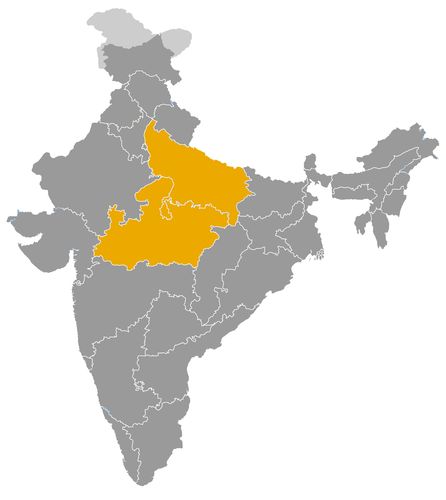
This map illustrates the maximum territory that the Chandela Dynasty had reached at its height, covering the current regions of Madhya Pradesh and Uttar Pradesh in India. Its main purpose is to provide a visual aid to understand the geographical extent of this dynasty. However, it's important to note that the contemporary borders of these regions may not necessarily coincide with the historical territories.
The Chandela Dynasty: Political Power and Cultural Legacy in Medieval India
The Chandela dynasty was one of the most influential Rajput ruling houses of medieval India. Between the 9th and 13th centuries CE, the Chandelas governed the region of Bundelkhand, encompassing parts of present-day Madhya Pradesh and Uttar Pradesh. Rising from the status of feudatories under the Gurjara-Pratiharas, they established an independent kingdom that became a major political force in northern India. Their significance extends far beyond military achievements, however. The Chandelas fostered economic prosperity, encouraged artistic innovation, and created one of the world's finest architectural ensembles at Khajuraho, now recognized as a UNESCO World Heritage Site. Their political stability and cultural patronage left an enduring imprint on Indian civilization.
The Rise of an Independent Kingdom
The origins of the Chandela dynasty can be traced to the late 9th century, when local Rajput chiefs gradually consolidated their authority in the Bundelkhand region. Initially subordinate to the Gurjara-Pratiharas, they took advantage of the weakening of their overlords to establish an autonomous state.
The reign of Yashovarman in the 10th century marked the dynasty's emergence as a regional power. He expanded Chandela authority beyond its original territory and laid the foundations of an independent kingdom. His successor, Dhanga, further strengthened the state through military victories over neighboring dynasties, including the Kalachuris and the Rashtrakutas. Under these rulers, the Chandela kingdom evolved into one of the principal powers of central and northern India.
Strategically located between the Gangetic plains and central India, the kingdom occupied an important crossroads that enabled it to influence regional politics while controlling valuable commercial routes.
Political Organization and Diplomatic Strategy
The Chandela rulers developed a well-organized administrative system that ensured political stability over several centuries. The kingdom was divided into provinces administered by governors responsible for taxation, justice, and local defense, while supreme authority remained firmly in the hands of the king.
Diplomacy played a central role in Chandela statecraft. Relations with neighboring dynasties varied according to changing political circumstances. Conflicts with the Kalachuris and Paramaras alternated with periods of cooperation and temporary alliances. This flexible diplomatic approach enabled the Chandelas to preserve their independence despite the ambitions of more powerful neighboring kingdoms.
One of the greatest challenges came in the early 11th century, when Mahmud of Ghazni launched his campaigns into northern India. Although the invasion of Kalinjar in 1022 caused considerable destruction, it did not destroy the Chandela kingdom. The dynasty recovered and continued to flourish for nearly two more centuries, demonstrating both military resilience and administrative strength.
Cultural Patronage and Architectural Achievement
The Chandela dynasty is best remembered for its extraordinary contribution to Indian art and architecture. During the period between the 10th and 12th centuries, the rulers sponsored the construction of numerous Hindu and Jain temples, transforming Khajuraho into one of medieval India's greatest religious and artistic centers.
Originally consisting of approximately eighty-five temples, about twenty-five survive today in an exceptional state of preservation. These monuments represent the culmination of the Nagara style of North Indian temple architecture, characterized by soaring towers, harmonious proportions, and richly sculpted facades.
Although Khajuraho is widely known for its erotic sculptures, these constitute only a small fraction of the decorative program. Most carvings depict scenes from everyday life, religious ceremonies, musicians, dancers, mythological narratives, celestial beings, and Hindu deities. Together they present a comprehensive vision of medieval Indian society in which spirituality, artistic expression, and worldly existence coexist harmoniously.
The Chandela court also encouraged literature, music, philosophy, and religious scholarship. Sanskrit remained the principal literary language, while scholars, poets, and theologians found generous patronage under Chandela rulers. Their support contributed significantly to the intellectual vitality of central India during the medieval period.
Economic Prosperity and Regional Development
The Chandela kingdom enjoyed substantial economic prosperity based primarily on agriculture. The rulers invested heavily in hydraulic engineering by constructing reservoirs, artificial lakes, dams, and irrigation canals. These projects increased agricultural productivity, ensured reliable harvests, and strengthened the kingdom's fiscal resources.
The strategic location of Bundelkhand also favored commercial development. Major trade routes connecting the Gangetic plain with central India passed through Chandela territory, facilitating the movement of textiles, metals, precious stones, agricultural products, and luxury goods. Urban centers such as Mahoba and Khajuraho became important administrative and commercial hubs.
Temples themselves played a significant economic role. Beyond serving as places of worship, they functioned as centers of education, land management, artisan production, and redistribution of wealth. Donations from rulers and local elites supported extensive economic networks that contributed to the prosperity of surrounding communities.
This combination of agricultural productivity, commercial activity, and institutional investment enabled the Chandela kingdom to maintain both political stability and sustained economic growth for several generations.
Decline and Enduring Legacy
From the late 12th century onward, the political balance of northern India changed dramatically with the expansion of the Ghurids and, subsequently, the Delhi Sultanate. Military campaigns led by Qutb-ud-din Aibak significantly weakened Chandela authority, and much of their territory gradually fell under the control of emerging Islamic powers.
Although branches of the dynasty continued to rule smaller territories into the 14th century, they never regained their former influence. Nevertheless, their political decline did not diminish the importance of their cultural achievements.
Today, the temples of Khajuraho remain among the finest masterpieces of Indian architecture and sculpture. The Chandela legacy also survives in their sophisticated systems of water management, regional administration, and artistic patronage, all of which influenced later kingdoms in central India.
Conclusion
The Chandela dynasty occupies a distinguished place in the history of medieval India. Through effective governance, diplomatic adaptability, economic development, and exceptional cultural patronage, the Chandelas transformed Bundelkhand into one of the most prosperous and influential regions of northern India. Their achievements demonstrate that regional kingdoms could exercise profound influence without creating vast territorial empires. Above all, the magnificent temples of Khajuraho stand as enduring monuments to their vision, artistic refinement, and lasting contribution to India's political, cultural, and economic heritage.
Geographic Expansion of the Chandela Dynasty: Territorial Growth and Regional Relations in Medieval India
The Chandela dynasty emerged as one of the principal regional powers of northern and central India between the 9th and 13th centuries CE. Originating in the Bundelkhand region, the Chandelas gradually transformed themselves from feudatories of the Gurjara-Pratiharas into independent rulers who controlled a strategically important kingdom at the crossroads of northern and central India. Although they never established an empire comparable in size to those of the Cholas or the Gurjara-Pratiharas, their territorial expansion enabled them to dominate key commercial routes, defend vital fortresses, and influence the political balance of the subcontinent for several centuries. Their geographical position also shaped their diplomatic and military relationships with neighboring dynasties, making the Chandela kingdom an essential component of medieval India's political landscape.
The Core Territory: Bundelkhand
The Chandela kingdom was centered in the historical region of Bundelkhand, corresponding today to parts of Madhya Pradesh and Uttar Pradesh. This territory consisted of rocky plateaus, fertile river valleys, forests, and naturally fortified hills that offered excellent defensive advantages.
Khajuraho served as the dynasty's principal religious and ceremonial center, while Mahoba emerged as its political and military capital. The formidable hill fortress of Kalinjar became one of the strongest defensive positions in northern India and played a decisive role in protecting the kingdom from repeated invasions.
The location of Bundelkhand allowed the Chandelas to control communication routes linking the Gangetic plain with central India and the Deccan. This strategic position strengthened both their military security and their economic prosperity by facilitating regional trade.
Territorial Expansion During the Tenth and Eleventh Centuries
The Chandela kingdom experienced its greatest territorial expansion under rulers such as Yashovarman and Dhanga during the 10th century. As the Gurjara-Pratihara Empire weakened, the Chandelas asserted their independence and extended their authority over neighboring regions.
At its height, the kingdom controlled most of present-day Bundelkhand, including territories corresponding to modern districts such as Chhatarpur, Panna, Tikamgarh, Damoh, Sagar, Jhansi, Banda, and Mahoba. Their influence also extended toward parts of Gwalior and northern Madhya Pradesh, while temporary military campaigns reached neighboring territories beyond these core regions.
This expansion enabled the Chandelas to dominate important trade corridors connecting northern India with Malwa and central India. Agricultural production, commercial exchange, and taxation from these routes provided the economic foundation necessary to sustain both military campaigns and large-scale architectural projects.
Relations with the Gurjara-Pratiharas
The early Chandela rulers began as loyal feudatories of the Gurjara-Pratihara Empire, which dominated much of northern India during the 9th century. As Pratihara authority declined due to internal fragmentation and external invasions, the Chandelas gradually assumed political independence.
Rather than overthrowing their former overlords through a single decisive conflict, the Chandelas expanded their influence progressively, replacing the Pratiharas as the dominant regional power in Bundelkhand. They inherited many administrative practices while adapting them to suit their own growing kingdom.
This transition illustrates the gradual redistribution of political power that characterized much of medieval India, where regional dynasties frequently emerged from the weakening structures of larger empires.
Rivalry with the Kalachuris
To the southeast, the Chandela kingdom bordered the territories of the Kalachuris of Tripuri, one of central India's strongest dynasties. Relations between the two kingdoms were frequently marked by military conflict, primarily over fertile agricultural lands and control of commercial routes crossing central India.
Neither dynasty achieved lasting supremacy over the other. Instead, repeated campaigns produced a fluctuating frontier that reflected the broader balance of power within the region.
Despite these conflicts, periods of peaceful coexistence also occurred, allowing commercial exchanges and diplomatic contacts to continue even during times of political rivalry.
Relations with the Paramaras of Malwa
The western frontier of the Chandela kingdom brought it into regular contact with the Paramaras of Malwa. Territorial disputes occasionally led to military confrontations, particularly over frontier districts and strategic fortifications.
However, these rivalries were balanced by pragmatic diplomacy. When confronted by common external threats, the Chandela and Paramara rulers sometimes entered temporary alliances that served their mutual interests. Such shifting relationships illustrate the flexible diplomatic environment of medieval India, where political alliances often evolved according to changing strategic circumstances rather than permanent loyalties.
Cultural exchanges also flourished between the two kingdoms, particularly in architecture, religious patronage, and literary traditions.
Encounters with the Ghaznavids and the Delhi Sultanate
The expansion of the Ghaznavid Empire introduced a new geopolitical challenge during the early 11th century. In 1022, Mahmud of Ghazni attacked Kalinjar, the Chandela dynasty's principal fortress. Although the invasion caused significant destruction and resulted in tribute payments, it failed to destroy the kingdom.
The Chandela rulers retained control over their core territory and continued to govern for nearly two additional centuries. Their resilience demonstrated both the strength of their military organization and the defensive advantages offered by their strategically located hill fortresses.
Beginning in the late 12th century, however, the political situation changed dramatically with the advance of the Ghurids and the subsequent rise of the Delhi Sultanate. Military campaigns led by Qutb-ud-din Aibak progressively reduced Chandela territory, and many of their principal cities eventually came under Muslim rule. By the 13th century, the dynasty's authority had largely been confined to smaller regional domains.
Conclusion
The geographic expansion of the Chandela dynasty was characterized less by vast imperial conquest than by the consolidation of a strategically vital region at the center of northern India. By controlling Bundelkhand and the communication routes linking the Gangetic plain with central India, the Chandelas became indispensable participants in the political, economic, and military affairs of medieval India. Their relationships with the Gurjara-Pratiharas, Kalachuris, Paramaras, Ghaznavids, and eventually the Delhi Sultanate demonstrate how geography shaped both diplomacy and warfare throughout their history. Although their kingdom ultimately declined, the territorial organization they established and the political influence they exercised ensured that the Chandela dynasty remained one of the defining regional powers of medieval India.
This chronology concerns the Chandelas of Jejakabhukti, a region broadly corresponding to historical Bundelkhand. The early rulers appear to have been feudatories of the Gurjara-Pratiharas before the assertion of effective sovereignty in the tenth century. Inscriptions use various royal and imperial honorific titles, but the general designation of kings remains the clearest for the dynasty as a whole. The dates are indicative and may vary between scholarly chronologies.
- Nannuka (c. 831–845 CE) • He is regarded as the founder of the Chandela line in the Khajuraho region.
- Vakpati (c. 845–865 CE) • He succeeded Nannuka and strengthened the small dynastic power still linked to the Pratiharas.
- Jayashakti (c. 865–885 CE) • He is associated with Vijayashakti in an early phase whose chronology remains poorly detailed.
- Vijayashakti (c. 865–885 CE) • He is generally placed with Jayashakti among the early Chandela rulers of Jejakabhukti.
- Rahila (c. 885–905 CE) • He consolidated Chandela authority and his name remained linked to the early memory of Bundelkhand.
- Harsha (c. 905–925 CE) • He strengthened the political position of the Chandelas while probably retaining ties of dependence on the Pratiharas.
- Yashovarman (c. 925–950 CE) • He asserted Chandela autonomy and captured the strategic fortress of Kalinjar.
- Dhanga (c. 950–999 CE) • He more clearly established Chandela sovereignty and patronized the monumental architecture of Khajuraho.
- Ganda (c. 999–1002 CE) • His brief reign ensured dynastic continuity after Dhanga.
- Vidyadhara (c. 1003–1035 CE) • He defended the kingdom against the Ghaznavids and maintained the military prestige of the Chandelas.
- Vijayapala (c. 1035–1050 CE) • His reign marked a phase of continued Chandela authority in central India.
- Devavarman (c. 1050–1060 CE) • He ruled during a period of growing pressure from the Kalachuris of Tripuri and other neighbours.
- Kirtivarman (c. 1060–1100 CE) • He restored part of Chandela power after the reverses of the mid-eleventh century.
- Sallakshanavarman (c. 1100–1110 CE) • He maintained dynastic authority during a phase of political transition.
- Jayavarman (c. 1110–1120 CE) • His reign is poorly documented and appears to represent a period of limited continuity.
- Prithvivarman (c. 1120–1128 CE) • He ruled briefly before the more prominent rise of Madanavarman.
- Madanavarman (c. 1128–1164 CE) • He restored Chandela prestige and pursued an active policy toward neighbouring powers.
- Yashovarman II (c. 1164–1165 CE) • His very brief reign preceded the accession of Paramardi.
- Paramardi (c. 1165–1203 CE) • The last major Chandela king, he faced the Chahamanas and the forces of the Delhi Sultanate.
- Trailokyavarman (c. 1203–1245 CE) • He partially restored Chandela authority after the crisis caused by the Turko-Afghan conquests.
- Viravarman (c. 1245–1285 CE) • He ruled a reduced kingdom still centred on the fortresses of Bundelkhand.
- Bhojavarman (c. 1285–1288 CE) • His brief reign belongs to the late and weakened phase of the dynasty.
- Hammiravarman (c. 1288–1311 CE) • He ruled when Chandela power had lost much of its imperial status.
- Viravarman II (c. 1311–1315 CE) • He is generally regarded as one of the last Chandela rulers of Jejakabhukti.