Français (France)
  Nederlands (nl-NL)
 00:00 • intro | 00:20 • various buildings in an excellent state of conservation
Personal creation from visual material collected during my trip India • Rajasthan and Varanasi (2015)
Map of places or practices in Fatehpur Sikri on this site
• Use the markers to explore the content •
Fatehpur Sikri, the Imperial City Preserved in Stone
An imperial capital born from ambition
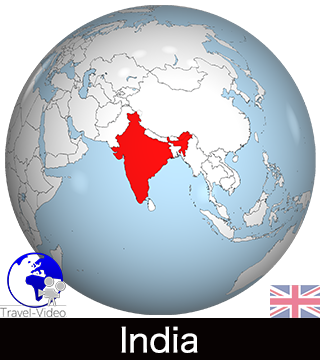
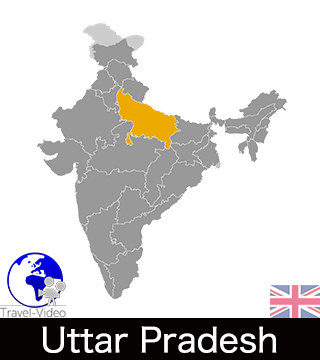
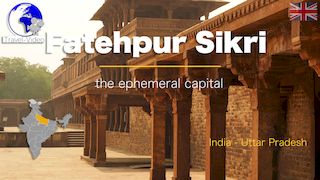
Fatehpur Sikri is one of the most remarkable historic urban ensembles in northern India. Located in present-day Uttar Pradesh, the city was selected in the sixteenth century by the Mughal emperor Akbar as his imperial capital. Planned and developed within a relatively short period, it brought together palaces, audience halls, ceremonial courts, residential pavilions and administrative spaces in a highly coherent setting.
The video offers an opportunity to discover a site where architecture remains unusually legible. Many buildings still preserve their original volumes, carved details and spatial organization, making it possible to understand how an imperial Mughal capital functioned. Fatehpur Sikri is more than a collection of monuments: it is a large-scale statement of political power, artistic experimentation and urban planning. Inscribed on the UNESCO World Heritage List in 1986, it ranks among the most important historic sites of the Indian subcontinent.
Major buildings and spaces visible in the video
The images emphasize the exceptional state of preservation found across much of the complex. Unlike many former capitals transformed continuously over centuries, Fatehpur Sikri retains broad sectors where the historic layout can still be read clearly. This allows visitors to appreciate not only individual monuments but also the relationships between courtyards, terraces, passages and specialized buildings.
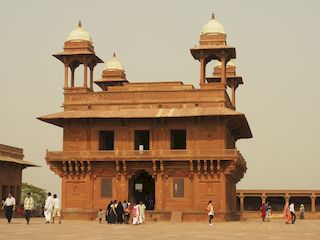
The Diwan-e-Khas, often regarded as one of the most original structures on the site, represents the political dimension of the city. This private audience hall is famous for its extraordinary interior, centered on a monumental carved pillar linked by stone bridges to an upper gallery. The building expresses imperial authority through architectural form while demonstrating the refinement of Akbar’s workshops.
The palace traditionally known as Jodha Bai’s Palace reflects the residential and dynastic side of the capital. Organized around a large internal courtyard, it combines protected living quarters, carefully controlled circulation and richly treated architectural details. It illustrates how palace architecture balanced privacy, status and practical use.
The Panch Mahal stands apart through its tiered, open-sided composition of superimposed levels carried by numerous columns. Lighter and more airy than the surrounding palaces, it appears designed for ventilation, views and courtly leisure. Its elegant silhouette creates a striking contrast with the more compact masses nearby.
Historical and cultural context
Fatehpur Sikri was developed mainly during the 1570s and 1580s, at a moment when Akbar was consolidating the Mughal Empire. The choice of site is commonly linked to the presence of the Sufi saint Salim Chishti, whose spiritual prestige was important to the emperor. The city therefore combined political strategy, dynastic symbolism and religious association.
Akbar used architecture as an instrument of rule. By concentrating halls of audience, residential compounds and ceremonial spaces within a newly founded city, he gave material form to imperial authority. The buildings also reflect a period of artistic openness. Decorative programs and structural forms combine Persian influences, Indo-Islamic traditions and regional Indian craftsmanship.
The city did not remain the capital for long. By the late sixteenth century, the imperial court shifted to other centers. Historians have suggested strategic priorities, administrative needs and water supply concerns among the reasons. This relatively brief occupation partly explains the site’s remarkable condition: once it ceased to function as a major capital, many areas escaped later rebuilding.
Today Fatehpur Sikri remains one of the clearest surviving testimonies to early Mughal urban planning and to Akbar’s imperial vision.
What the videos on this site make especially clear
The videos of travel-video.info, often created from carefully selected photographs animated with smooth transitions, are particularly well suited to a place such as Fatehpur Sikri. A site of this scale is understood less through one monument than through the sequence of spaces linking many structures together. Gradual visual movement helps the viewer pass from wide views to carved details, from a courtyard to a façade, or from one palace sector to another.
This method makes proportions and urban relationships easier to grasp. The arrangement of courts, gateways and pavilions becomes more intelligible than during a rapid on-site visit. The viewer can follow how the city was organized for ceremony, residence and controlled access.
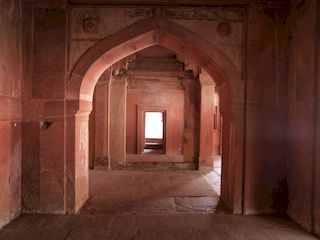
Architectural details also become more visible: bracketed supports, rhythmic colonnades, pierced openings and the play of light across red sandstone surfaces. Slow transitions allow attention to settle on features that are often overlooked in crowded conditions.
The site’s strong state of preservation is equally apparent. Continuous walls, surviving platforms and coherent alignments reveal why Fatehpur Sikri remains such a valuable historical document.
A short-lived capital with lasting significance
To discover Fatehpur Sikri through this video is to approach a city built to embody Mughal power, then largely frozen by history. Few places allow the architecture of empire to be read with such clarity. The detailed pages devoted to the Diwan-e-Khas, Jodha Bai’s Palace and the Panch Mahal offer an excellent way to continue exploring this extraordinary former capital.
Links to related pages




Audio Commentary Transcript
Despite its remarkable state of conservation, Fatehpur Sikri, a ghost town located about forty kilometers from Agra, dates no less from the 16th century.
Founded by Emperor Akbar, the city served as the capital of the Mughal Empire for only ten years.
The political necessities of the time demanded the presence of the emperor in Lahore, and this together with the poor water resources of Fatehpur Sikri ended up signing the death warrant of this ephemeral capital.

Music:
- - Lakshminarayana Subramaniam (Inde) - Le violon de l'Inde du Sud - Rga Kirvani Ragam, Ocora (558585/86)