

 Français (France)
  Nederlands (nl-NL)
 The Diwan e Khas of Fatehpur Sikri, in the state of Uttar Pradesh, is one of the most notable buildings of the former Mughal imperial capital. Its name traditionally refers to the Hall of Private Audience, where official meetings and high-level discussions were held. The structure holds strong symbolic importance within the organization of imperial authority. It reflects the political refinement and court culture developed under the Mughal rulers. Today, the Diwan e Khas remains one of the key monuments of Fatehpur Sikri and helps illustrate the functioning of royal life in imperial India.

Monument profile
Diwan e Khas
Monument category: Palace
Monument family: Palace and Annexes
Monument genre: Residential
Cultural heritage: Hindu
Geographic location: Fatehpur Sikri • Uttar Pradesh • India
Construction period: 16th century AD
This monument in Fatehpur Sikri is inscribed on the UNESCO World Heritage List since 1986 and is part of the serial property "Fatehpur Sikri".See the UNESCO monuments featured on this site
• Links to •
• Dynasties that contributed to the construction of the monument •

• List of videos about Fatehpur Sikri on this site •
Fatehpur Sikri, the ephemeral capital • Uttar Pradesh, India
• References •
UNESCO: Fatehpur Sikri
The Diwan-e-Khas of Fatehpur Sikri: Imperial Audience Hall under Akbar
Foundation within the New Mughal Capital
The Diwan-e-Khas was built within the imperial city of Fatehpur Sikri during the reign of the Mughal emperor Akbar, most likely in the 1570s, when the site served as the political center of the empire. Fatehpur Sikri was established near the residence of the Sufi saint Sheikh Salim Chishti, whose spiritual prestige was closely associated with Akbar’s court. The emperor transformed the area into a planned capital containing palaces, administrative buildings, ceremonial courts and religious monuments.
Within this ensemble, the Diwan-e-Khas occupied a distinct place among the buildings of governance. Unlike the Diwan-e-Am, intended for more public audiences, the Diwan-e-Khas was designed for restricted meetings and high-level consultations. Its construction reflects Akbar’s effort to create specialized spaces corresponding to different levels of imperial authority.
The building’s relatively compact scale suggests that its importance lay less in size than in function. It was conceived as a setting where political hierarchy and controlled access could be expressed architecturally.
Political Role and Courtly Function
The Diwan-e-Khas is generally understood as a hall for private audiences, diplomatic receptions or confidential consultations involving the emperor and selected advisers. In the Mughal administrative system, such restricted access was politically significant. Admission to the ruler’s presence reflected rank, trust and proximity to power.
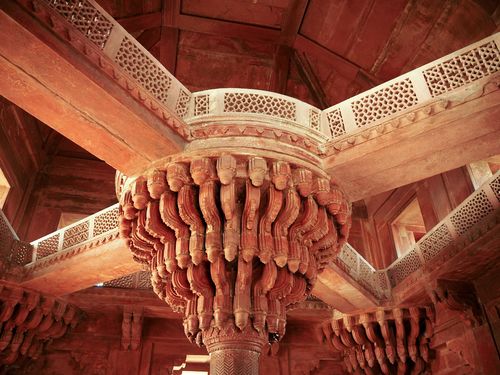
Its famous central pillar and elevated platform have often been interpreted as symbolic of Akbar’s position at the center of the court. Whether used literally in this manner or not, the interior arrangement clearly emphasized authority concentrated around a single focal point. Those admitted to the chamber would have encountered a carefully staged environment in which architecture reinforced imperial status.
Some historians have also linked the building to Akbar’s interest in debate and intellectual exchange. During this phase of his reign, the emperor encouraged discussions involving theologians, jurists and representatives of different traditions. Although the better-known religious debates were associated with other structures, the Diwan-e-Khas belongs to the broader context of a ruler experimenting with new forms of governance and court culture.
Change of Status after the Abandonment of Fatehpur Sikri
Fatehpur Sikri ceased to function as the permanent Mughal capital after only a relatively short period, as the court gradually shifted elsewhere, especially to Agra and later Lahore. The reasons were multiple and included strategic, logistical and water-supply considerations. As a result, the Diwan-e-Khas lost its original administrative role within a few decades of construction.
Once the imperial court departed, the building became part of a partially abandoned ceremonial city. Without continuous political use, many palace structures entered a long phase of decline. However, the robust stone construction of the Diwan-e-Khas allowed it to survive more successfully than lighter or more vulnerable elements of the complex.
During later centuries, travelers, officials and scholars identified the monument as one of the most unusual buildings at Fatehpur Sikri because of its singular interior composition.
Global Historical Context in the Sixteenth Century
The Diwan-e-Khas was built when the Ottoman Empire ruled much of the eastern Mediterranean and the Middle East. In Europe, the late Renaissance was reshaping royal courts, urban planning and palace architecture. In Ming China, imperial authority remained centered in Beijing under a highly organized bureaucratic state. In the Americas, Spanish colonial power was expanding after the conquest of major indigenous empires.
Rediscovery, UNESCO Recognition and Present Role
Under British rule in India, Fatehpur Sikri attracted increasing archaeological and historical attention. Surveys, documentation and conservation campaigns helped preserve the Diwan-e-Khas as one of the key monuments of the abandoned Mughal capital. Modern restoration has focused mainly on structural stabilization and protection of carved stone surfaces.
Today the building forms part of the UNESCO World Heritage property of Fatehpur Sikri, inscribed in 1986. It is visited as one of the most intellectually intriguing monuments of Akbar’s reign, because its purpose, symbolism and ceremonial use continue to be studied.
The Diwan-e-Khas now functions as a historical monument rather than a seat of power, yet it still communicates the ambitions of a ruler who used architecture to organize access, display authority and shape the culture of empire. Its preserved state allows direct insight into the experimental political environment of the Mughal court in the late sixteenth century.
Architectural Composition of the Diwan-e-Khas at Fatehpur Sikri
Setting within the Palace Complex and Overall Form
The Diwan-e-Khas stands within the royal precinct of Fatehpur Sikri, in the sector reserved for imperial administration and ceremonial authority. Its location separates it from the vast public courts and religious monuments of the city. The building belongs to a controlled environment associated with restricted audiences, political consultation and proximity to the emperor.
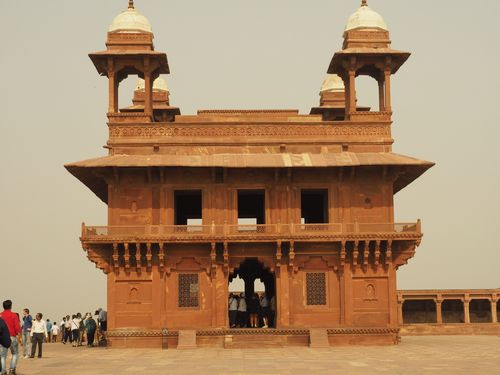
Unlike elongated halls or courtyard-centered compounds elsewhere in the complex, the Diwan-e-Khas appears as an autonomous pavilion. It is set on a slightly raised plinth that distinguishes it from surrounding circulation levels and gives the structure prominence. This platform also creates a transition between exterior ground and interior ceremonial space.
The plan is nearly square, with balanced elevations on all sides. The compact footprint contrasts with the importance of the internal design. Emphasis is concentrated on the central chamber and its vertical composition rather than on horizontal expansion.
Its exterior massing is stable and measured. The walls rise in clear geometric volumes, relieved by projecting cornices, chhajja elements and corner accents. The building’s power derives from proportion, symmetry and internal invention rather than sheer scale.
Materials, Construction Techniques and Surface Treatment
The Diwan-e-Khas is built primarily of the red sandstone that characterizes much of Fatehpur Sikri. This stone was suited to precise carving, crisp edges and large structural blocks. Its warm coloration visually unifies the building with the wider imperial city.
Wall construction relies on carefully dressed masonry laid in regular courses. Joints are closely fitted, producing smooth surfaces and a strong sense of permanence. The thickness of the walls contributes to structural stability and thermal moderation within the chamber.
The structural system is fundamentally trabeate. Horizontal stone beams, lintels and slabs span between supports rather than relying on large arches or masonry vaults. This method reflects advanced stone-working skills and careful control of weight transfer.
Exterior surfaces combine plain wall areas with concentrated carved detail. Ornament is focused on brackets, window surrounds, cornices, parapets and transitional elements. This restraint heightens the effect of sculptural zones and preserves the clarity of the overall form.
Evidence of skilled craftsmanship appears in the precision of mouldings, the sharpness of carved profiles and the complexity of bracket systems. The building required coordinated quarrying, transport and assembly by specialized workshops under imperial supervision.
Interior Spatial Organization and the Central Pillar System
The interior of the Diwan-e-Khas is among the most distinctive enclosed spaces of Mughal architecture. Rather than being divided by rows of columns or dominated by an empty hall, the chamber is organized around a monumental central pillar rising from the floor to support an elevated platform.
This pillar forms the visual and structural nucleus of the room. Its broad base rises into elaborately carved brackets that spread outward like radiating supports. Above them sits a circular or polygonal platform suspended at the center of the chamber.
From this platform, four narrow stone bridges extend diagonally toward the upper corners of the room, linking the center to surrounding galleries. These bridges create a rare suspended circulation system within a palace building. Their arrangement transforms the room into a three-dimensional composition of center, perimeter and void.
The lower level remains relatively open, allowing people to gather around the central axis. Spatial hierarchy is expressed vertically: the most privileged position occupies the raised center, while attendants or visitors remain below or at the edges. Few buildings of the period render political order so directly through geometry.
Natural light enters through openings on each façade. Illumination from several directions emphasizes the relief of the central pillar and deepens the contrast between solid stone masses and open interior volume.
Decorative Language and Formal Synthesis
The central pillar contains the richest decorative program of the building. Its shaft and capital incorporate layered brackets, carved bands, projecting members and geometric organization of exceptional intricacy. The design suggests adaptation of earlier Indian bracket traditions into a new imperial idiom.
Elsewhere in the chamber, carved details remain more controlled. Balustrades, bridge edges and gallery members are treated with enough ornament to enrich the space without competing with the central support. This hierarchy directs attention toward the architectural core.
Exterior façades display a different decorative logic. Window openings are framed by refined stone surrounds, while projecting eaves cast strong shadow lines across the sandstone walls. Corner kiosks and parapet elements lighten the roofline and break the cubic mass into a more articulated silhouette.
The building combines multiple formal influences. Bracketed supports, trabeate construction and carved stone vocabulary relate to regional Indian traditions, while symmetrical planning and controlled façades anticipate mature Mughal preferences. The Diwan-e-Khas thus functions as a synthesis rather than a repetition of one style.
Its most striking quality lies in the contrast between an orderly exterior and an unexpectedly experimental interior. The outside suggests disciplined court architecture; the inside reveals unusual spatial invention.
Preservation, Alteration and Present Legibility
The Diwan-e-Khas survives in comparatively good condition within Fatehpur Sikri. Its walls, principal openings and central pillar system remain substantially intact, allowing the original organization to be clearly understood.
Weathering has softened some carved surfaces, especially exposed edges and projecting details. Sandstone erosion, seasonal moisture and centuries of abandonment affected delicate elements more than the main structural masses. Conservation work has focused on stabilization, drainage control and maintenance of surface carving.
Modern visitors can still read the intended sequence of approach: elevated plinth, controlled entry, enclosed chamber and sudden revelation of the central pillar composition. Because the defining structural features remain visible, the building continues to communicate its original architectural purpose with unusual clarity.
Today the Diwan-e-Khas is valued less for size than for conceptual sophistication. Its compact plan, controlled geometry and singular interior make it one of the most studied palace buildings of Akbar’s reign and one of the most original spaces preserved at Fatehpur Sikri.