Français (France)
  Nederlands (nl-NL)
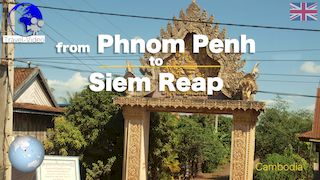
 Embark on a unique journey from Phnom Penh to Siem Reap on National Road 6. In just over 6 minutes, discover how the residents of this fertile yet flood-prone region have adapted their lives and homes. Don’t miss this deep dive into everyday Cambodian culture and its captivating landscapes.
00:00 • intro | 00:41 • on the road | 03:53 • a fish market | 04:45 • an insect market
Personal creation from visual materials collected during my travel Vietnam & Cambodia (2014)
Map of places or practices in National Highway 6 on this site
• Use the markers to explore the content •
Along the Road Between Phnom Penh and Siem Reap
A Journey Through Everyday Cambodia
The road linking Phnom Penh to Siem Reap crosses a large part of Cambodia’s central plains and offers a different perspective on the country from the better-known monuments of Angkor or the ceremonial spaces of the capital. The video presents a gradual discovery of rural landscapes, roadside activity and local markets that reveal aspects of daily life and regional traditions in contemporary Cambodia.
The images show highways bordered by small settlements, agricultural areas and improvised commercial spaces that structure much of the Cambodian countryside. Between travel sequences and stops along the route, the film highlights the importance of local trade and food markets within the country’s everyday economy.
Particular attention is given to two distinctive markets that illustrate traditional food practices deeply connected to Cambodian culture: dried fish markets and insect markets. These places reflect culinary traditions shaped by the resources of the Mekong basin, the Tonlé Sap region and the surrounding rural provinces.
Markets, Food Traditions and Rural Trade
The fish market sequences emphasize the importance of freshwater products in Cambodian cuisine. Dried, smoked and fermented fish have long played a central role in food preservation throughout Southeast Asia, especially in tropical climates where transport and storage historically presented significant challenges. The crowded stalls visible in the video illustrate both the diversity of products and the intensity of commercial activity in these local markets.
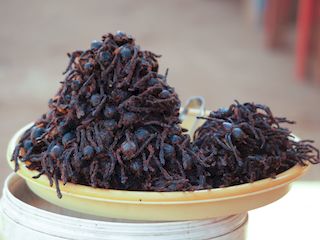
The insect market reveals another aspect of regional culinary traditions. Fried or grilled insects are consumed in several parts of Cambodia and are commonly sold along major roads used by travellers moving between large cities. While these foods often attract curiosity from foreign visitors, they belong to long-established local practices linked to available natural resources and rural food traditions.
The journey itself also becomes part of the subject. The gradual transition from Phnom Penh toward Siem Reap allows viewers to observe changing landscapes, roadside villages and agricultural environments. This progression offers a broader understanding of how transport routes connect the country’s urban centres with rural communities.
Between River Resources and Local Economies
For centuries, Cambodia’s trade networks developed around rivers, seasonal waterways and roads connecting political centres with farming regions. Local markets continue to play an essential role in the circulation of food products and in the economic life of provincial communities.
The dried fish seen in the video reflect the historical importance of the Tonlé Sap ecosystem, whose fishing resources have supported large populations for generations. Preservation techniques made it possible to transport products over long distances despite the tropical climate.
The roadside insect markets similarly illustrate the adaptation of local food traditions to both environmental conditions and modern transportation networks. Over time, some of these markets also became associated with tourism and long-distance travel routes across the country.
What the Videos on This Site Make Particularly Clear
The videos on travel-video.info rely heavily on animated photography, allowing viewers to observe details of markets, landscapes and everyday scenes with greater precision. This visual approach encourages a slower and more progressive reading of the places encountered along the route.
The gradual transitions between wide views and close-up details make the textures of dried fish, the organisation of market stalls and the atmosphere of roadside commerce particularly easy to understand. The photographs also help clarify the relationship between transportation, trade and rural life in Cambodia.
This visual construction finally contributes to recreating the atmosphere of overland travel across the Cambodian countryside, where the journey itself becomes an opportunity to observe the social and cultural realities of the country.
A Different View of Cambodia
The route between Phnom Penh and Siem Reap reveals a Cambodia that is often less visible than the country’s famous temples and royal monuments. Through markets, roadside activity and regional food traditions, the video offers a closer look at the daily exchanges and local practices that continue to shape much of Cambodian life today. The detailed pages linked to these traditions provide an opportunity to explore further the cultural and commercial heritage of rural Cambodia.
Links to related pages

Audio Commentary Transcript
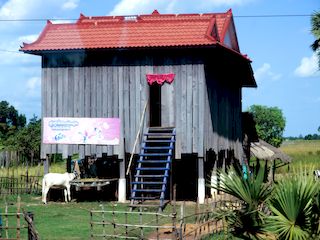
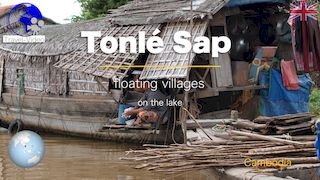
In Cambodia, and in particular in the region between the Mekong and the Tonle Sap River, houses are built on stilts. Because in these countries, they do not ignore the force of the floods caused by the monsoon rains. So, rather than having their feet in the water and spending long hours scooping and cleaning, they prefer to raise the houses.
But it's not just houses along the road. There are also temples in each village and these intriguing gates at the entrance to them.
And there are of course also animals, especially cows near the houses or on the road.
But what is perhaps most striking are these amazing landscapes, very flat with rice fields embellished with a few scattered trees.
The road also crosses some localities and in these villages there is often a market. Even if some of the local specialties are sometimes surprising.
After this fish market, a stop at the insect market is a must. These fried and spicy insects are now part of Cambodian gastronomy, since their discovery by the inhabitants under the Khmer Rouge regime, forced at the time to show imagination in order not to starve.

Music:
- - YouTube video library - Automn Day, (© Autumn Day by Kevin MacLeod is licensed under a Creative Commons Attribution 4.0 license. https://creativecommons.org/licenses/by/4.0/
- Source: http://incompetech.com/music/royalty-free/index.html?isrc=USUAN1100765
- Artist: http://incompetech.com/)
- - YouTube video library - BTS Prologue, (© BTS Prolog by Kevin MacLeod is licensed under a Creative Commons Attribution 4.0 license. https://creativecommons.org/licenses/by/4.0/
- Source: http://freepd.com/Unclassified/BTS%20Prolog
- Artist: http://incompetech.com/)
Disclaimer: Despite its appropriateness, copyright issues prevent the use of cambodian traditional music in "From Phnom Penh to SIem Reap • Cambodia", hence the use of royalty-free music. Despite our careful selection, some might regret this decision, which is necessary to avoid potential lawsuits. Although difficult, this decision is the only viable solution.