Français (France)
  Nederlands (nl-NL)
 00:00 • intro | 00:29 • South gate | 01:00 • Bayon temple | 03:05 • Baphuon temple | 04:31 • Phimeanakas temple | 05:34 • terraces of the leper king and elephants
Personal creation from visual material collected during my trip Vietnam & Cambodia (2014)
Map of places or practices in Angkor on this site
• Use the markers to explore the content •
Angkor Thom, the Great Royal City of Ancient Cambodia
A monumental capital at the heart of Angkor
Within the archaeological landscape of Angkor, Angkor Thom occupies a central place. This vast fortified city was one of the last great capitals of the Khmer empire and remains one of the most remarkable urban ensembles of medieval Asia. More than a group of temples, Angkor Thom was a true royal city organised around religious monuments, ceremonial spaces, processional roads and defensive walls.
The video explores several of its most famous sites: the South Gate, the Bayon, the Baphuon, Phimeanakas, and the terraces of the Leper King and the Elephants. It helps viewers understand that Angkor Thom is not a single monument, but a coherent urban landscape where architecture, kingship and symbolism were closely linked.
Even today, the city impresses through its scale, the richness of its sculpture and the variety of its structures. It stands as evidence of the technical and artistic achievements reached by Khmer civilisation at its height.
The major monuments visible in the video
The South Gate is one of the best-known entrances to Angkor Thom. Reached by a causeway crossing the moat, it is lined with monumental figures of gods and demons holding the naga serpent. The gate tower, crowned with large carved faces, announced from the first approach the royal authority and symbolic protection of the city.
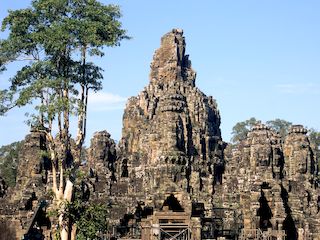
At the centre of Angkor Thom rises the Bayon, the state temple founded under Jayavarman VII. It is famous for its many towers carved with serene faces looking toward the cardinal directions. Its galleries also contain bas-reliefs depicting battles, markets, ceremonies and scenes of daily life, making the monument an exceptional historical source.
The Baphuon, an earlier temple mountain later incorporated into Angkor Thom, dominates its sector through its imposing proportions. Restored after a long and complex conservation campaign, it represents the monumental ambition of classical Khmer architecture.
Phimeanakas stood within the royal palace enclosure. Smaller in scale than some other sanctuaries, it nevertheless held an important symbolic role within the ceremonial life of the court.
The Terraces of the Elephants and the Leper King bordered the royal square. They served as platforms for receptions, public ceremonies and royal display. Their sculpted decoration makes them among the most significant civic monuments of the city.
Historical and architectural context
Angkor Thom was founded in the late twelfth century after a period of conflict by King Jayavarman VII. This ruler launched an ambitious programme of political and monumental renewal across the Khmer kingdom. The new capital was conceived as a fortified city surrounded by walls and wide moats, combining defensive purpose with cosmological meaning.
Its general plan follows a highly ordered design. Major roads connect the gates to the urban centre, where the Bayon stands. This structure reflects a royal vision in which the city symbolically mirrored the universe.
The architecture of Angkor Thom combines monuments from different periods. Some buildings predate the official foundation of the city, while others belong to the programme of Jayavarman VII. This layering gives the site particular richness and illustrates the religious evolution of the kingdom between Hindu traditions and Mahayana Buddhism.
The principal materials are sandstone for visible and sculpted elements, with laterite used for internal masses, walls and supporting structures. Decorative carving, monumental stairways, towers and galleries demonstrate a high level of technical mastery.
After the gradual decline of Angkor in the fifteenth century, the city lost its central political role. Vegetation spread across many structures before modern rediscovery and conservation campaigns began in the contemporary era.
What the videos on this site make especially clear
Videos created from carefully selected and animated photographs are particularly effective for a site as extensive as Angkor Thom. They allow separate monuments to be connected visually and help restore the logic of the ancient city.
Successive views of the South Gate clearly reveal the scale of the entrance, the width of the approach causeway and the defensive role of the moat. Viewers better understand that they are entering a planned and symbolically charged urban space.
At the Bayon, changing angles highlight the famous face towers, whose complexity is difficult to grasp from a single viewpoint. Closer images also reveal the finesse of the relief carvings and the expressive quality of the sculpture.
For the Baphuon and Phimeanakas, gradual visual progression helps explain the stacked terraces, stairways and elevated sanctuaries. These monuments are often better understood through movement of the eye than through one isolated image.
The royal terraces also benefit from this approach. A sequence of images makes their length, sculpted surfaces and role as monumental ceremonial stages easier to appreciate.
Above all, the visual narrative reminds viewers that Angkor Thom was once an organised living city rather than a scattered collection of ruins.
A capital where the memory of an empire endures
Angkor Thom remains one of the most impressive testimonies to Khmer civilisation. Through its monumental gates, central temples and ceremonial spaces, it embodies the union of urban planning, religion and royal power.
The detailed pages linked to this video offer an opportunity to explore further the monuments of this great historic city, essential for understanding the history of ancient Cambodia and the grandeur of Angkor.


Audio Commentary Transcript
Angkor Thom, which means The Great City of Angkor was founded by King Jayavarman VII after the destruction of the ancient Khmer capital by Cham armies in the 12th century. This royal city covers 9 square kilometers and is surrounded by ramparts 8 meters high. Four main gates allow entry into the city.
On the bridge crossing the moat of the South Gate, two rows of giants carry a naga, the sacred serpent of Hinduism.
Above the gate, four heads of benevolent Buddhas watch over the entrance to the city.
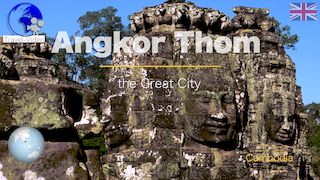
The significance of the many smiling heads that adorn the Bayon Temple is not known with certainty. Some researchers suggest the hypothesis that it is the head of Brahma, creator of the universe and others think it is Buddha. When we know the proximity of Hinduism and Buddhism in the Khmer kingdom, it may well be that both hypotheses are valid.
But beyond these giant heads, the temple of Bayon houses many bas-reliefs depicting historical scenes and everyday life.
Located within the walls of Angkor Thom, the Baphuon Temple is slightly older. Built around the middle of the 11th century, the Baphuon was a temple dedicated to Shiva. It is a temple-mountain, typical of Khmer architecture. A temple supposed to represent Mount Meru, celestial residence of the gods according to Hindu beliefs, partially taken over by Buddhists.
This temple suffered greatly from the onslaught of time, and its restoration, which lasted nearly a century, is a real feat.
A walk on the north side of the temple reveals a surprising statue of a reclining Buddha almost 75 meters long, making it one of the tallest in the world. Surprising because this temple is dedicated to Shiva. It would seem that this huge Buddha was added around the 16th century, probably to help consolidate the temple which was beginning to show worrying cracks.
King Jayavarman VII had two terraces built as an extension of the royal palace so as to be able to dominate the square of Angkor Thom which extended in front of the palace. One of them bears the name of Terrace of the Leper King and the other Terrace of the Elephants. The terrace of the Leper King owes its name to a statue which is missing several fingers. Could this be a reference to Yasovarman 1st, king of the beginning of the 9th century, who would have been affected by the terrible disease?

Music:
- - YouTube video library - Anamalie, (© Anamalie by Kevin MacLeod is licensed under a Creative Commons Attribution 4.0 license. https://creativecommons.org/licenses/by/4.0/
- Source: http://incompetech.com/music/royalty-free/index.html?isrc=USUAN1500007
- Artist: http://incompetech.com/)
- - YouTube video library - Constancy Part 1 - The Descent, (© Constancy Part 1 - The Descent by Kevin MacLeod is licensed under a Creative Commons Attribution 4.0 license. https://creativecommons.org/licenses/by/4.0/
- Source: http://incompetech.com/music/royalty-free/index.html?isrc=USUAN1100775
- Artist: http://incompetech.com/)
- - YouTube video library - Constancy Part 2 - The Descent, (© Constancy Part 2 - The Descent by Kevin MacLeod is licensed under a Creative Commons Attribution 4.0 license. https://creativecommons.org/licenses/by/4.0/
- Source: http://incompetech.com/music/royalty-free/index.html?isrc=USUAN1100774
- Artist: http://incompetech.com/)
- - YouTube video library - Constancy Part 3 - The Descent, (© Constancy Part 3 - The Descent by Kevin MacLeod is licensed under a Creative Commons Attribution 4.0 license. https://creativecommons.org/licenses/by/4.0/
- Source: http://incompetech.com/music/royalty-free/index.html?isrc=USUAN1100774
- Artist: http://incompetech.com/)
Disclaimer: Despite its appropriateness, copyright issues prevent the use of cambodian traditional music in "Angkor Thom, the Great City • Cambodia", hence the use of royalty-free music. Despite our careful selection, some might regret this decision, which is necessary to avoid potential lawsuits. Although difficult, this decision is the only viable solution.