Français (France)
  Nederlands (nl-NL)
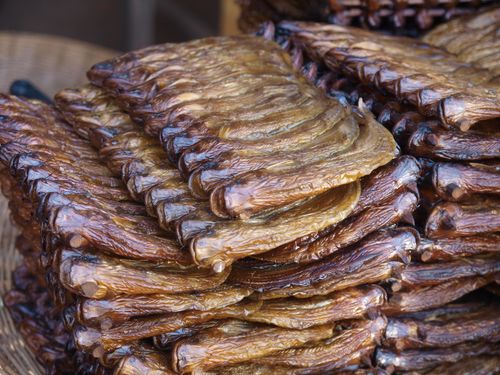
 The dried fish market in Stoung, located in Kampong Thom Province in Cambodia, represents an important commercial practice linked to the processing and preservation of aquatic resources. Based on drying techniques that extend the shelf life of fish, it supports year-round food supply for local populations. This type of market brings together fishermen, processors, and traders, organizing the distribution of products suitable for storage and transport. It reflects how rural societies adapt to environmental and economic constraints while maintaining stable food systems and facilitating exchanges between surrounding communities across the region.

Stoung • Fish market
Stoung • Fish market

Stoung • Fish market
Tradition profile
Fish market
Tradition category: Local market
Tradition family: Traditional markets and fairs
Tradition genre: Trade and Local Creativity
Geographic location: Stoung • Cambodia
• Links to •
• List of videos about National Highway 6 on this site •
From Phnom Penh to SIem Reap • Cambodia
History of the Dried Fish Market Tradition in Stoung (Cambodia)
The dried fish market tradition in Stoung, located in Kampong Thom Province in Cambodia, is rooted in long-standing interactions between rural communities and the aquatic ecosystems of the Mekong basin. Situated within a region influenced by seasonal flooding and riverine networks connected to the Tonlé Sap system, Stoung developed within an environment where fishing has historically played a central role. The transformation of fish through drying techniques allowed communities to preserve surplus resources, giving rise to organized forms of exchange that eventually structured local market traditions.
Political and Social Context of Emergence
The emergence of dried fish markets in inland Cambodia is closely linked to environmental constraints and socio-economic organization. Seasonal abundance of fish during flood periods required preservation methods to ensure food availability throughout the year. Drying, often combined with salting, provided an efficient solution that allowed fish to be stored, transported, and traded over longer distances.
In early Khmer societies, particularly during and after the Angkorian period, rural communities operated within decentralized systems where village-level organization played a key role. Local leaders, including village heads and regional authorities, facilitated the organization of communal spaces where trade could take place. These markets often developed in proximity to religious or communal gathering points, integrating economic activities into the broader social fabric.
The role of Theravāda Buddhism also contributed to this framework. Religious institutions acted as centers of community life, where social cohesion and resource sharing were encouraged. Markets held near temples or public spaces gained both legitimacy and regularity, reinforcing their function as structured economic environments.
Alliances between fishermen, processors, and traders were essential for the establishment of dried fish markets. While competition for fishing resources existed, cooperation in processing and distribution ensured the stability of trade networks. These dynamics shaped the early development of the tradition.
Major Historical Events Affecting the Tradition
The dried fish market tradition has been shaped by successive political transformations in Cambodian history. After the decline of Angkor in the fifteenth century, rural economic systems remained largely resilient. Inland regions such as Kampong Thom continued to rely on fishing and agricultural production, maintaining local trade practices.
During the nineteenth century, the establishment of French colonial rule introduced new economic structures. Colonial authorities sought to regulate fisheries and agricultural production, sometimes imposing systems of taxation or concessions. Although these policies altered access to certain resources, local markets remained essential for the distribution of preserved food products such as dried fish.
The twentieth century brought significant disruption. During periods of conflict, particularly under the Khmer Rouge regime, traditional markets were largely dismantled as part of broader efforts to reorganize society along collectivist lines. Commercial exchange was restricted, and local economic traditions were suppressed.
Following the collapse of this regime, the gradual reconstruction of Cambodian society allowed traditional practices to re-emerge. By the late twentieth century, dried fish markets had regained their importance as accessible and practical systems for distributing preserved food.
Global Context at the Time of Emergence
The practice of drying fish and organizing markets around preserved aquatic products forms part of a broader global pattern. Across different continents, societies facing similar environmental conditions developed comparable preservation techniques. In Asia, dried fish markets have long existed in coastal China, Japan, and Southeast Asia, where they play a role in both daily consumption and regional trade.
In Europe, particularly in northern regions, dried fish such as stockfish became a staple in maritime trade networks. In Africa, similar practices developed along river systems and coastal zones, where drying ensured the preservation of fish in hot climates.
The Cambodian tradition fits within this global context as a freshwater-based adaptation of a widely shared practice. Unlike maritime traditions, the Stoung market reflects the specific ecological conditions of floodplain environments, where seasonal cycles strongly influence production and trade.
Transformations of the Tradition
Over time, the dried fish market tradition in Stoung has undergone notable transformations. Improvements in transportation infrastructure during the late twentieth century enabled wider distribution of preserved fish, linking rural markets to urban centers. This development expanded economic opportunities while also altering traditional patterns of exchange.
Technological innovations influenced production methods. While sun-drying remains the dominant technique, improvements in drying structures and storage conditions have enhanced product quality and consistency. The introduction of refrigeration has also modified the relationship between fresh and preserved fish markets.
Despite these changes, traditional practices have persisted. Small-scale producers continue to rely on inherited techniques, maintaining continuity in production methods and market organization. The coexistence of traditional and modern systems illustrates the adaptability of the practice.
Contemporary Role and Cultural Significance
Today, the dried fish market in Stoung continues to serve both economic and social functions. It provides a reliable source of preserved food that can be stored and transported, ensuring food security in rural communities. At the same time, it acts as a gathering place where individuals from different villages interact regularly.
The tradition holds cultural significance as a reflection of collective knowledge and adaptation to environmental conditions. Techniques of drying and processing are transmitted across generations, reinforcing cultural continuity. The presence of dried fish in daily cuisine further underscores its importance in local identity.
The market also facilitates informal cooperation among participants. Producers, traders, and consumers exchange information about fishing conditions, seasonal variations, and market trends. These interactions contribute to the resilience of the community.
Preservation Status and Modern Challenges
Although the dried fish market tradition remains active, it faces several contemporary challenges. Urbanization and the expansion of industrial food distribution systems may reduce reliance on traditional markets. Younger generations may seek alternative livelihoods, leading to a gradual decline in traditional knowledge transmission.
Environmental changes in the Mekong basin represent another significant concern. Variations in water flow, overfishing, and ecological pressures can affect fish availability, directly impacting production.
Efforts to address these challenges include local initiatives aimed at promoting sustainable fishing practices and preserving traditional processing techniques. While the tradition has not been formally recognized at an international heritage level, it is increasingly valued as part of Cambodia’s intangible cultural heritage.
In this context, the dried fish market of Stoung stands as an example of how rural communities have historically adapted to environmental constraints through innovation and cooperation, while continuing to maintain practices that connect past and present within a shared cultural framework.
Characteristics of the Dried Fish Market Tradition in Stoung (Cambodia)
The dried fish market tradition practiced in Stoung, in Kampong Thom Province in Cambodia, represents a significant cultural and economic practice shaped by the interaction between local communities and the aquatic ecosystems of the Mekong basin. Situated within a region influenced by seasonal flooding and river systems connected to the Tonlé Sap hydrological network, Stoung developed within an environment where freshwater fisheries have long supported local livelihoods. The production and trade of dried fish formed an organized activity that combined practical food preservation, regional commerce, and community interaction.
Origin and Context of Emergence
The tradition of producing and trading dried fish in Stoung emerged in response to environmental and social conditions characteristic of central Cambodia. The annual flooding cycles of the Mekong basin bring large quantities of fish into rivers, canals, and floodplains. While this abundance provides an important food source, it also requires efficient preservation methods to prevent spoilage and ensure availability during periods of lower catches.
Drying fish, often accompanied by salting, became one of the most practical solutions for conserving surplus catches. This technique allowed fish to be stored for extended periods and transported across rural regions. In this context, specialized markets gradually developed to distribute these preserved products.
Social organization within Khmer rural society also facilitated the development of such markets. Fishing was often practiced alongside rice cultivation, creating a diversified household economy. Villages required regular places where producers and consumers could meet to exchange goods. The dried fish market therefore fulfilled an essential function by linking fishermen, processors, and traders within a structured economic framework.
Religious and communal institutions played a role as well. Public spaces near temples or village centers often served as natural gathering places where trading activities could occur regularly. These locations provided accessibility and reinforced the social legitimacy of market activities.
Constitutive Elements and Practices
The dried fish market in Stoung follows a sequence of activities that begins with fishing and processing. Fishermen capture freshwater species in rivers, canals, and flooded fields using traditional techniques such as nets, traps, and lines. Once caught, the fish are cleaned and prepared for drying, often with the addition of salt to improve preservation.
Drying typically takes place in open-air environments where fish are laid out on bamboo racks, wooden frames, or woven mats. Exposure to sunlight and airflow gradually removes moisture from the fish, producing a product that can be stored and transported more easily than fresh fish.
After drying, the fish are brought to market for sale. Vendors organize their stalls by species, size, or preparation method. The presentation of the products is an important element of the trade, as experienced buyers assess quality based on color, texture, and smell.
Participants in the market include fishermen, household processors, small-scale traders, and consumers from nearby villages. Women often play a prominent role in the processing and sale of dried fish, reflecting long-standing divisions of labor within rural communities.
Knowledge associated with the preparation and preservation of dried fish is typically transmitted within families. Skills include selecting appropriate species, determining the correct duration of drying, and storing the finished products in ways that prevent spoilage. These practices represent an important body of local expertise.
Symbolism and Cultural Meanings
Although primarily economic, the dried fish market also carries symbolic significance in Cambodian rural culture. The transformation of fresh fish into a preserved product reflects the community’s ability to manage natural abundance and prepare for seasonal variations in food availability.
The presence of dried fish on market stalls symbolizes foresight and resource management. It demonstrates how communities adapt to the rhythms of their environment by preserving resources for future use.
Sensory elements of the market also convey meaning. The golden or brown tones of dried fish, the characteristic aromas of preserved products, and the sounds of bargaining and conversation create an atmosphere that is widely recognized in Cambodian rural life. These elements contribute to a shared cultural experience that reinforces the identity of the market.
Local variations exist depending on available species and preparation techniques. Differences in drying methods, salting levels, and product presentation distinguish regional practices across Cambodia.
Evolution and External Influences
Over time, the dried fish market tradition in Stoung has adapted to broader economic and social transformations. Colonial administration introduced new economic regulations affecting fisheries and trade, although local markets largely continued to operate as practical distribution centers.
During the twentieth century, improvements in infrastructure gradually connected rural communities to wider commercial networks. Transportation developments allowed preserved fish to reach urban markets, expanding the economic scope of the trade.
Technological changes also influenced production. While sun drying remains the most common method, improved drying structures and storage techniques have enhanced the efficiency and quality of processing. Refrigeration and ice production have altered the relationship between fresh fish and preserved fish markets, although dried fish continues to serve a distinct economic and culinary role.
Comparable traditions exist in many parts of the world. Coastal regions of Southeast Asia, East Asia, and parts of Africa maintain markets dedicated to dried or salted fish products. In northern Europe, dried fish historically played a similar role in food preservation and trade. These parallels demonstrate that drying fish is a widespread cultural adaptation to environmental and economic conditions.
Social Organization and Community Impact
The dried fish market contributes significantly to the organization of social life in Stoung. It functions as a meeting place where individuals from different villages interact on a regular basis. Through daily exchanges, the market strengthens social networks and reinforces relationships among fishermen, traders, and consumers.
The market also reflects intergenerational cooperation. Older members of the community pass down fishing knowledge and processing techniques, while younger participants often adopt new trading strategies or technologies. This dynamic ensures continuity while allowing the tradition to adapt to changing conditions.
In addition to economic exchange, the market serves as an informal communication hub. News about fishing conditions, environmental changes, and local events circulates through conversations among traders and buyers. These interactions contribute to community cohesion.
Statistics, Anecdotes, and Notable Narratives
Although detailed statistical records are rarely maintained for rural markets, a dried fish market in a locality such as Stoung may involve dozens of vendors and a large number of buyers from surrounding villages. Activity tends to follow seasonal patterns, increasing during periods of abundant fishing when surplus catches are processed for drying.
Local narratives sometimes refer to particularly productive fishing seasons when large quantities of fish were transformed into dried products. Such periods are remembered as times of economic vitality and collective cooperation.
Certain families have gained recognition for their expertise in drying and processing fish. Their continued presence across generations has contributed to the preservation of traditional knowledge and market practices.
Recognition and Preservation Challenges
The dried fish market tradition remains an important element of Stoung’s local economy and cultural identity. However, it faces several contemporary challenges. Urban expansion, modernization of food supply chains, and changing consumer habits may reduce reliance on traditional markets.
Environmental pressures affecting fish populations within the Mekong basin also pose risks to the sustainability of small-scale fisheries and related processing activities. Maintaining ecological balance is therefore essential for the continuation of this tradition.
Local initiatives aimed at promoting sustainable fishing practices and preserving traditional processing knowledge contribute to safeguarding the market’s future. Although not formally recognized as an international heritage element, the dried fish market tradition represents a living cultural practice that illustrates the historical relationship between Cambodian rural communities and their aquatic environment.
 Links to the main sections of the site