

 Français (France)
  Nederlands (nl-NL)
 Shwenandaw Monastery is a Buddhist religious structure located in Mandalay, Myanmar. Built in the 19th century, it exemplifies traditional Burmese teak architecture. Originally part of the royal palace complex, it was relocated and converted into a monastery following the death of King Mindon. The site is now valued for its cultural and spiritual significance, as well as for the craftsmanship of its wood carvings, reflecting Burmese Buddhist artistic traditions. It remains an essential destination for those interested in the religious and royal history of the country.
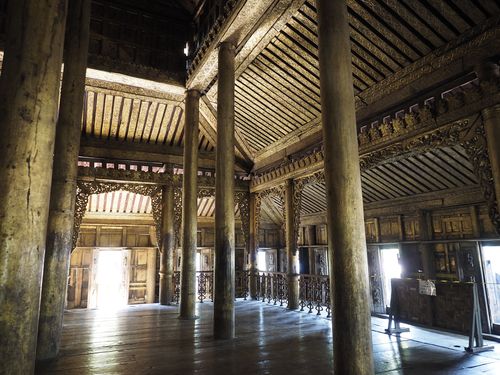
Mandalay • Shwenandaw monastery
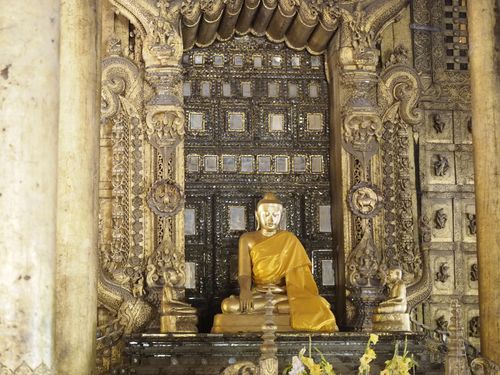
Mandalay • Shwenandaw monastery
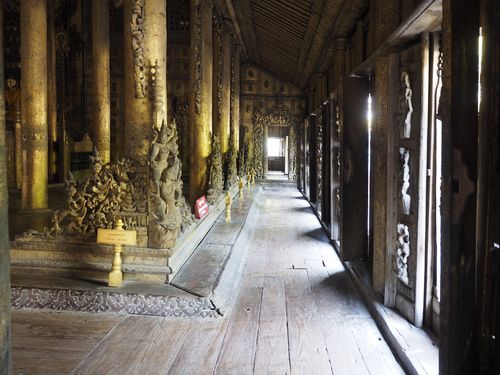
Mandalay • Shwenandaw monastery
Monument profile
Shwenandaw monastery
Monument category: Monastery
Monument family: Monastery
Monument genre: Religious
Cultural heritage: Buddhist
Geographic location: Mandalay • Myanmar
Construction period: 19th century AD
• Links to •
• List of videos about Mandalay on this site •
Mandalay, scenes from everyday life • Myanmar
Mandalay, Bagaya, wooden monastery • Myanmar
Mandalay, Su Taung Pyae Pagoda • Myanmar
Mandalay, Kuthodaw Pagoda • Myanmar
Mandalay, Mingun Pahtodawgyi Pagoda • Myanmar
Mandalay, Maha Aung Mye Bom San monastery • Myanmar
Mandalay, Mahamuni Buddha temple • Myanmar
Mandalay, Shwenandaw monastery • Myanmar
Mandalay, U Bein bridge in Amarapura • Myanmar
The Historical Significance of Shwenandaw Monastery: From Royal Pavilion to National Treasure
The Shwenandaw Monastery, located in Mandalay, Myanmar, is a rare surviving example of traditional Burmese wooden architecture. Originally constructed as part of the Mandalay Palace complex in the mid-19th century, it has since evolved into a culturally significant religious site. Its history reflects broader political, dynastic, and cultural changes in Myanmar, from the fall of the Konbaung dynasty to modern efforts at heritage preservation. As both a religious and historical monument, Shwenandaw encapsulates the political ambitions of a royal court, the trauma of colonial conquest, and contemporary challenges of conservation.
Political and Social Context of Construction
Shwenandaw Monastery began its existence not as a religious building, but as part of the royal residence of King Mindon Min, one of the last sovereigns of the Konbaung dynasty. In 1857, Mindon relocated the capital from Amarapura to Mandalay to assert his power and revive the spiritual and political authority of the Burmese monarchy. This move came after two Anglo-Burmese wars had significantly reduced the kingdom’s territory and influence.
The construction of the new royal palace was both an architectural and political statement. It was meant to reaffirm the sanctity of the monarch’s role and provide a centre for Theravāda Buddhism, the state religion. The wooden building that would become Shwenandaw served as a royal apartment, richly adorned with teak carvings and scenes from the Jataka tales. It symbolized the intersection of royal authority and Buddhist virtue, aligning the king with cosmic order and religious merit.
Mindon Min’s political vision also reflected efforts to modernize the kingdom selectively. While he embraced traditional Burmese architectural forms, he also sought to centralize administration and reform taxation. The royal palace and its dependencies, including the Shwenandaw pavilion, thus functioned as embodiments of both conservatism and calculated reform.
Historical Events and Transformations
The death of Mindon Min in 1878 was a turning point for the pavilion. His successor, King Thibaw Min, reportedly believed that the building was haunted by his father’s spirit. In response, he ordered the dismantling of the structure and its relocation just outside the palace walls, where it was reassembled and converted into a monastery. This transformation occurred in October 1878 and marked the building’s shift from secular power to religious purpose.
Soon afterward, in 1885, the Third Anglo-Burmese War led to the full annexation of Burma by the British Empire. The royal family was exiled, and the palace complex fell into decline. Much of it was destroyed during World War II. Because Shwenandaw Monastery had been moved beyond the palace enclosure, it survived these ravages almost untouched. Today, it is the only original wooden structure from the Mandalay Palace still standing.
Throughout the colonial period and into the post-independence era, the monastery continued to serve religious functions. Although its role as an active monastic residence has diminished, it has remained a symbol of resistance, memory, and cultural identity for the Burmese people.
Global Context at the Time of Construction
Shwenandaw’s construction coincided with a broader pattern of monumental architecture seen across the world in the mid-19th century. In Europe, the Second Empire style under Napoleon III transformed Paris with grand boulevards and civic buildings. In India, the British Raj initiated a wave of colonial architecture blending Indo-Islamic and European motifs. In Southeast Asia, similar architectural efforts were underway to either resist or incorporate colonial influences.
Against this backdrop, the Mandalay Palace and Shwenandaw Pavilion stand as efforts to preserve indigenous architectural forms in the face of external pressure. The use of traditional teak joinery, symbolic ornamentation, and Buddhist iconography was a deliberate act of cultural preservation, asserting continuity with the past even as geopolitical realities were rapidly changing.
Modifications and Urban Evolution
Since its conversion in 1878, Shwenandaw Monastery has undergone minimal structural changes, preserving its authenticity. However, the context around the monument has transformed significantly. Mandalay has expanded rapidly, and the once-secluded monastic zone is now surrounded by urban infrastructure, traffic, and tourism facilities.
The monastery has remained remarkably intact due to the durability of teak and traditional construction methods. Yet the surrounding environment poses new threats. Urbanization has increased pollution, while the rising number of visitors creates pressure on the wooden floors and delicate carvings. Moreover, modern buildings nearby visually disrupt the historical ambiance of the site.
While the original religious function has been largely ceremonial in recent decades, the monastery continues to be used for occasional rituals, religious festivals, and as a site of pilgrimage. Its visual and cultural presence remains strong in the collective memory of Myanmar’s Buddhist population.
Contemporary Role and Cultural Significance
Today, Shwenandaw Monastery is one of Mandalay’s most visited heritage sites and a key attraction for international tourists. It functions as a bridge between the historical monarchy and contemporary Buddhist identity. Schoolchildren, monks, and travelers alike visit the site to admire its artistry and reflect on its symbolism.
As a remnant of the last Burmese dynasty, the monastery holds a revered place in national consciousness. It represents both a golden age of craftsmanship and the spiritual dignity of a people whose sovereignty was eroded by colonialism. It also plays a role in cultural diplomacy, featuring in exhibitions and academic studies as an exemplar of Southeast Asian wooden architecture.
Conservation Challenges and Protection Measures
Shwenandaw Monastery faces ongoing conservation challenges. The structure is vulnerable to moisture, termite infestation, and seasonal weather fluctuations. Despite teak’s natural resistance, centuries of exposure have worn down parts of the building. The intricate carvings, in particular, require constant monitoring and skilled restoration using traditional techniques.
The Department of Archaeology and National Museum of Myanmar, with support from international partners, has implemented several restoration campaigns. These focus on structural reinforcement, treatment of wood against decay, and controlled visitor access. Documentation and digital surveys are now part of preservation efforts to ensure accurate future reconstructions if necessary.
The monastery is included on Myanmar’s tentative list for UNESCO World Heritage status. This recognition underscores its global significance but also introduces new responsibilities, including sustainable tourism, community engagement, and compliance with international conservation standards.
In sum, Shwenandaw Monastery is more than a relic of a vanished monarchy. It is a living document of Burmese resilience, artistry, and spiritual tradition. From its origins as a royal pavilion to its present role as a national monument, it continues to reflect the evolving identity of Myanmar, standing in silent testimony to the country’s rich and turbulent history.
The Architecture of Shwenandaw Monastery: An Exemplar of Burmese Teak Design
The Shwenandaw Monastery, located in Mandalay, Myanmar, is one of the finest surviving examples of traditional Burmese teak architecture. Originally a royal pavilion within the Mandalay Palace complex before being converted into a Buddhist monastery in 1878, the structure embodies centuries of accumulated craftsmanship, religious symbolism, and adaptive engineering. Its construction, materials, and ornamental richness make it a unique monument that bridges royal grandeur and religious devotion. This article presents a comprehensive architectural analysis of the monastery, emphasizing its design innovations, construction techniques, spatial organization, artistic influences, and the ongoing challenges of its conservation.
Architectural and Technological Innovations of the Era
Constructed in the mid-19th century during the Konbaung dynasty, Shwenandaw Monastery reflects the culmination of traditional Burmese wooden architecture. At that time, Mandalay was newly established as the royal capital by King Mindon Min, and major constructions like the palace and its associated buildings were opportunities to reaffirm indigenous forms in the face of external political pressures. The architecture of Shwenandaw captures a sophisticated understanding of materials, climate, and cultural meaning.
One of the most significant technological aspects of the building is its joinery. The entire structure was assembled without the use of nails or metal fasteners, relying instead on a complex system of wooden joints, including mortise and tenon, dovetailing, and wooden pegs. This technique not only enhanced the building's resilience to frequent seismic activity in the region but also allowed flexibility and ease of dismantling and reassembly—critical when the pavilion was relocated and transformed into a monastery in 1878.
Ventilation and thermal comfort were ingeniously managed through spatial design. The building is elevated on teak posts, allowing air to circulate underneath and preventing ground moisture from damaging the structure. Large, ornately carved windows and high ceilings promote airflow and maintain a cooler interior temperature, essential for both religious practice and structural longevity in Myanmar’s humid climate. The tiered roof system, composed of multiple overlapping gables, facilitates the deflection of heat and rain, demonstrating a mature understanding of passive environmental control.
Materials and Construction Methods
The exclusive use of teak wood is a defining characteristic of Shwenandaw Monastery. Teak was chosen for its high durability, resistance to termites and moisture, and aesthetic appeal. The wood’s golden hue and fine grain contribute to the visual elegance of the monastery, especially when enhanced with traditional lacquering and gold leaf applications.
Every structural and decorative element of the building is carved from teak, from the load-bearing columns and beams to the intricate reliefs covering walls, doors, and ceilings. The outer surfaces were once fully gilded, earning the building the name "Golden Palace Monastery." Although much of the gilding has faded, traces remain, hinting at its former splendor.
The construction followed principles codified by generations of artisans serving the Konbaung court. Roof elements were composed of layered components with carved ridge caps and finials representing mythical beings. Carpenters and sculptors employed chisels, mallets, and knives passed down through family lineages, embedding generational knowledge directly into the fabric of the building. The result is a structure that is not only architecturally sound but also a repository of intangible cultural heritage.
Artistic and Architectural Influences
Shwenandaw Monastery represents a synthesis of regional traditions and broader artistic currents. The layout and form are quintessentially Burmese, particularly in their hierarchical spatial arrangement and roof design. Yet, the influence of neighboring cultures is subtly present. Elements of Thai and Lao ornamentation can be seen in the fluid curves of floral motifs and guardian figures, while certain stylistic parallels with South Indian temple carvings reflect long-standing religious and artistic exchanges in the region.
Despite these external influences, the monastery remains rooted in the Burmese Buddhist worldview. Its decoration is dominated by scenes from the Jataka tales—stories of the Buddha’s previous lives—rendered in finely detailed low-relief panels. These carvings served both didactic and meditative functions, guiding monks and lay visitors in their spiritual reflection.
The motif vocabulary is deeply symbolic. Nats (spirits), nagas (serpents), kinnari (mythical birds), and chinthe (guardian lions) populate the surfaces, interwoven with vegetal scrolls and lotus patterns. Each element was placed with intentionality, forming a visual narrative that unfolds throughout the building. This iconographic program elevates the architecture beyond mere functionality, embedding it with cosmological and moral meaning.
Spatial Organization and Design Features
The spatial layout of Shwenandaw Monastery follows traditional Burmese monastic principles but retains some aspects of its original function as a royal residence. The building is organized around a central prayer hall (called the thein), which is accessed through elaborately carved staircases and corridors. The main hall is rectangular and supported by multiple teak columns, which frame the open floor plan and create a sense of solemn procession toward the main altar.
The roofs are arranged in a tiered configuration, with each successive level slightly smaller than the one below it. This not only creates a visual crescendo but also reflects Buddhist cosmology, with the structure ascending toward the heavens. Each tier is capped with pyatthat—a traditional Burmese spire of odd-numbered layers (usually five or seven), indicating the sanctity of the space.
There are no domes or minarets, as found in Islamic or European architecture; instead, the emphasis is placed on horizontal articulation and vertical layering. Decorative balustrades and railings enclose the structure, offering a visual boundary between the sacred interior and the surrounding world. Frescoes are absent, as the medium of carved wood is preferred for storytelling and ornamentation in Burmese religious architecture.
Dimensions, Statistics, and Anecdotes
Shwenandaw Monastery measures approximately 60 meters in length and 40 meters in width, covering a substantial footprint for a wooden religious structure. Over 150 carved panels are distributed across its surfaces, each portraying a unique episode from Buddhist scripture or royal myth.
One of the most famous anecdotes associated with the building relates to its relocation. After King Mindon Min's death in 1878, his son Thibaw Min, the last Burmese king, believed the original royal apartment was haunted by his father’s spirit. Seeking to honor his father while distancing himself from perceived supernatural disturbances, Thibaw ordered the building to be dismantled and reconstructed as a monastery. This act preserved the building when much of the palace was later destroyed during the British annexation and subsequent warfare.
International Recognition and Conservation Challenges
The architecture of Shwenandaw Monastery has earned it a place of prominence in Myanmar’s heritage discourse. As the only remaining original wooden structure from the Mandalay Palace complex, it has been proposed for UNESCO World Heritage status. Its design not only represents an architectural style but also encapsulates spiritual beliefs, royal history, and artistic excellence.
However, preserving a wooden building of this scale poses numerous challenges. Exposure to humidity, insect infestation, air pollution, and human traffic endanger its integrity. Urban development in Mandalay has brought increased tourism and infrastructure pressures, altering the monastery’s immediate environment and visual context.
Conservation efforts, led by Myanmar’s Department of Archaeology and supported by international heritage organizations, focus on stabilizing structural elements, restoring damaged carvings, and training local artisans in traditional techniques. These efforts aim to maintain the monastery’s authenticity while accommodating its growing role as a national symbol and educational site.
In conclusion, the architecture of Shwenandaw Monastery embodies the peak of Burmese wooden craftsmanship, seamlessly integrating engineering, artistry, and spirituality. Its enduring structure and intricate ornamentation continue to inspire admiration, while its architectural logic offers lessons in sustainability, cultural continuity, and aesthetic depth. As both an architectural masterpiece and a symbol of Burmese identity, it stands as a guardian of memory and a beacon for future generations.