

 Français (France)
  Nederlands (nl-NL)
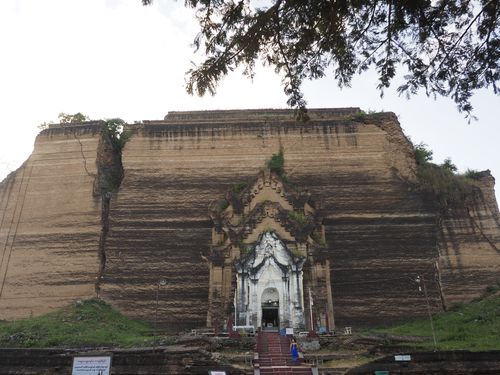
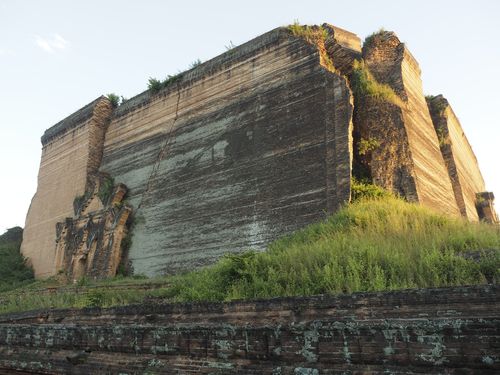
 The Mingun Pahtodawgyi Pagoda in Mandalay, Myanmar, is a remarkable unfinished structure. Commissioned by King Bodawpaya in the late eighteenth century, it was intended to become one of the largest religious monuments in the world, yet construction stopped before reaching completion, leaving a massive brick base marked by earthquake cracks. Today, the site attracts visitors and worshippers who are drawn to its imposing presence and its association with royal ambition. The monument illustrates how grand projects can exceed material capability, and it remains a unique example of spiritual heritage preserved in an incomplete state while continuing to play a role in cultural identity.
Monument profile
Mingun Pahtodawgyi Pagoda
Monument category: Pagoda
Monument family: Pagoda or stupa
Monument genre: Religious
Cultural heritage: Buddhist
Geographic location: Mandalay • Myanmar
Construction period: 18th century AD
• Links to •
• List of videos about Mandalay on this site •
Mandalay, scenes from everyday life • Myanmar
Mandalay, Bagaya, wooden monastery • Myanmar
Mandalay, Su Taung Pyae Pagoda • Myanmar
Mandalay, Kuthodaw Pagoda • Myanmar
Mandalay, Mingun Pahtodawgyi Pagoda • Myanmar
Mandalay, Maha Aung Mye Bom San monastery • Myanmar
Mandalay, Mahamuni Buddha temple • Myanmar
Mandalay, Shwenandaw monastery • Myanmar
Mandalay, U Bein bridge in Amarapura • Myanmar
History of the Mingun Pahtodawgyi Pagoda
The Mingun Pahtodawgyi, standing on the western bank of the Irrawaddy opposite Mandalay, is one of the most ambitious and enigmatic religious structures in Myanmar. Conceived in the late eighteenth century under King Bodawpaya of the Konbaung dynasty, it embodies royal ideology, political anxiety and spiritual ambition at a moment when the Burmese state was asserting its regional influence while confronting profound structural constraints. Its unfinished condition, shaped by human decisions and natural catastrophe, has become central to its identity and historical significance.
Political context and royal ambitions
Construction began in 1790, shortly after Bodawpaya consolidated control over territories that now constitute northern Myanmar and the Arakan region. The monarch sought to strengthen dynastic legitimacy by financing monumental religious works. The Mingun Pahtodawgyi was intended to be the largest stupa ever constructed, signalling devotion to Buddhism, asserting royal authority and rivaling monumental projects of neighbouring polities. Building at Mingun allowed Bodawpaya to extend the sacred landscape of the capital while demonstrating spiritual protection over the riverine corridors of trade and movement.
The scale of the project reflected more than piety. It was tied to a competitive environment among Southeast Asian states, notably Burma and Siam, where ritual architecture enhanced claims of kingship. Reports suggest that Bodawpaya used conscripted labour and levied taxes to support the works, generating widespread resentment. Oral traditions later interpreted the monument as both a testament to ambition and a burden imposed on the population.
Major historical events affecting the site
Despite initial momentum, progress was slow due to technical limitations, logistical challenges and the enormous volume of material required. When Bodawpaya died in 1819, the project lost its chief sponsor. His successor did not resume construction, possibly influenced by a popular prophecy that completing the pagoda would bring ruin to the kingdom or death to its ruler. What stands today is essentially the massive core of a planned stupa, frozen at an early stage.
Over the nineteenth century, the region underwent major political upheavals. Subsequent Anglo–Burmese wars destabilised the monarchy, culminating in full British annexation in 1885. The Mingun Pahtodawgyi, already incomplete, became a symbol of dynastic decline. Earthquakes in 1839, 1938 and notably 1975 left deep fractures in the structure, transforming its appearance into a monumental, damaged stone mass. Rather than a triumphal shrine, it became an emblem of thwarted ambition and the vulnerability of royal projects to material and historical forces.
Global architectural currents and comparative context
The Mingun Pahtodawgyi emerged in a period when rulers across Asia were attempting to manifest power through monumental construction. Qing China maintained vast temple complexes, Siam built symbolic temples, and South Asian rulers commissioned grand mosques and palaces. The idea that architecture could project permanence and legitimacy was widely shared. However, few projects equalled Mingun in its combination of vision and abandonment. Its unfinished state sets it apart from contemporaneous works, illustrating how monumental planning could exceed state capacity or succumb to contingency.
Transformation and adaptive uses
The monument did not disappear from collective life after abandonment. During the colonial period, it was visited by administrators and travellers, becoming a subject of curiosity and a picturesque ruin. Its scale, fissures and exposed brick invoked exoticism in European travel writing. Local monks maintained minimal ritual functions at the site, though it never became a major centre of worship like Mandalay’s functioning pagodas.
Following independence in 1948, Mingun was integrated into national narratives of heritage. State and religious institutions organised small-scale repairs, mainly stabilising edges and creating access paths. The river ferry from Mandalay made the site a popular excursion, embedding it in tourist itineraries while preserving its aura of incompletion.
Perception, identity and cultural role today
In contemporary Myanmar, the Mingun Pahtodawgyi carries multiple meanings. For many Burmese, it represents both a cautionary tale of excess and a testament to royal aspiration. Its cracked surfaces and truncated mass are interpreted as a visible reminder of impermanence, resonating with Buddhist reflections on transience. Local communities regard it as a cultural landmark rather than an active pilgrimage centre. Rituals occur here, but they are modest and overshadowed by the nearby functioning shrines such as the Mingun Bell and Hsinbyume Pagoda.
Nationally, the monument has acquired symbolic relevance as an architectural relic reflecting the highs and lows of Burmese statehood. It appears in heritage literature, educational material and tourism promotion, though it does not command the same ritual centrality as other stupas. Its unfinished condition fascinates academics, artists and photographers, who view it as an artefact that exposes the making of royal architecture.
Condition, threats and conservation concerns
The Mingun Pahtodawgyi faces persistent structural fragility. Constructed largely of brick with lime-based mortar, it is vulnerable to water infiltration, biological growth, erosion and seismic activity. The cracks caused by earthquakes have widened, and unchecked vegetation exacerbates the damage. Stabilisation efforts are infrequent and constrained by limited financial and technical resources.
Tourism adds both opportunity and strain. Visitor traffic erodes pathways and encourages casual climbing on sensitive surfaces. Urban expansion along the Irrawaddy edge, alongside pollution and vibration from river transport, further pressures the monument. Conservation requires balancing public access with protective measures—a challenge in a context where institutional frameworks for heritage management vary in consistency.
Although the site features on national lists of protected monuments and has appeared on tentative heritage inventories, it has not been accorded full international designation. This partly reflects the difficulty of restoring the structure without altering the very incompleteness that makes it significant. Any intervention must respect its material vulnerability while acknowledging that its historical message lies in its fractured state.
Conclusion
The Mingun Pahtodawgyi stands as a compelling chapter in Myanmar’s architectural and political history. Conceived to immortalise Buddhist devotion and royal legitimacy, it became instead a monumental fragment whose power derives from what it is not—an unfinished stupa that reveals the limits of kingship. It encapsulates transitions from monarchy to colonial subjugation and then to independent statehood, without ever fulfilling its intended religious role. Today, it is preserved not through grandeur but through endurance: a ruined yet eloquent record of ambition, disruption and resilience. As such, the Mingun Pahtodawgyi remains a cultural marker, a site of contemplation and a rare architectural lesson in how incompletion itself can shape heritage identity.
Architecture of the Mingun Pahtodawgyi Pagoda
The Mingun Pahtodawgyi, on the banks of the Irrawaddy opposite Mandalay, is one of Southeast Asia’s most striking architectural enigmas. Although unfinished, it stands as a monumental testimony to late eighteenth-century Burmese building practices, royal ambition and the limits of pre-industrial engineering. Its current mass—vast, fractured and almost geometric—exposes the construction logic of a gigantic stupa and offers a rare opportunity to study a sacred structure frozen at the stage of raw conception.
Overall design and spatial organisation
The project was conceived as a colossal solid brick stupa rising above successive terraces. Unlike temples with interior galleries or shrines, Mingun Pahtodawgyi was planned as a reliquary mound with very limited internal space. The existing structure is essentially the truncated core of what was intended to be one of the highest pagodas in the world. Its square base, slightly raised above the river plain, was aligned to form a visual anchor within the royal landscape. Grand stairways and recessed portals punctuate the façades, creating ceremonial axes even though the building never functioned fully as a ritual centre.
The formal composition emphasises mass and readability. The terraces form horizontal registers, while the portals introduce faint vertical rhythms. This abstraction distinguishes the monument from more elaborately sculpted stupas of Bagan or Mandalay, where ornamentation diffuses visual weight. Mingun, instead, asserts an overwhelming presence through sheer volume.
Materials and construction methods
The dominant material is fired brick, manufactured locally in large quantities. Bricklaying followed established Burmese techniques: lengthy drying, precise bedding and mortar composed of lime and clay. The initial plan envisaged a continuous stucco jacket, coloured and possibly gilded, unifying the surfaces and protecting them from rain. Only traces of this finish survive; the exposed brick seen today results from weathering and halted construction rather than from deliberate design.
Using brick at such scale represented an architectural challenge. Burmese builders were accustomed to massive stupas, but the Pahtodawgyi pushed structural thickness and load distribution into new realms. Walls were engineered to be exceptionally thick; the intended upper levels would have incrementally reduced the diameter to control gravitational pressure. The interior was largely solid, an approach that improved stability but rendered any future cracking more catastrophic. The persistence of the truncated core demonstrates the endurance of brick structures when mass is used as the primary stabiliser.
Structural intentions and engineering limits
Architecturally, the project embodied an effort to amplify traditional stupas through repetition and enlargement. Terraces served not only symbolic purposes but also structural ones: they acted as setbacks, distributing downward forces. The absence of wide interior cavities reduced the risk of collapse under seismic stress, at least in theory. In practice, earthquakes revealed weaknesses at mortar joints and layering phases. The deep vertical fissures visible today trace fault lines through the enormous volume and illustrate how the ambition to scale up familiar techniques reached their functional boundary.
The Pahtodawgyi also demonstrates pre-industrial efficiency in material handling and labour organisation. Transporting, firing and laying millions of bricks required standardisation and a large workforce. The use of moulded components for cornices and stair edges indicates an early, if rudimentary, form of modular production.
Stylistic vocabulary and regional influences
Although monumental, the design adheres to Burmese architectural tradition. The square plan, pyramidal ascension and were intended to culminate in a gilded conical finial, the hti, typical of Burmese pagodas. Artistic influences from Mon traditions, found across Lower Myanmar, are evident in the framing forms of the portals, with tiers of mouldings and lightly pointed arches. The project inscribes itself within the royal architectural lineage of Ava and Amarapura, but unique in its abstraction: its unfinished state eliminates the decorative layer that would typically communicate cosmological symbolism.
Fragments of surviving stucco suggest that the façades would have carried designs such as flame motifs, lotus petals and possibly guardian figures, common across Konbaung-era religious architecture. In its current state, however, Mingun Pahtodawgyi appears almost minimalist, a stripped-down shrine where geometry replaces ornament.
Design elements and urban positioning
Spatially, the pagoda dominates its village context and was meant to engage in dialogue with the river. Its frontal stairway was designed to receive processions from the landing stages, linking the monument to Mandalay and the former royal capitals. The scale of the base was calculated to withstand monsoon waters and seasonal flooding, indicating an awareness of environmental context.
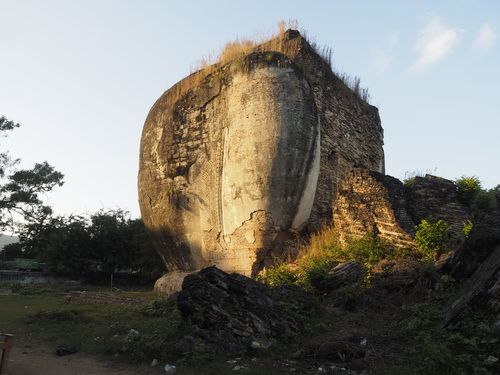
Architectural features of note include the monumental southern entrance with its ornate plaster threshold, now partially eroded, and the remnants of giant lion guardians situated near the riverbank. These guardian figures, severely damaged by earthquakes, originally framed the visual approach from the water, underscoring the intention to treat Mingun as a ceremonial gateway rather than an isolated shrine.
Dimensions, legends and notable facts
Had it been completed, estimates suggest the stupa might have exceeded 150 metres in height, surpassing major contemporaneous pagodas. Even reduced to one-third of its intended size, it remains one of the largest brick structures in Asia. Local oral tradition claims that Bodawpaya’s death halted construction, reinforced by a prophecy that finishing the work would bring collapse to his reign. Whether apocryphal or political, the story reflects a tension between royal ambition and spiritual caution.
The apparent simplicity of Mingun Pahtodawgyi masks a sophisticated conceptual apparatus: scale serves as symbolism. Where other stupas achieve transcendence through gold and ornament, Mingun sought it through magnitude.
Architectural value and conservation challenges
Today, the architectural significance of Mingun Pahtodawgyi lies not in its completeness but in its arrested process. It exposes construction layers rarely visible in finished stupas, offering insights into brick coursing, volumetric strategies and the interface between stucco and structural substrate. Its ruin-like appearance has aesthetic value, influencing how the monument is perceived—more as a relic of ambition than an object of ritual perfection.
Conservation issues derive from the same factors that once promised endurance. Brick and lime mortar are highly susceptible to seismic forces; repeated earthquakes have destabilised portions of the façades. Vegetation infiltrates cracks, widening structural gaps. Tourism creates erosion along stairways and entrances, while informal facilities near the site compete visually with the monument.
Preservation efforts are complicated by philosophical questions: stabilising the monument risks altering the fractured identity that has become integral to its meaning. As a national heritage site, it receives periodic maintenance, but large-scale consolidation remains limited by resources and the technical difficulty of reinforcing a solid mass without invasive intervention.
Conclusion
The architecture of the Mingun Pahtodawgyi renders visible the tension between aspiration and limitation. It represents an unprecedented experiment in scale within Burmese architectural tradition, using brick to model an idealised sacred mountain intended to dominate the landscape. Its unfinished form, rather than diminishing its significance, deepens it: the monument has become both a document of architectural ambition and a testimonial to fragility. Through its mass, fissures and setting, Mingun Pahtodawgyi continues to shape Myanmar’s heritage discourse, reminding observers that monumental architecture transmits meaning not only when complete but also when broken, interrupted and transformed by time.