Français (France)
  Nederlands (nl-NL)
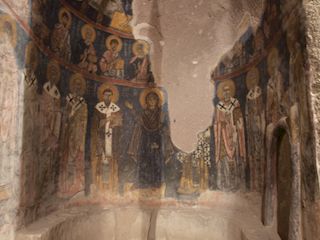
 00:00 • intro | 00:30 • a monastery dug into the cliff | 01:39 • frescoes inside the monastery
Personal creation from visual material collected during my trip Turkey • Cappadocia (2014)
Map of places or practices featured in the video
• Use the markers to explore the content •
Gümüşler Monastery, a Byzantine Heritage Site in Cappadocia
Location and Geographic Setting
The Gümüşler Monastery is located in Niğde Province, in the southern part of the historical region of Cappadocia in central Anatolia, Turkey. It lies a few kilometers north of the modern city of Niğde, in a landscape shaped by ancient volcanic activity. The region’s soft tuff rock has long allowed the creation of underground dwellings, sanctuaries, and entire monastic complexes. Cappadocia itself occupies a strategic crossroads, historically linked to trade and cultural exchange, while also providing refuge for religious communities seeking security during times of political instability.
Historical Background
The origins of Gümüşler Monastery go back to the Byzantine period, when Cappadocia was an important frontier region of the Eastern Roman Empire. As early as late antiquity, Christian monks settled in the area to pursue a secluded life of prayer and study. The monastery is believed to have developed during the early Middle Ages and reached its height between the 10th and 11th centuries, a time when the Byzantine Empire consolidated its authority over central Anatolia.
This era marked a relative stability for Eastern Christianity, supported by imperial administration and local aristocratic families who patronized monastic life. Monasteries such as Gümüşler became centers of faith and learning, playing a crucial role in preserving Christian traditions in a region that was both remote and exposed to shifting political influences.
Religious and Cultural Role
The Gümüşler Monastery functioned primarily as a communal residence for monks dedicated to prayer, the study of scripture, and the transmission of liturgical traditions. Like other Cappadocian monastic sites, it was part of a wider network that sustained Christian identity in Anatolia. These monastic communities safeguarded manuscripts, taught theology, and often served as places of refuge for local populations during periods of unrest.
Through such institutions, Cappadocia became a spiritual stronghold of the Byzantine world. Monasteries not only preserved faith and learning but also symbolized resilience in the face of political changes. Gümüşler reflects this capacity for adaptation, maintaining its religious function even as the Byzantine Empire faced new challenges.
Gümüşler in the History of Cappadocia
Cappadocia is famous for its rock-hewn churches, monasteries, and hidden settlements. Within this broader heritage, Gümüşler stands out for its size and the long span of religious activity it represents. It illustrates the flourishing of monasticism in the region during the Byzantine era and its persistence despite later transformations brought by the arrival of the Seljuk Turks in the 11th century. The site embodies both the spiritual aspirations of its monastic founders and the changing history of Anatolia as a frontier between empires and faiths.
Legacy and Contemporary Significance
Today, Gümüşler Monastery is recognized as an important cultural and historical monument that sheds light on the Christian past of Cappadocia and the diversity of Anatolia’s religious heritage. It remains a valuable witness to the role of monasteries in preserving Byzantine culture and faith. Understanding this historical and geographical context provides essential background for appreciating the significance of Gümüşler before exploring its architectural details and symbolic meanings in dedicated sections.
Videos
• Turkey •








Spoken comments in the film:
The troglodyte monastery of Gumusler was dug in the tuff towards the beginnings of the Christian era. This remarkable complex includes, among other things, a Byzantine church which has frescoes dating for the oldest from the 6th century and which are among the best preserved in Cappadocia. This site was not rediscovered until the middle of the 20th century.
One of the originalities of the monastery of Gumusler is this fresco representing hunting scenes. It has no equal in Cappadocia. The poor state of preservation of this painting seems to indicate that it does not date from the same period. Specialists believe that it dates from a more recent era.

Music:
- - YouTube video library - A Fallen Cowboy
- - YouTube video library - Argonne - Zachariah Hickman
Disclaimer: Despite its appropriateness, copyright issues prevent the use of turkish traditional music in "Gümüsler monastery • Nigde, Turkey", hence the use of royalty-free music. Despite our careful selection, some might regret this decision, which is necessary to avoid potential lawsuits. Although difficult, this decision is the only viable solution.