Français (France)
  Nederlands (nl-NL)
 00:00 • intro | 00:54 • Palace of Charles V, Museum of Fine Arts | 01:40 • Nasrid Palace | 07:31 • Generalife gardens
Personal creation from visual material collected during my trip Spain: Semana Santa in Andalusia (2022)
Map of places or practices in Granada on this site
• Use the markers to explore the content •
Granada and the Alhambra, Andalusian Memory of Palaces and Gardens
A major palace complex above Granada
Alhambra is one of the most celebrated monuments in Europe and one of the outstanding legacies of medieval Spain. Rising above Granada on the Sabika hill, this vast ensemble combines fortress walls, royal palaces, gardens, ceremonial courts and residential quarters. The video offers an introduction to a site where Islamic Andalusian art, later Christian interventions and carefully designed landscapes meet within a single historic setting.
The Alhambra is not simply a palace, but a planned palatine city created for government and dynastic representation. Within its walls, viewers encounter defensive towers, elegant courtyards, water channels, audience halls and elevated viewpoints overlooking Granada and the surrounding plain. Together with the nearby Generalife and later Renaissance additions, the complex preserves several centuries of political and artistic history in a remarkably coherent form.
Inscribed on the UNESCO World Heritage List in 1984, the Alhambra remains one of Spain’s most important cultural landmarks and one of the clearest surviving expressions of courtly life in late Islamic Iberia.
The principal monuments and spaces seen in the video
The Palace of Charles V introduces the Christian phase of the site’s history. Built in the sixteenth century within the Alhambra enclosure, it contrasts sharply with the Nasrid palaces around it. Its geometric layout, monumental façades and circular inner courtyard reflect Renaissance ideals of proportion and imperial authority. Today it houses, among other institutions, the Fine Arts Museum.
The Nasrid Palaces form the artistic and historical core of the visit. Constructed for the rulers of the Nasrid dynasty, these spaces were designed for government, ceremony and residence. The succession of patios, reception halls and private apartments reveals a refined understanding of movement, privacy and symbolic display. Decorative plasterwork, carved wood, inscriptions and water basins transform architecture into an environment of controlled elegance.
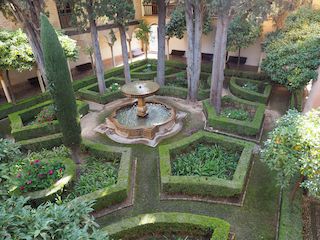
The Generalife gardens complete the ensemble. Originally conceived as a leisure residence and seasonal retreat for the rulers of Granada, the Generalife combines terraces, orchards, pavilions and long water channels. It represents a different but complementary aspect of royal life: not defence or ceremony, but cultivated repose and contact with nature.
Historical, architectural and cultural context
The Alhambra reached its principal phase of expansion during the thirteenth and fourteenth centuries under the Nasrid dynasty, the last major Muslim ruling house in the Iberian Peninsula. Granada became the capital of a resilient kingdom whose rulers invested heavily in architecture as a statement of legitimacy and prestige. The fortified hill was transformed into the administrative and ceremonial heart of the state.
Nasrid architecture relied on careful spatial sequencing rather than sheer mass. Visitors moved through gates, courtyards and halls arranged to control perspective and experience. Water played a central role, cooling spaces, reflecting façades and adding sound and movement. Geometry, poetry and vegetal ornament reinforced the image of cultivated order.
In 1492, Granada was conquered by the Catholic Monarchs. The Alhambra did not disappear, but entered a new historical phase. Some spaces were adapted for Christian use, while others were preserved, altered or neglected according to changing priorities. The later construction of the Palace of Charles V clearly marked the integration of the site into the Spanish monarchy of the early modern era.
During subsequent centuries, periods of decay alternated with renewed appreciation. Modern restoration campaigns and conservation policies have been essential in stabilising structures, preserving decoration and managing large visitor numbers.
What the videos on this site make especially clear
The videos of travel-video.info, often created from carefully selected photographs animated with smooth transitions, are particularly effective for a site as layered as the Alhambra. They allow viewers to move gradually from the overall hilltop complex to the detail of a fountain, arch or carved wall without losing a sense of the whole.
This visual method makes the relationship between the different sectors easier to understand: defensive walls, Nasrid palaces, Renaissance additions and the Generalife gardens. Progressive framing helps reveal how courts connect to halls, how gardens extend palace life, and how the monument was integrated into the topography above Granada.
Close views are equally valuable for appreciating details often missed in a rapid visit. Stucco carving, Arabic inscriptions, timber ceilings, reflections in water basins and subtle proportional effects become more legible when the image pauses long enough for observation.
The same approach also clarifies the dialogue between architecture and landscape. Terraces, towers and windows were positioned to command views over the city and surrounding countryside. The Alhambra was designed not only as a residence, but as an elevated seat of power visibly linked to its territory.
A summit of Andalusian heritage
Watching this video means discovering a place where Islamic court culture, Christian transformation and landscape design remain closely intertwined. Few monuments unite architecture, history and setting with such coherence. To continue the visit, the detailed pages dedicated to the Alhambra, the Generalife gardens and the Palace of Charles V offer a deeper understanding of each part of this exceptional ensemble.
Links to related pages




Audio Commentary Transcript
Strategically built on the Sabika hill in Andalusia, the Alhambra was the fortified palace of the sultans of Granada, capital of what is usually called the "Kingdom of Granada". This state was ruled by the Nasrid sultans, and was the last Muslim enclave in Spain, before the total reconquest of the peninsula by the Catholic kings, Ferdinand and Isabella in 1492. The capture of Granada ended more than 700 years of Muslim domination in Andalusia. These events also marked an important stage in the infamous period of the Inquisition which had just been decreed by the Catholic kings and which would continue for more than 3 centuries.
At the entrance to the Alhambra complex, a name coming from the Arabic Qalát al-Hamra which means 'the red fortress', and which was the residence of the Moorish sovereigns, stands a palace built by Charles V to mark the power of the kings of Spain. This palace now houses the Museum of Fine Arts of Granada.
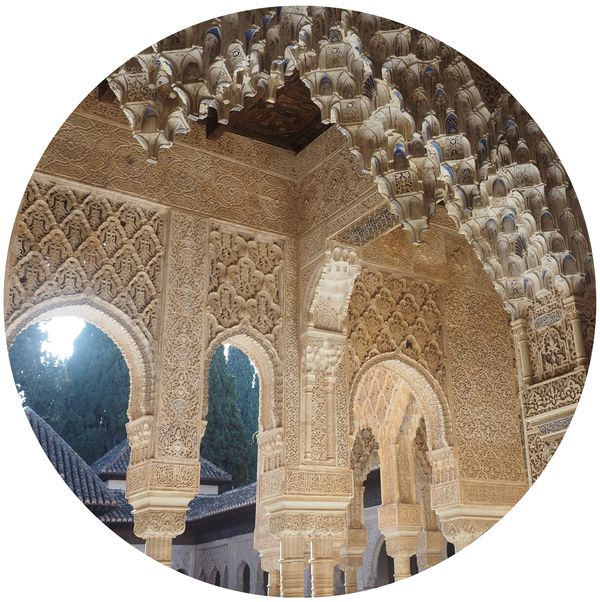
The Nasrid Palace of the Alhambra is a masterpiece of Islamic Art. The walls and ceilings of the Nasrid Palace are a testament to the zenith of Islamic art in Andalusia. Marked by intricate geometric patterns and floral motifs, these decorations symbolize infinity and divine perfection. The beautifully carved cedar wood ceilings represent the cosmos. Fine stucco work and colorful ceramics complete this visual harmony, creating a space for contemplation and splendor.
The Hall of Kings is one of the most remarkable. This room has several alcoves with ceilings decorated with unusual frescoes in the Muslim world, since they represent scenes from the court, therefore human figures, which is generally prohibited in Muslim works of art.
But a visit to the Alhambra of Granada would not be complete without its gardens and those of the Nasrid summer residence, the Generalife located a few hundred meters away.
Music:
- - YouTube video library - Lost Love Song
- - YouTube video library - Song of Sadhana - Jesse Gallagher
Disclaimer: Despite its appropriateness, copyright issues prevent the use of spanish traditional music in "Granada, the Alhambra, Andalusia • Spain", hence the use of royalty-free music. Despite our careful selection, some might regret this decision, which is necessary to avoid potential lawsuits. Although difficult, this decision is the only viable solution.