

 Français (France)
  Nederlands (nl-NL)
 The Palace of Charles V is a monumental building located in Granada, in the region of Andalusia in southern Spain, within the historic complex of the Alhambra. Commissioned in the sixteenth century by Emperor Charles V, the palace reflects the political ambitions of the Spanish monarchy following the end of Muslim rule in Granada. The structure is notable for its geometric design and for the unusual circular courtyard surrounded by arcaded galleries. Today the palace forms part of one of Spain’s most significant historical sites and houses cultural institutions and exhibition spaces, contributing to the interpretation and preservation of Granada’s historical heritage.
Monument profile
Palace of Charles V
Monument categories: Palace, Museum
Monument families: Palace and Annexes • Museum, remarkable architecture or group of buildings
Monument genres: Residential, Cultural or scientific
Cultural heritage: Christian
Geographic location: Granada • Andalusia • Spain
Construction period: 16th century AD
This monument in Granada is inscribed on the UNESCO World Heritage List since 1984 and is part of the serial property "Alhambra, Generalife and Albayzín, Granada".See the UNESCO monuments featured on this site
• Links to •
• List of videos about Toledo, Seville, Ronda, Granada, Baena on this site •
Spain • Holy Week celebrations • Andalusia and Toledo
Granada, the Alhambra, Andalusia • Spain
• References •
UNESCO: Alhambra, Generalife and Albayzín, Granada
History of the Palace of Charles V in Granada
Political and social context of the construction
The Palace of Charles V was constructed during the sixteenth century within the Alhambra complex in Granada, a site already deeply associated with political authority in the Iberian Peninsula. The palace emerged in the aftermath of the conquest of Granada in 1492, when the Catholic Monarchs Ferdinand II of Aragon and Isabella I of Castile ended the rule of the Nasrid dynasty, the last Muslim kingdom in Spain. This event marked the conclusion of the Reconquista and initiated a period of profound political and cultural transformation in the region.
After the incorporation of Granada into the Crown of Castile, the Alhambra remained an important symbol of royal authority. Rather than abandoning the former Nasrid palatial complex, the Spanish monarchy sought to integrate it into the framework of the new Christian state. By the time Charles I of Spain, later known as Emperor Charles V of the Holy Roman Empire, ascended to power in the early sixteenth century, the Spanish monarchy governed a rapidly expanding imperial network that extended across Europe and the Americas.
Charles V visited Granada in 1526 shortly after his marriage to Isabella of Portugal. During this visit, the decision was made to construct a new imperial palace within the Alhambra precinct. The project was both symbolic and political. It demonstrated the authority of the Habsburg monarchy over the former Nasrid capital and reinforced the legitimacy of Christian rule in a region that had long been associated with Islamic governance.
The construction of the palace also reflected the ambitions of a ruler who governed one of the largest political entities of the early modern period. Charles V controlled territories across Spain, the Low Countries, parts of Italy, Central Europe, and the recently established Spanish colonies in the Americas. The palace in Granada therefore functioned not only as a residence but also as a statement of imperial prestige.
Construction and early phases of the project
The palace project formally began in 1527 under the direction of the architect Pedro Machuca. Machuca had been influenced by the artistic environment of Renaissance Italy, possibly having worked in Rome during the early sixteenth century. His design introduced architectural principles associated with the Italian Renaissance into the Iberian Peninsula.
The construction of such a monumental structure inside the Alhambra represented a bold architectural and political gesture. It required significant modifications to the existing environment, including the removal of several Nasrid buildings that previously occupied the site. These transformations reflected the desire to create a new imperial architectural statement within the historic complex.
Despite the ambitious nature of the project, construction progressed slowly. The vast financial and military commitments of Charles V across Europe limited the resources available for the palace. The emperor was engaged in numerous conflicts, including wars against France, struggles with the Ottoman Empire, and internal political tensions within the Holy Roman Empire.
Following the death of Pedro Machuca in 1550, the project continued under the supervision of his son Luis Machuca and other architects. Nevertheless, the palace remained incomplete. By the seventeenth century, construction had largely ceased, leaving the building unfinished for a long period.
Historical events affecting the monument
Although the palace itself was never fully completed according to the original plans, it remained part of the Alhambra complex and continued to be influenced by historical developments affecting Granada.
During the seventeenth and eighteenth centuries, the Alhambra experienced periods of decline. Some sections of the complex were neglected, while others were adapted for military or administrative uses. The Palace of Charles V, lacking a complete roof for a long time, was partially exposed to weathering and deterioration.
In the early nineteenth century, the Napoleonic Wars had significant consequences for the Alhambra and the surrounding region. French troops occupied Granada between 1810 and 1812. During their retreat, attempts were made to destroy parts of the Alhambra complex. Although the Palace of Charles V survived without major structural damage, the broader site suffered from neglect and instability during this turbulent period.
Throughout the nineteenth century, interest in the Alhambra grew among European travelers, scholars, and artists. Romantic literature and travel narratives contributed to the rediscovery of the site as an important historical monument. This renewed attention encouraged Spanish authorities to consider preservation efforts for the entire complex, including the unfinished palace.
Global context during the period of construction
The construction of the Palace of Charles V took place during a period of major political and cultural transformations across Europe. The sixteenth century witnessed the consolidation of powerful monarchies, the spread of Renaissance artistic ideals, and the expansion of European exploration and colonization.
Across the continent, rulers commissioned monumental buildings designed to express political authority and cultural sophistication. Palaces, administrative complexes, and urban projects increasingly adopted architectural principles inspired by classical antiquity. The diffusion of Renaissance ideas from Italy influenced architectural developments in Spain, France, the Holy Roman Empire, and other regions.
At the same time, Spain played a central role in the emerging global order. Following the voyages of Christopher Columbus and subsequent expeditions, the Spanish Crown established a vast colonial presence in the Americas. The wealth derived from these territories reinforced Spain’s position as a major European power.
The palace in Granada therefore formed part of a broader trend in which architecture served as a visual representation of political ambition. The adoption of Renaissance forms in the palace symbolized Spain’s participation in the cultural and intellectual movements shaping early modern Europe.
Transformations and uses over time
After construction slowed in the seventeenth century, the palace remained largely incomplete for several generations. Nevertheless, its monumental structure ensured that it remained an important feature of the Alhambra complex.
During the nineteenth century, restoration efforts began to stabilize parts of the building. These interventions were motivated by a growing awareness of the historical importance of the Alhambra and by the desire to protect the site from further deterioration.
In the twentieth century, the Palace of Charles V gradually acquired new functions. Restoration programs allowed the building to be adapted for cultural and institutional purposes. Several museums were installed within its walls, including institutions dedicated to fine arts and to the history of the Alhambra.
These transformations allowed the palace to become an active cultural center rather than a dormant historical structure. The integration of museum spaces ensured that the building contributed to the interpretation and presentation of the broader historical context of Granada.
Contemporary role and cultural significance
Today, the Palace of Charles V forms an essential component of the Alhambra complex, one of the most significant historical sites in Spain. Its presence illustrates the transition from the Nasrid Islamic period to the era of Christian monarchy and Habsburg imperial power.
The palace also plays a key role in the cultural identity of Granada. It provides visitors with a tangible example of the political and artistic transformations that occurred in Spain during the sixteenth century.
As part of the Alhambra ensemble, the palace contributes to the international recognition of the site as a major historical monument. The complex attracts millions of visitors each year, making it one of the most visited cultural destinations in Europe.
Conservation and modern preservation challenges
The preservation of the Palace of Charles V forms part of the broader conservation strategy for the Alhambra complex. Maintaining the structural stability of the building requires continuous monitoring and restoration efforts.
Environmental factors such as temperature fluctuations, humidity, and natural erosion affect the stone surfaces and structural elements of the palace. In addition, the large number of visitors creates pressures that must be carefully managed to protect the monument.
Spanish cultural authorities have implemented various preservation policies aimed at safeguarding the architectural integrity of the building while ensuring public access. These initiatives include structural maintenance, archaeological research, and improved visitor management systems.
The Palace of Charles V is today integrated into the protected heritage landscape of the Alhambra, which has been recognized internationally for its historical and cultural value. Within this context, the palace represents a significant chapter in the architectural and political history of early modern Spain.
Architecture of the Palace of Charles V in Granada
Architectural conception and formal ambition
The Palace of Charles V represents one of the most significant introductions of Renaissance architectural principles into Spain during the sixteenth century. Constructed within the enclosure of the Alhambra in Granada, the palace was conceived as a monumental expression of imperial authority and as a deliberate architectural contrast to the surrounding Nasrid palaces. Its design reflects the growing influence of Italian Renaissance theory in the Iberian Peninsula and the political ambitions of the Habsburg monarchy.
The project was designed by the architect Pedro Machuca, who had been exposed to the artistic and intellectual environment of Renaissance Italy. His design introduced an architectural language based on classical proportion, geometric clarity, and monumental composition. The building departs radically from the decorative and spatial traditions of Islamic palatial architecture that dominate the Alhambra complex.
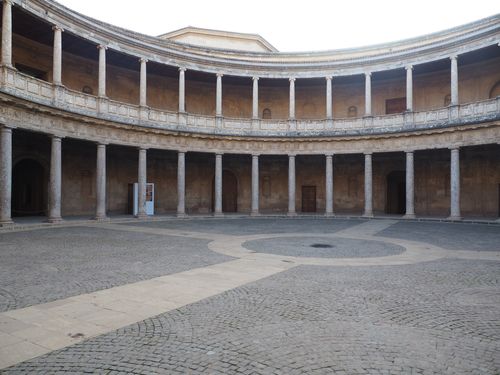
One of the most distinctive aspects of the palace is its geometric conception. The structure consists of a square exterior block enclosing a perfectly circular courtyard at its center. This combination of forms embodies Renaissance ideals of harmony and mathematical order. The square represents stability and rational organization, while the circle evokes classical ideals of perfection and balance.
Through this architectural concept, the palace became a symbolic statement of imperial power. Its rigorous geometry and monumental scale expressed the authority of Charles V while demonstrating the adoption of Renaissance architectural thought in Spain.
Technological and architectural innovations
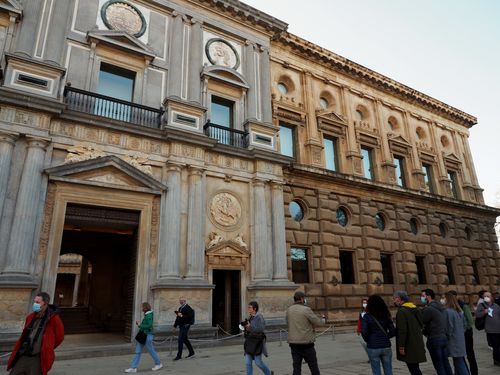
The construction of the palace introduced several innovations associated with Renaissance building practices. One of the most important is the systematic use of classical architectural orders to structure the composition of the building. The exterior façades and the interior courtyard are organized according to strict proportional systems derived from ancient Roman architecture.
The circular courtyard is surrounded by a two-level colonnaded gallery that demonstrates a sophisticated understanding of classical architectural hierarchy. The lower level uses the Doric order, characterized by massive columns and a sense of structural solidity. The upper level employs the Ionic order, which is more slender and decorative, creating a visual transition from the heavy base to the lighter upper structure.
This arrangement reflects Renaissance theories of architectural harmony in which different orders were used to articulate the vertical hierarchy of a building. The structural rhythm of columns, arches, and entablatures establishes a strong sense of balance and symmetry.
The circular courtyard itself was a highly ambitious structural feature. Constructing a perfectly circular colonnade required careful geometric planning and precise stonecutting techniques. The circular configuration also created a central ceremonial space that could accommodate gatherings and official events.
From an engineering perspective, the palace relied on thick masonry walls and carefully positioned structural supports to distribute loads throughout the building. The arches of the courtyard galleries function both as structural elements and as visual features, reinforcing the architectural rhythm of the composition.
Ventilation and lighting were also considered in the design. The open courtyard allows natural light to reach the surrounding galleries and interior spaces. The circulation of air within the courtyard contributes to temperature regulation, an important factor in the Mediterranean climate of southern Spain.
Materials and construction techniques
The palace was primarily constructed using locally quarried stone from the region surrounding Granada. The choice of stone provided durability and allowed for the precise carving required for classical architectural ornamentation. The surfaces of the stone blocks were carefully dressed, creating smooth façades that emphasize the geometry of the building.
Large ashlar blocks were used for the main structural components, including the walls, columns, and arcades. This type of construction ensured the stability of the building while giving it a monumental appearance appropriate for an imperial residence.
The columns and decorative elements were sculpted with considerable precision. Capitals, cornices, and moldings were carved according to classical models, demonstrating the influence of Renaissance architectural treatises. The careful shaping of these elements reflects the technical skill of the stonemasons working on the project.
Interior structural systems combined masonry with timber frameworks where appropriate. Wooden beams were used for certain floors and roof structures, while the primary load-bearing elements remained stone. This combination of materials allowed builders to maintain structural strength while facilitating the construction of large interior spaces.
Although the decoration of the palace is relatively restrained compared with the elaborate ornamentation of Nasrid architecture, its aesthetic strength lies in proportion and architectural articulation. The visual impact is achieved through the rhythm of columns, the scale of the structural elements, and the clarity of geometric organization.
Architectural influences and artistic synthesis
The palace reflects the growing influence of Italian Renaissance architecture in Spain during the sixteenth century. Its design demonstrates familiarity with the principles of classical architecture derived from ancient Roman monuments and Renaissance architectural theory.
The use of symmetrical composition, classical orders, and carefully calculated proportions illustrates the intellectual environment of Renaissance architecture, in which geometry and mathematics were regarded as essential tools for architectural design.
At the same time, the palace exists within the unique architectural context of the Alhambra. The surrounding Nasrid buildings are characterized by intricate decoration, delicate columns, and complex courtyard compositions. In contrast, the Palace of Charles V presents a monumental and austere architectural language based on structural clarity rather than decorative surface patterns.
This juxtaposition creates one of the most striking architectural contrasts in European heritage sites. The palace represents the arrival of Renaissance classicism in a setting shaped by Islamic artistic traditions. The coexistence of these two architectural worlds illustrates the broader cultural transition that occurred in Granada after the end of Nasrid rule.
Spatial organization and structural composition
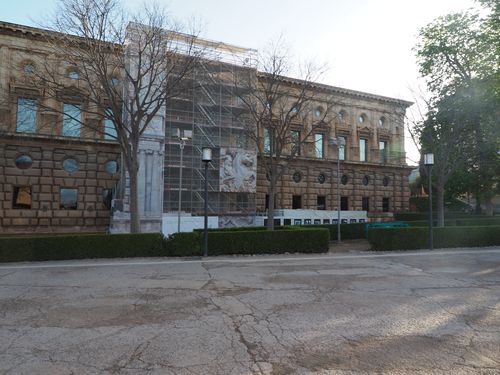
The palace follows a rigorous geometric plan centered on the circular courtyard. The exterior structure forms a square measuring approximately sixty meters on each side, enclosing the circular space at its center.
The courtyard itself measures roughly thirty meters in diameter and is surrounded by two levels of arcaded galleries. These galleries create a continuous circulation space around the central courtyard and connect the various rooms of the palace.
The façades of the palace are organized according to a system of pilasters and window openings that reinforce the symmetry of the design. Monumental portals provide access to the building, emphasizing its ceremonial character.
Inside the courtyard, the superimposed colonnades create a powerful spatial experience. The lower Doric level establishes a strong architectural base, while the Ionic colonnade above introduces a sense of refinement and vertical continuity.
The circular courtyard functions as the visual and spatial focus of the building. Its proportions create a balanced environment in which the viewer perceives the harmony between geometry and architectural order.
Dimensions and notable architectural characteristics
The building’s square exterior combined with its circular courtyard is one of the most distinctive spatial arrangements of Renaissance architecture in Spain. This dual geometry creates a powerful architectural identity that distinguishes the palace from other contemporary structures.
Despite its relatively compact footprint compared with large royal palaces elsewhere in Europe, the palace achieves a strong sense of monumentality through scale and proportion. The height of the galleries, the thickness of the walls, and the mass of the columns contribute to this visual impact.
One notable aspect of the palace’s history is that construction was never fully completed according to the original design. For centuries the building remained partially unfinished, lacking certain structural elements such as a complete roof. This unusual situation influenced the preservation of the structure, as the building experienced fewer later alterations than many contemporary monuments.
Restoration campaigns carried out in the twentieth century stabilized the structure and adapted parts of the building for cultural use. These interventions sought to respect the original Renaissance design while ensuring the durability of the monument.
International recognition and conservation challenges
Today the Palace of Charles V forms an integral part of the Alhambra monumental complex, one of the most visited historical sites in Europe. The palace contributes to the architectural diversity of the complex and illustrates the historical transition from Nasrid Granada to the period of Habsburg rule.
Its architectural significance lies not only in its Renaissance design but also in the dialogue it establishes with the surrounding Islamic architecture of the Alhambra. The coexistence of these architectural traditions makes the site a unique historical landscape.
Conservation efforts focus on protecting the stone structures from environmental deterioration and managing the impact of tourism. Temperature fluctuations, humidity, and erosion affect the surfaces of the building, requiring continuous maintenance.
Modern preservation programs aim to maintain the architectural integrity of the palace while allowing it to function as a cultural and museum space. These efforts ensure that the building remains an important example of Renaissance architecture and a key component of the historical heritage of Granada.