

 Français (France)
  Nederlands (nl-NL)
 The Generalife Gardens are located in Granada, in the Andalusia region of Spain, near the Alhambra palace complex. This ensemble forms a landscaped area historically associated with the royal residences of the Nasrid period. The gardens consist of a sequence of courtyards, pathways, and planted spaces arranged around pools and water channels. Their layout reflects a designed environment where architecture, water, and vegetation form a unified composition. Today the Generalife Gardens are part of the monumental complex of the Alhambra and are among the most visited sites in Granada. They attract visitors interested in the historical and cultural heritage of Andalusia.

Granada • Generalife Gardens
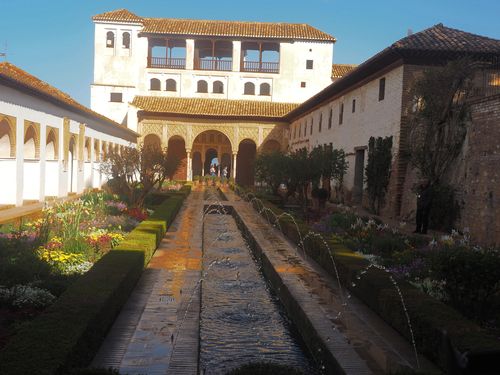
Granada • Generalife Gardens

Granada • Generalife Gardens
Monument profile
Generalife Gardens
Monument category: Gardens
Monument family: Palace and Annexes
Monument genre: Residential
Cultural heritage: Islamic
Geographic location: Granada • Andalusia • Spain
Construction period: 13th century AD
This monument in Granada is inscribed on the UNESCO World Heritage List since 1984 and is part of the serial property "Alhambra, Generalife and Albayzín, Granada".See the UNESCO monuments featured on this site
• Links to •
• List of videos about Toledo, Seville, Ronda, Granada, Baena on this site •
Spain • Holy Week celebrations • Andalusia and Toledo
Granada, the Alhambra, Andalusia • Spain
• References •
UNESCO: Alhambra, Generalife and Albayzín, Granada
History of the Gardens of the Generalife
Foundation of the Nasrid summer residence
The gardens of the Generalife were established during the thirteenth century on the slopes of the Cerro del Sol hill, located opposite the Alhambra in Granada. The complex formed part of the architectural development undertaken by the Nasrid dynasty, which ruled the Emirate of Granada between the thirteenth and fifteenth centuries. The Generalife functioned as a rural palace and garden estate used by the Nasrid rulers as a place of retreat separate from the administrative and ceremonial environment of the Alhambra.
The construction of the complex is generally attributed to the reign of Muhammad II (1273–1302) or possibly to that of his successor Muhammad III (1302–1309). The site combined a residential palace with cultivated terraces and gardens arranged along the hillside. Its position outside the fortified enclosure of the Alhambra allowed the rulers to maintain proximity to the political center of the Nasrid court while occupying a quieter residential environment.
The estate was connected to the Alhambra through paths and access routes that allowed the sovereign and members of the court to move between the two complexes. The name Generalife likely derives from the Arabic expression Jannat al-‘Arif, often interpreted as “Garden of the Architect” or “Garden of the Knowing One,” although the precise meaning remains debated.
Development and use during the Nasrid period
During the fourteenth and fifteenth centuries the Generalife estate underwent several phases of modification and expansion under successive Nasrid rulers. The palace complex and the surrounding terraces were gradually reorganized to accommodate the residential functions of the court and the cultivation of the gardens.
One of the most significant elements in the development of the site was the hydraulic infrastructure that supplied water to the gardens. The estate was fed by the Acequia Real, a canal that diverted water from the Darro River toward the Alhambra and the surrounding estates. This irrigation system allowed water to be distributed through basins, channels, and fountains that structured the gardens.
The Generalife served as a seasonal residence used by members of the Nasrid dynasty and by the royal court. The complex hosted periods of leisure, private gatherings, and courtly activities that differed from the more formal political functions associated with the Alhambra. The organization of the gardens and residential spaces reflects this function as a retreat linked to the Nasrid palace complex.
Maintenance and modification of the site continued throughout the Nasrid period. These works mainly involved the upkeep of the terraces, irrigation channels, and palace structures rather than large-scale reconstruction.
Changes after the Christian conquest of Granada
The capture of Granada by the Catholic Monarchs Ferdinand II of Aragon and Isabella I of Castile in 1492 marked a major political transformation that also affected the Generalife estate. Ownership of the property passed from the Nasrid rulers to the Spanish Crown and was subsequently granted to noble families associated with the new administration of Granada.
Unlike some structures within the Alhambra that fell into disuse, the Generalife continued to function as a rural residence. During the sixteenth century the new owners introduced architectural modifications and adjustments to the gardens. Some parts of the palace were altered to suit different residential practices, while the gardens were reorganized in certain areas.
Despite these changes, the fundamental structure of the Nasrid garden layout remained largely preserved. The terraces, irrigation systems, and main courtyard of the palace continued to shape the organization of the estate. Later interventions mainly involved maintenance of the gardens and adaptation of some architectural elements rather than complete redesign.
During the following centuries the Generalife remained a privately held property. Repairs, reconstructions of garden areas, and maintenance of hydraulic structures were carried out periodically to sustain the functioning of the estate.
Global historical context at the time of the estate’s creation
The establishment of the Generalife during the late thirteenth and early fourteenth centuries coincided with significant developments in other parts of the world. In Western Europe, monarchies were consolidating their political authority and urban centers were expanding through commercial growth. In East Asia, the Yuan dynasty ruled China following the Mongol conquests. In the Middle East and North Africa, several regional dynasties governed territories that had once formed part of the Abbasid Caliphate.
Modern use, conservation and heritage recognition
In the modern period the Generalife became integrated into the broader heritage complex of the Alhambra. The estate gradually transitioned from a private residence into a historic monument open to the public. Conservation programs have focused on preserving the terraces, palace structures, irrigation systems, and landscaped gardens that define the historic layout of the site.
Maintenance work includes the restoration of water channels, basins, stairways, and supporting walls that stabilize the terraces. These interventions aim to preserve the architectural coherence of the gardens while accommodating a large number of visitors.
The gardens of the Generalife form part of the monumental ensemble inscribed on the UNESCO World Heritage List in 1984 under the official designation “Alhambra, Generalife and Albayzín, Granada.” This inscription recognizes the historical and cultural significance of the interconnected palatial, garden, and urban landscapes that developed around the Nasrid capital of Granada.
Architecture of the Gardens of the Generalife
Topographical setting and overall spatial organization
The gardens of the Generalife occupy a sloping hillside on the Cerro del Sol, located to the east of the Alhambra in Granada. The architectural organization of the estate directly reflects the natural topography of the terrain. The complex is structured through a sequence of terraced platforms that descend along the hillside toward the valley of the Darro River. Each terrace is supported by retaining walls that stabilize the slope and create horizontal surfaces suitable for circulation, planting, and architectural structures.
The overall plan combines a residential palace complex with a network of gardens and terraces arranged around it. The palace occupies a central position within the estate, while the gardens extend both above and below this core structure. Circulation through the complex follows a series of axial paths and stairways connecting the terraces.
The spatial layout also establishes visual relationships with the surrounding landscape. Openings in walls, elevated terraces, and garden paths provide viewpoints toward the Alhambra and the surrounding valleys. The arrangement of the terraces allows the gardens to unfold gradually along the hillside rather than forming a single enclosed space.
Palace structures and courtyard configuration
The palace of the Generalife forms the architectural nucleus of the complex. Its principal organizing element is the elongated courtyard known as the Patio de la Acequia. This rectangular courtyard is oriented along a longitudinal axis and is defined by a central water channel that runs through its entire length.
On both sides of the courtyard stand arcaded galleries supported by slender columns. These galleries provide sheltered circulation spaces connecting the rooms of the palace. The alignment of the columns and arches establishes a rhythmic architectural framework that emphasizes the linear geometry of the courtyard.
The residential rooms of the palace open directly onto these galleries. Doors and windows allow visual continuity between the interior spaces and the garden courtyard. The configuration of the courtyard creates a strong central axis reinforced by the water channel and by the symmetrical arrangement of the surrounding architectural elements.
At the ends of the courtyard stand pavilion structures that mark the termination of the central axis. These structures frame the perspective of the courtyard and provide elevated viewpoints over the gardens and the surrounding landscape.
Hydraulic infrastructure and water architecture
Water plays a structural role in the architecture of the Generalife gardens. The hydraulic system supplying the estate originates from the Acequia Real, a canal that diverts water from the Darro River toward the Alhambra hill. From this canal, water is distributed throughout the Generalife through a network of channels integrated into the architectural layout.
The central feature of the Patio de la Acequia is the long reflecting basin that occupies the axis of the courtyard. Along the edges of this basin, rows of small fountains project jets of water that form intersecting arcs above the surface. These fountains are spaced at regular intervals and create a rhythmic sequence along the length of the basin.
Water is also directed into secondary channels that irrigate the garden terraces. These channels are incorporated into pavements or run along the edges of planting beds. Their layout ensures the distribution of water to different levels of the garden while maintaining continuous circulation.
The hydraulic infrastructure therefore serves multiple functions. It irrigates the vegetation, structures the spatial composition of the gardens, and contributes to the visual and acoustic environment of the complex through the movement of water.
Terraced gardens and stairway structures
Beyond the palace courtyard, the gardens extend across a series of terraces that rise along the hillside. These terraces are connected through stairways, ramps, and narrow paths that guide movement between levels. Each terrace forms a distinct garden area defined by retaining walls and planted beds.
One of the most notable architectural features within the terraced system is the Escalera del Agua, a stairway in which water flows along channels integrated into the handrails. The stone steps are flanked by narrow watercourses that carry running water from the upper terraces toward the lower levels. This configuration combines circulation and hydraulic engineering within a single architectural element.
The terraces are bordered by masonry walls that serve both structural and spatial purposes. Structurally, they support the earth of the upper levels. Spatially, they define enclosed garden areas and create controlled transitions between different parts of the estate.
Vegetation is arranged within these terraces in alignment with the geometric layout of the paths and irrigation channels. The terraces therefore form an architectural extension of the palace complex rather than functioning as independent landscape areas.
Architectural modifications and preservation
The present architectural appearance of the Generalife gardens reflects a combination of Nasrid construction and later modifications. Following the Christian conquest of Granada in 1492, certain architectural adjustments were introduced to adapt the estate to new residential uses. These modifications affected some palace interiors and portions of the garden layout.
Subsequent centuries brought further interventions aimed at maintaining the terraces, hydraulic infrastructure, and architectural structures of the complex. Repairs were periodically carried out on retaining walls, stairways, and water channels to preserve the stability of the hillside gardens.
Modern conservation programs have focused on stabilizing the terraced structure and restoring elements of the historical garden layout. Maintenance of the irrigation system remains an essential component of preservation efforts, since the functioning of the gardens depends on the continued circulation of water through the channels and basins.
These conservation efforts seek to maintain the architectural coherence of the Generalife while preserving the structural elements that define the relationship between palace buildings, terraces, and hydraulic infrastructure.