Français (France)
  Nederlands (nl-NL)
 00:00 • intro | 00:31 • outside the mosque-cathedral | 01:43 • inside the mosque-cathedral | 04:04 • the capilla moyor
Personal creation from visual material collected during my trip Spain: Semana Santa in Andalusia (2022)
Map of places or practices in Cordoba on this site
• Use the markers to explore the content •
Córdoba and the Mosque-Cathedral, Monumental Memory of Andalusia
A Landmark Between Islamic and Christian Worlds
In the historic center of Córdoba stands one of Europe’s most extraordinary monuments: the Mosque-Cathedral. Few buildings express so clearly the layered history of the western Mediterranean. It embodies the Umayyad period of al-Andalus, the Christian reconquest, later liturgical transformations, and the modern age of heritage preservation. Even today, the complex dominates the old city and remains one of the best-known symbols of Andalusia.
This video approaches the monument through its exterior spaces, its vast interior, and the insertion of a major Christian sanctuary within the former mosque. It therefore presents not only an architectural masterpiece, but also a visible dialogue between civilizations, religions, and historical periods.
The surrounding urban fabric of Córdoba adds further meaning. The city was once among the great intellectual, political, and economic capitals of medieval Europe and the Islamic world.
The Main Spaces Seen in the Video
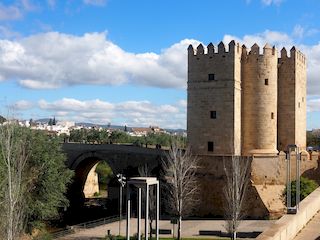
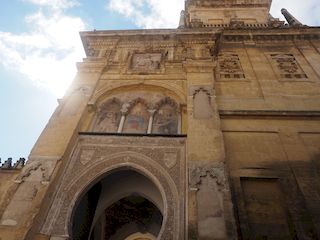
The exterior views first reveal the unusual character of the monument. Behind strong enclosing walls, the building presents a largely horizontal profile. Unlike many Gothic cathedrals designed to dominate the skyline through height, this structure extends across space with controlled mass and calm monumentality. That outward restraint reflects its original function as a congregational mosque.
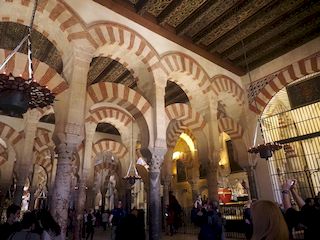
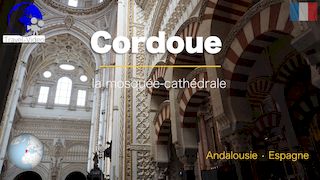
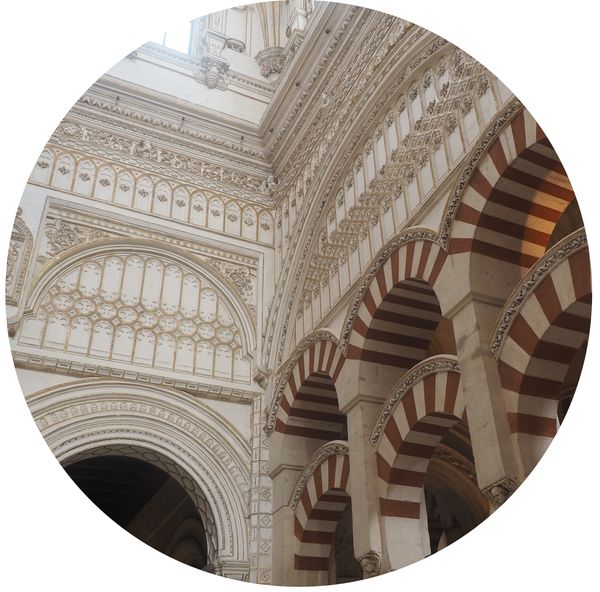
Inside, the most celebrated feature appears: the forest of columns and double arches. Repetition creates rhythm, while long aligned perspectives give the impression of endless depth. The alternating red and pale tones of the arches reinforce movement and visual unity. Light enters in measured ways, producing an atmosphere very different from later European churches.
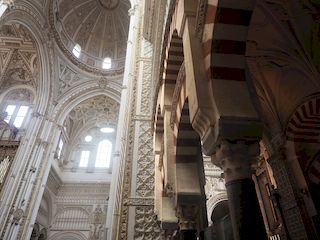
The video then moves toward the Capilla Mayor, the great central chapel inserted after the Christian conquest. Here the language changes dramatically. Vertical emphasis, sculptural decoration, liturgical focus, and richer ceremonial staging contrast with the ordered horizontality of the mosque.
These successive views make clear that the monument is not a single-period building. It is a palimpsest in stone.
A Monument Built Through Successive Phases
The origins of the site go back to the eighth century, when the Umayyad rulers of Córdoba commissioned a major mosque to affirm political legitimacy and religious authority. Construction began under Abd al-Rahman I and continued under later rulers, who enlarged and enriched the building several times.
During the ninth and tenth centuries, Córdoba became the capital of a powerful state and later a caliphate of great prestige. As the city expanded, the mosque also grew. New prayer halls, decorative programs, and improved circulation turned it into one of the most important Islamic monuments in the western world.
In 1236, Córdoba was taken by Christian forces, and the mosque was consecrated as a cathedral. Unlike many converted sacred sites, the original structure was not entirely destroyed. Instead, chapels were gradually inserted around the perimeter, while a major cathedral nave and choir were built in the sixteenth century in the center of the former prayer hall.
That decision was debated even in its own time, yet it produced the unique hybrid form seen today. The monument preserves traces of nearly every major stage in its long history.
Architecture, Symbolism, and Spatial Experience
The fame of the Mosque-Cathedral rests not only on history, but on spatial intelligence. Hundreds of columns support a system of superimposed arches that allowed greater height while maintaining harmony. The design transforms structural necessity into aesthetic identity.
Near the former Islamic sanctuary, the mihrab zone displays some of the richest decoration in medieval Iberia. Marble, carved surfaces, geometric order, and mosaic work reveal the resources once devoted to the caliphal project.
The Christian additions introduced another conception of sacred space. The Capilla Mayor emphasizes axial focus, hierarchy, ornament, and vertical drama. Where the mosque disperses attention across repeated space, the cathedral concentrates it toward altar and choir.
This coexistence is more than stylistic contrast. It records changes in power, faith, and cultural meaning while preserving continuity of sacred use.
Outside, the Patio de los Naranjos extends the monument into open air. Originally linked to ablutions and gathering before prayer, it remains a transitional zone between city and sanctuary.
What the Videos on This Site Make Especially Clear
A monument of this complexity can be difficult to understand during a crowded or hurried visit. Videos built mainly from carefully selected and animated photographs offer a valuable alternative. They slow down perception and guide the viewer through the building’s logic.
Exterior sequences clarify scale, enclosure, and the relation between the monument and the surrounding city. Interior views highlight how columns, arches, and light create depth and orientation. The gradual approach toward the Capilla Mayor helps viewers understand how the Christian structure occupies the former mosque rather than replacing it entirely.
This visual method is particularly effective for revealing textures, proportions, recurring patterns, and transitions between architectural languages. It also allows the viewer to compare spaces calmly, something often difficult on site.
For a building defined by sequence and layered perception, this approach is especially useful.
A Universal Heritage Site Still Alive
Recognized by UNESCO as part of the historic heritage of Córdoba, the Mosque-Cathedral remains one of the world’s most significant monuments of cultural encounter and transformation. It attracts visitors for its beauty, but also for the historical questions it raises about continuity, adaptation, and memory.
This video invites a closer reading of the monument through form, space, and atmosphere. Those wishing to continue the exploration can consult the detailed page dedicated to the Mosque-Cathedral, where its history, architecture, and enduring significance are examined in greater depth.
Links to related pages




Audio Commentary Transcript
The city of Cordoba in Andalusia, southern Spain, had its heyday in the 10th century, when it was the capital of the Emirate of Cordoba.
The city has a turbulent history, like almost all cities in southern Spain, passing in turn from Roman domination to that of the Visigoths, who gave way to Arabs, before it became part of Catholic Spain. .
A monument perfectly illustrates this history, the mosque-cathedral which rises in the heart of the old city.
The Great Mosque of Cordoba had more than 1000 pillars. A large part of the columns were taken from pre-existing monuments, and materials taken from the many churches destroyed during the Arab takeover.
In 1236, after the conquest of Cordoba by Ferdinand III of Castile, these pillars were kept, but the entire mosque was consecrated as a Catholic cathedral. Many chapels were built along the walls of the building.
All these chapels were built from the end of the 13th century.
The most richly decorated chapel is undoubtedly the "Capilla Mayor", a major chapel which was built later in the 16th century and which is so beautiful and large that many people think it is the cathedral. In reality, the whole of the converted mosque forms the cathedral.
Music:
- - YouTube video library - Butterflies in Love
- - YouTube video library - Clenched Teeth, (© Clenched Teeth - The Descent by Kevin MacLeod is licensed under a Creative Commons Attribution 4.0 license. https://creativecommons.org/licenses/by/4.0/
- Source: http://incompetech.com/music/royalty-free/index.html?isrc=USUAN1100705
- Artist: http://incompetech.com/)
- - YouTube video library - Cortosis - Scoring Action, (© Cortosis - Scoring Action by Kevin MacLeod is licensed under a Creative Commons Attribution 4.0 license. https://creativecommons.org/licenses/by/4.0/
- Source: http://incompetech.com/music/royalty-free/index.html?isrc=USUAN1100815
- Artist: http://incompetech.com/)
- - YouTube video library - Dissappointment, (© Dissappointment by Kevin MacLeod is licensed under a Creative Commons Attribution 4.0 license. https://creativecommons.org/licenses/by/4.0/
- Source: http://incompetech.com/music/royalty-free/index.html?isrc=USUAN1100481
- Artist: http://incompetech.com/)
Disclaimer: Despite its appropriateness, copyright issues prevent the use of spanish traditional music in "Cordoba, the Mosque-Cathedral, Andalusia • Spain", hence the use of royalty-free music. Despite our careful selection, some might regret this decision, which is necessary to avoid potential lawsuits. Although difficult, this decision is the only viable solution.