

 Français (France)
  Nederlands (nl-NL)
 00:00 • intro | 00:59 • Patio de las Doncellas | 02:15 • Ceilings of the launges of the Patio de las Doncellas | 04:12 • Patio de las Muñecas | 05:18 • Patio de los Embajadores | 06:06 • The gardens
Personal creation from visual material collected during my trip Spain: Semana Santa in Andalusia (2022)
Map of places or practices in Seville on this site
• Use the markers to explore the content •
The Real Alcázar of Seville Between Islamic Heritage and Royal Architecture
A Palace at the Heart of Andalusian History
Located in the historic centre of Seville, the Real Alcázar of Seville is one of the most remarkable royal palace complexes in Spain. Still used today by the Spanish royal family during official visits, the palace reflects several centuries of political, artistic and cultural history linked to Andalusia. Its architecture combines Islamic traditions, Mudéjar influences, Gothic additions and later Christian modifications, creating a monument shaped by multiple historical periods.
The video explores several of the palace’s most famous courtyards, ceremonial halls and gardens. The images highlight the refinement of decorative details, the richness of carved ceilings and the relationship between architecture, water and vegetation that characterises many Andalusian palaces.
Courtyards, Ceremonial Spaces and Decorative Art
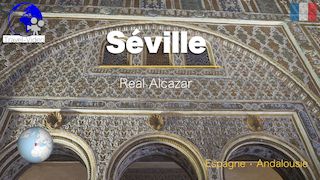
The Patio de las Doncellas is among the most recognisable spaces within the Real Alcázar. Organised around a long reflecting pool and framed by richly decorated arcades, the courtyard illustrates the development of Mudéjar architecture in medieval Spain after the Christian reconquest. Geometric decoration, Arabic inscriptions and colourful materials demonstrate the strong influence of Islamic artistic traditions on Christian royal architecture in Andalusia.
The video also focuses on the elaborately decorated ceilings of the surrounding halls. These carved wooden ceilings reflect the importance of ornamental craftsmanship within Spanish palace architecture during the fourteenth and fifteenth centuries. Their geometric and vegetal motifs preserve artistic traditions inherited from the Muslim dynasties that once ruled large parts of the Iberian Peninsula.
The Patio de las Muñecas presents a more intimate dimension of the palace complex. Smaller in scale and associated with private royal spaces, this courtyard reveals the attention devoted to decorative detail even within less formal areas of the residence. The proportions of the space and the subtle ornamentation contrast with the more monumental ceremonial sections of the palace.
Another important location shown in the video is the Patio de los Embajadores, one of the principal reception halls of the Real Alcázar. Covered by an impressive dome richly decorated with geometric patterns, the space was designed for royal audiences and diplomatic ceremonies. Its scale and visual richness emphasise the political role played by the palace throughout the history of Seville.
Gardens and the Legacy of al-Andalus
The gardens occupy an important place in the video and form an essential part of the Real Alcázar complex. Organised around pools, fountains, shaded pathways and carefully arranged vegetation, they continue the aesthetic principles developed in the palaces of Islamic al-Andalus. Water, shade and vegetation were used not only for decoration, but also to create comfort within the warm Andalusian climate.
The origins of the palace date back to the Islamic period of Seville, particularly during the Almohad dynasty, before extensive transformations were carried out after the Christian conquest of the city in the thirteenth century. Rather than entirely replacing earlier structures, Christian rulers integrated many Islamic architectural traditions into the new royal residence. This continuity explains the unique character of the Real Alcázar, where multiple artistic traditions coexist within a single architectural ensemble.
What the Videos on This Site Make Easier to Observe
The videos published on travel-video.info frequently use carefully selected and animated photographs combined with gradual transitions that encourage detailed observation of monuments and historical spaces. This approach allows viewers to better perceive proportions, decorative details and the relationship between architecture and surrounding landscapes.
In the case of the Real Alcázar, the slow visual movements reveal the complexity of carved ceilings, the perspectives of the courtyards and the effects of light across arcades, gardens and tiled surfaces. The visual construction also helps explain how Islamic and Christian artistic traditions became intertwined within Andalusian architecture.
A Symbol of Seville’s Multicultural Past
Through its courtyards, Mudéjar decoration and gardens, the Real Alcázar remains one of the most important testimonies to the artistic and political history of Seville. The video offers a progressive exploration of this exceptional palace while illustrating the cultural diversity that shaped Andalusia over many centuries. The detailed pages dedicated to related monuments provide an opportunity to further explore the architecture and historical evolution of this major site of Spanish heritage.
Links to related pages




Audio Commentary Transcript
Originally a Moorish fortress built in the 10th century by the Umayyads who occupied the entire south of Spain, the Alcazar of Seville was transformed into a royal palace by the Christian kings after the Reconquista. The palace underwent various phases of renovation and expansion, but it was Peter I of Castile, who reigned in the 14th century, who gave it its current style, known as Mudéjar – a unique blend of Islamic and Christian elements, later incorporating Gothic, Renaissance, and Baroque influences. Today, the Alcazar still occasionally serves as a royal residence.
The 'Patio de las Doncellas', or Court of the Maidens, derives its name from a legend that Moorish kings used to demand an annual tribute of a hundred virgins from neighboring kingdoms. In reality, it serves as a central element in palace life, where official ceremonies and public audiences are held.
Its design reflects the significance of water in Islamic architecture. Another example of this pivotal role of water is the Taj Mahal in Agra, India.
The Patio de las Doncellas has several lounges, rivaling each other in richness and beauty with their finely chiseled walls and their remarkable, meticulously carved cedar wood ceilings.

Music:
- - YouTube video library - Lost Love Song
- - YouTube video library - Sweetly My Heart - Asher Fulero
Disclaimer: Despite its appropriateness, copyright issues prevent the use of spanish traditional music in "Seville, Real Alcazar • Andalusia. Spain", hence the use of royalty-free music. Despite our careful selection, some might regret this decision, which is necessary to avoid potential lawsuits. Although difficult, this decision is the only viable solution.


