

 Français (France)
  Nederlands (nl-NL)
 The Real Alcázar of Seville is a palace complex closely linked to the political and cultural development of Andalusia. Over the centuries, successive dynasties occupied and reshaped the site, turning it into a symbol of authority and continuity within the city. Its distinct architectural phases reflect long-term adaptations to new rulers and evolving functions. Today, the Alcázar remains an emblematic component of Spain’s heritage, still used for official purposes and widely recognised for its cultural significance. It attracts large numbers of visitors who appreciate the depth and variety of its historical legacy.
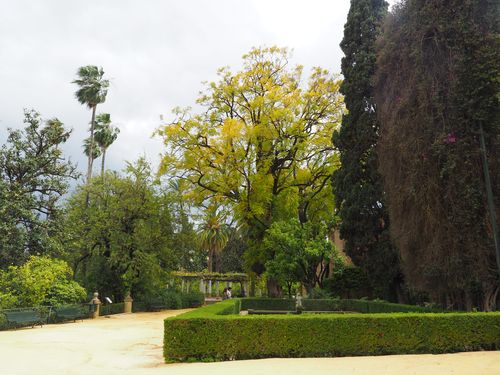
Seville • Real Alcazar
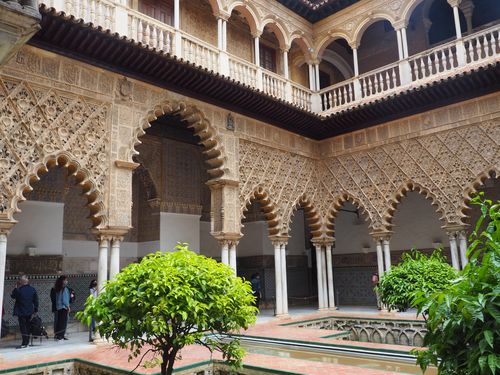
Seville • Real Alcazar
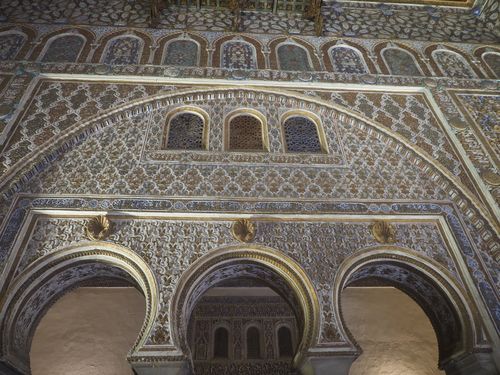
Seville • Real Alcazar
History of the Real Alcázar of Seville
The Real Alcázar of Seville is one of the longest-standing royal residences in Europe and an exceptional record of the political, social and cultural transformations that have shaped Andalusia. Its history spans more than a thousand years, during which successive rulers—Muslim governors, Almohad caliphs, Castilian monarchs and Habsburg emperors—adapted, demolished, rebuilt and expanded the complex. Each intervention responded to shifting political imperatives, changing social structures and evolving symbolic needs. As a result, the Real Alcázar stands today as a uniquely layered monument, bearing the imprint of medieval Islam, Christian rule, Renaissance ideals and early modern statecraft.
Political and social context of its creation
The origins of the Alcázar lie in the early Islamic period of the Iberian Peninsula. In the ninth century, when the Umayyad emirate and later caliphate of Córdoba sought to secure control over its western territories, Seville became a strategic administrative centre. The first fortified precinct was built to protect the governor’s seat and to house military and bureaucratic officials. This early construction responded to several issues: local rebellions, the need for stronger provincial governance, and increasing competition among aristocratic families within al-Andalus.
Under the Almohads in the twelfth century, the site acquired new significance. With Seville elevated to the rank of capital for a western Mediterranean empire extending into North Africa, the existing fortress was no longer sufficient. The caliphs initiated extensive works to create a palace that projected authority, diplomatic prestige and religious legitimacy. Their interventions were systematic: new walls, administrative halls, courtyards, gardens and ceremonial spaces were added in order to articulate a more centralised political order. The palace had to display ideological continuity with North African power centres while accommodating the administrative complexities of a major Andalusian city.
Following the Christian conquest of Seville in 1248, the Castilian crown retained the complex as its royal residence. Several motives explain this choice: the exceptional strategic location of the Alcázar within the urban fabric, its robust and well-organised internal layout, and the prestige attached to ruling from a palace that had symbolised regional authority for centuries. By preserving and modifying the Islamic structure rather than replacing it entirely, the Castilian monarchy asserted both domination and continuity, embedding its rule within an architectural framework already associated with power.
Major historical events and dynastic transformations
Over the centuries, the Alcázar was shaped by political instability, warfare and changing dynasties. During the thirteenth and fourteenth centuries, the complex served not only as a residence but also as a key administrative node for military campaigns in southern Iberia. It sheltered monarchs during periods of conflict, including internal disputes among the Castilian nobility.
One of the most decisive transformations occurred under King Peter I of Castile (1350-1369). Keen to strengthen his position in the midst of civil unrest and rivalry with the high aristocracy, Peter embarked on an ambitious plan to construct a new palatial residence within the Alcázar. He employed master craftsmen from the Nasrid kingdom of Granada, integrating aesthetic and architectural principles of the contemporary Islamic courts. This decision reflected both diplomatic strategies—Peter often oscillated between alliance and rivalry with Granada—and a desire to promote a distinctive royal identity. The palace built under his rule remains a masterpiece of Mudéjar art and a crucial chapter in the history of the Alcázar.
Later, the Habsburg dynasty left its mark. Under Charles V in the sixteenth century, new rooms were added to accommodate imperial ceremonial practices and to align the palace with Renaissance tastes. Seville’s role as the administrative centre of trade with the Americas reinforced the importance of the Alcázar as a political and symbolic space. In the eighteenth century, the site was affected by the Lisbon earthquake of 1755, prompting significant restoration campaigns and architectural modifications consistent with the aesthetics of the time.
Global context at the time of construction
The development of the Alcázar must be understood within a broader international framework. During the Almohad period, Islamic courts across North Africa and the Middle East invested heavily in fortified palace complexes expressing both spiritual legitimacy and political supremacy. The Alcázar, with its military origins and palatial adaptations, participated in this architectural tradition.
In the fourteenth century, Peter I’s palace reflected wider European trends toward princely residences elaborated as centres of power and culture. Comparable developments occurred in France, England and the Italian states, where rulers asserted authority by constructing or modifying palatial environments. Yet the Alcázar stands apart for its fusion of Islamic and Christian aesthetics, shaped by the unique coexistence of cultures in medieval Iberia.
During the Renaissance, the Alcázar engaged with broader European currents through the adoption of classical symmetry, decorative programmes and ceremonial layouts. These transformations mirrored the ambitions of an empire that connected Europe, the Americas and the Mediterranean.
Transformations, changes of use and phases of restoration
The Alcázar underwent continual transformations as each ruling power imposed new spatial and functional priorities. After the Reconquest, former mosques, administrative halls and military buildings were repurposed as chapels, throne rooms or residential chambers. The Mudéjar palace of Peter I became the focal point of court life, integrating Islamic artisanship into a Christian royal residence.
From the seventeenth century onward, the gardens underwent extensive redesign, gradually departing from medieval layouts to incorporate Renaissance and Baroque ideals: geometric parterres, terraces, fountains and long axial vistas. These alterations reflected evolving tastes in landscape architecture and a shift from defensive to recreational functions.
During the nineteenth century, romanticism generated a renewed appreciation for Islamic-inspired architecture. Restoration campaigns often emphasised Mudéjar aesthetics, sometimes selectively reconstructing elements considered representative of a perceived “golden age.” This period coincided with the emergence of the Alcázar as a public heritage site, reinforcing its cultural and touristic visibility.
The role of the monument today and its cultural significance
Today, the Real Alcázar remains an active royal residence, used by the Spanish monarchy for official occasions in Seville. This continuity of function is rare in Europe and contributes to the symbolic authority of the site. It also reinforces the notion of the Alcázar as a living monument, not merely a preserved remnant of the past.
For the city of Seville, the Alcázar is a cornerstone of cultural identity. Its architectural layers encapsulate the region’s multicultural history, while its gardens and palatial rooms form an emblem of Andalusian heritage. The complex hosts concerts, exhibitions and institutional events, integrating contemporary cultural life within a historical environment. Its influence extends into global popular culture and tourism, further enhancing its international profile.
Conservation challenges and heritage protection
The materials that define the Alcázar—mud, brick, carved stucco, wood, ceramics—are vulnerable to environmental stress, especially in a city marked by high temperatures, humidity fluctuations and urban pollution. Gardens face water shortages linked to climate change, requiring careful management of irrigation systems.
Tourism generates significant pressure on fragile decorative surfaces and narrow circulation zones. Conservation policies aim to balance public access with long-term preservation through controlled visitor flows, continuous scientific monitoring and regular restoration campaigns. The designation of the Alcázar as a UNESCO World Heritage Site strengthens protective measures and ensures that restoration follows international standards.
Conclusion
The Real Alcázar of Seville is not a static monument but a palimpsest of political ambitions, artistic exchanges and technical accomplishments. Its evolution—from an Islamic fortress to a Christian palace, from a medieval court to an imperial residence—illustrates the historical depth of Andalusia and the enduring relevance of royal architecture in shaping cultural identity. As a masterpiece of hybrid heritage, it remains one of Europe’s most significant historical complexes, embodying a millennium of continuity, adaptation and creativity.
Monument profiie
Real Alcazar
Monument categories: Fort, Palace
Monument families: Fort, Fortifications or Citadel • Palace and Annexes
Monument genres: Military, Residential
Cultural heritages: Islamic, Christian
Geographic location: Seville • Andalusia • Spain
Construction period: 10th century AD
This monument in Seville is inscribed on the UNESCO World Heritage List since 1987 eand is part of the serial property "Cathedral, Alcázar and Archivo de Indias in Seville". See the UNESCO monuments featured on this site
• Links to •
• List of videos about Toledo, Seville, Ronda, Granada, Baena on this site •
Spain • Holy Week celebrations • Andalusia and Toledo
Seville, the Cathedral • Andalusia, Spain
Seville, Real Alcazar • Andalusia. Spain
• References •
UNESCO: Cathedral, Alcázar and Archivo de Indias in Seville
Architecture of the Real Alcázar of Seville
The Real Alcázar of Seville is not a single palace but a layered architectural complex, shaped by successive Islamic and Christian dynasties from the early Middle Ages to the modern era. Its architecture brings together fortress elements, ceremonial spaces, residential apartments and gardens in a composition that is both highly functional and deeply symbolic. The result is one of the most complete examples of palatial architecture in the western Mediterranean, where construction techniques, decorative systems and spatial layouts reflect over a thousand years of innovation and adaptation.
Technological and architectural innovations
The earliest preserved structures date from the Islamic period, especially the Almohad era, when the Alcázar functioned as a fortified seat of government. Builders employed thick masonry walls in brick and rammed earth (tapial), designed to resist attack and provide thermal stability in Seville’s hot climate. These fortification techniques reveal sophisticated mastery of load-bearing wall construction, with towers and curtain walls carefully proportioned to distribute forces and resist lateral pressure.
When the Christian monarchs took control and, later, when King Peter I commissioned his Mudéjar palace in the fourteenth century, the focus shifted from purely defensive concerns to representational architecture. Technical innovation is evident in the design of timber roofs, especially the complex artesonado ceilings made of intricately joined wooden elements forming geometric patterns. These structures are both light and robust, using interlocking joints instead of heavy metal fastenings, which reduces weight and responds better to minor movements caused by temperature change or settling.
Ventilation and climatic comfort are key aspects of the design. Rooms are organised around courtyards with water features and vegetation, encouraging air circulation and evaporative cooling. Open arcades, shaded galleries and carefully placed windows control light and heat gain. This environmental intelligence, inherited from Islamic building traditions and preserved under Christian rule, constitutes one of the most important technical legacies of the Alcázar.
In the Renaissance period, new wings introduced proportional systems derived from classical theory. Regular bays, aligned openings and measured façades imposed a more geometric order on parts of the complex, integrating Seville into the broader European movement that linked architecture to mathematical harmony and perspective.
Materials and construction methods
The Real Alcázar is characterised by a sophisticated combination of materials, each selected for specific structural or aesthetic properties. The basic structural fabric in the older parts consists of rammed earth cores, faced with brick or stone. This composite technique allows thick, relatively light walls with good thermal performance. Brick was favoured for arches, vaults and towers, thanks to its predictable behaviour and ease of manufacture near Seville.
The Mudéjar palace of Peter I showcases an exceptionally refined use of timber, plaster and ceramic. Timber—often pine or cedar—forms the skeleton of roofs and ceilings. Carved and painted wooden ceilings combine structural elements with decorative patterns inspired by Islamic geometry. Plaster (stucco) is used extensively on interior walls and façades to create relief decoration: interlacing arches, calligraphic bands, vegetal motifs and muqarnas-like elements. These stucco layers are relatively thin and require a precise control of the substrate and moisture conditions, testifying to advanced knowledge of materials.
Ceramic tiles (azulejos) cover lower wall areas, stair risers and fountains. Besides their aesthetic appeal, tiles protect walls from damp and wear, particularly in areas near water features or exposed to intensive use. Their glazed surfaces are easy to clean and contribute to reflecting light, enhancing the perception of space.
With the arrival of Renaissance forms under Charles V and his successors, finely worked limestone and marble were introduced for columns, balustrades and portals. These stones, more suitable for classical mouldings and carved details, contrast with the earlier brick and stucco yet remain integrated through scale and rhythm.
Architectural and artistic influences
Architecturally, the Real Alcázar is a meeting point of Mediterranean, Islamic and European traditions. The Islamic contribution is evident in the organisation of space around courtyards, the use of water as a central element, and the preference for inward-looking façades. Courtyards such as the Patio del Yeso embody Almohad principles: rectangular plans, arcades with horseshoe and lobed arches, and shallow reflecting pools.
The Mudéjar palace of Peter I represents one of the highest achievements of the Christian appropriation of Islamic forms. Although built for a Castilian king, its decorative language is strongly influenced by Nasrid Granada: stucco inscriptions, interlacing motifs, stalactite cornices and intricate wooden ceilings. This hybrid architecture demonstrates how craftsmen trained in Islamic workshops adapted their skills to a Christian court, producing a style that is neither purely Andalusi nor simply European.
Gothic elements appear in some halls and chapels, notably in ribbed vaults and pointed arches added after the Reconquest. Later, Renaissance influences emerge in the apartments of Charles V, where regular window rhythms, classical orders and coffered ceilings define a different, more restrained aesthetic. Baroque interventions, though less dominant, include sculpted portals, decorative ceilings and alterations to chapel interiors.
Overall, the Alcázar illustrates a continuous dialogue between regional traditions and broader artistic currents, making it a key example of architectural hybridity.
Spatial organisation and structural features
The complex is composed of successive enclosures, gardens and palatial cores. The outermost belt consists of fortified walls with crenellations and towers, marking the boundary between the palace and the city. Within, a series of palaces and patios form interconnected layers.
The Almohad sector includes spaces such as the Patio del Yeso, which retains the character of an early Islamic court with arcades on at least two sides and a central pool. The palace of Peter I is organised around the Patio de las Doncellas and the Patio de las Muñecas. The former acts as a grand ceremonial courtyard, flanked by arcades and upper galleries, while the latter has a more intimate scale, associated with private apartments.
The Hall of Ambassadors, one of the most emblematic spaces, is a near-cubic room crowned by an elaborate wooden dome. Its plan and vertical proportions create a clear focal point for diplomatic ceremonies, while the surrounding alcoves and elevated galleries allow controlled access and layered visibility. Structurally, the hall relies on thick walls and concealed supports that transfer the weight of the dome to the perimeter, freeing the central space of massive columns.
The gardens extend the architectural composition outward. Terraces, hedge-lined paths, pavilions and galleries articulate a sequence of outdoor “rooms” that mirror the logic of interior spaces. Fountains and channels shape circulation and highlight axial relationships between façades and landscape elements.
Statistics and anecdotes
The Real Alcázar complex covers roughly seven hectares, including palaces, courtyards and gardens. The fortified walls encircle a sizeable portion of the historic core of Seville, and some towers reach several storeys in height. Numerous rooms, halls and galleries reflect the growth of the complex over time, although exact counts vary depending on classification.
The palace of Peter I is often cited as one of the most complete Mudéjar palaces in Spain, with ceilings composed of hundreds of individually carved wooden pieces assembled into star patterns. An oft-repeated anecdote relates that Peter openly sought to rival the splendour of the Nasrid court in Granada, commissioning artisans from there to work in Seville and thereby importing techniques and motifs that would otherwise not have appeared in a Christian royal residence.
International recognition and conservation issues
Architecturally, the Real Alcázar is recognised as a unique example of continuity in royal residence, where Islamic, Mudéjar, Gothic, Renaissance and Baroque elements coexist without cancelling one another out. This layered character is central to its inscription on the UNESCO World Heritage List, alongside the Cathedral and the Archivo de Indias.
Conservation poses specific challenges. Stucco decoration is vulnerable to moisture, salt crystallisation and mechanical damage. Wooden ceilings are sensitive to fluctuations in temperature and humidity, as well as to biological agents. Ceramic tiles can crack or lose glaze under stress. The gardens, meanwhile, must adapt to changing climatic conditions, including periods of drought and heat waves.
Urban pressures—pollution, vibrations from traffic, dense tourist flows—add to these vulnerabilities. Management strategies focus on preventive conservation, continuous monitoring, careful control of visitor numbers in sensitive areas and regular maintenance of both structures and gardens. All interventions aim to preserve the complexity of the monument while ensuring its continued use as an official residence and cultural landmark.
In this way, the architecture of the Real Alcázar remains a living testimony to the technical ingenuity, artistic creativity and cultural exchanges that have shaped Seville over the centuries.