Français (France)
  Nederlands (nl-NL)
 00:00 • intro | 01:05 • Sinabung volcano | 01:26 • Batak country | 01:46 • Berastagi fruit market | 02:44 • the Church of Saint Francis of Assisi in Berastagi | 03:34 • Dokan, Batak village | 06:08 • Waterfall. Air Terjun Sipiso Piso | 06:56 • Toba lake | 07:28 • King Sidabutar's tomb in Tomok | 08:31 • Simanindo | 09:29 • Batak dance
Personal creation from visual material collected during my trip Indonesia • Sumatra, Java and Bali (2019)
Map of places or practices in Toba Lake on this site
• Use the markers to explore the content •
Lake Toba and the Batak Highlands between Volcanoes, Villages and Traditions of Sumatra
A journey through the volcanic and cultural landscapes of northern Sumatra
This video explores the landscapes and cultural traditions surrounding Lake Toba in northern Sumatra, one of the most distinctive regions of Indonesia. Active volcanoes, Batak villages, mountain roads, markets, waterfalls, ceremonial dances, and lakeside settlements appear throughout the journey, creating a broad portrait of a territory shaped by both volcanic geology and strong regional identities.
The route crosses highland regions where agricultural activity, traditional architecture, and cultural practices remain closely linked to the surrounding environment. The landscapes visible in the film illustrate the influence of volcanic activity on settlement patterns, farming systems, and transportation routes across northern Sumatra.
At the same time, the video introduces several aspects of Batak culture, including village organization, funerary traditions, music, and ceremonial dance. Together, these elements present Lake Toba not only as a major natural landmark, but also as the historical and cultural center of several Batak communities.
Volcanoes, markets and villages of the Batak highlands
One of the first major landscapes shown in the video is the Mount Sinabung, an active volcano whose eruptions in recent decades have deeply affected surrounding regions. The volcanic environment visible throughout the journey reflects the geological instability that characterizes much of Sumatra. Fertile soils created by volcanic activity have also contributed to the development of agriculture in the surrounding highlands.
The fruit market of Berastagi represents another important aspect of the region. Located in a cool mountain environment favorable to agriculture, Berastagi became known for its production of fruits, vegetables, and flowers. The market scenes reveal the economic role played by regional trade networks linking rural producers with nearby towns and tourist areas.
The video also includes views of Saint Francis of Assisi Church in Berastagi, illustrating the religious diversity of northern Sumatra. Many Batak communities converted to Christianity during the nineteenth and early twentieth centuries through the influence of Protestant and Catholic missionary activity. Churches remain highly visible in many settlements throughout the Batak highlands today.
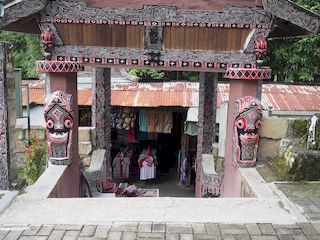
Scenes filmed in Dokan, a traditional Batak village, allow closer observation of local architecture and community organization. The large wooden houses with steeply curved roofs reflect building traditions adapted to both climate and social structure. Several families could traditionally occupy different sections of the same communal house, reinforcing clan-based organization within Batak society.
Lake Toba and the cultural heritage of the Batak peoples
The Lake Toba forms the geographical center of the journey. The lake occupies a vast volcanic caldera created by one of the largest known eruptions in prehistoric history. Surrounded by mountains and steep slopes, the lake continues to dominate the physical and cultural landscape of northern Sumatra.
The video also shows the Sipiso Piso Waterfall, located near the northern edge of the lake basin. The dramatic drop of the waterfall and the surrounding cliffs illustrate the rugged volcanic topography of the region, where erosion and tectonic activity continue to shape the landscape.
In Tomok, the tomb of King Sidabutar reflects the importance of ancestral traditions and local ruling lineages within Batak history. Stone sarcophagi, carved funerary monuments, and ceremonial spaces preserve elements of older social systems organized around clans and hereditary leadership. These monuments also reveal the persistence of funerary traditions linked to ancestor veneration.
The sequences filmed in Simanindo and during performances of Batak Tribal Dance highlight another dimension of Batak cultural identity. Traditional dances, music, and costumes continue to be performed during ceremonies and cultural presentations. Rhythmic movements, textile patterns, and musical accompaniment reveal traditions transmitted through generations and still maintained within contemporary Batak communities.
What the videos on this site make particularly easy to observe
The animated photographic sequences used throughout the video allow viewers to examine the landscapes and cultural details of the Batak highlands with particular clarity. Slow visual transitions make the scale of Lake Toba, the volcanic reliefs, and the organization of mountain villages easier to understand than rapidly edited footage often allows.
This approach is especially effective for observing traditional architecture and funerary monuments. Roof structures, carved decorations, wooden textures, and stone details remain visible long enough to encourage careful examination of forms and construction techniques.
Market scenes and dance performances also benefit from this visual method. Clothing, gestures, musical instruments, and ceremonial arrangements can be observed progressively through stable framing and gradual camera movements within the photographs.
The video further creates clear connections between different dimensions of northern Sumatra, linking volcanoes, lakeside landscapes, rural settlements, and cultural traditions within a coherent visual journey.
Between volcanic geography and Batak cultural identity
This journey around Lake Toba presents northern Sumatra as a region where volcanic landscapes, village life, and Batak traditions remain deeply interconnected. Active volcanoes, waterfalls, markets, traditional villages, funerary monuments, and ceremonial dances together form a portrait of a territory where environmental conditions and cultural heritage continue to shape everyday life across the Batak highlands.
Links to related pages





Audio Commentary Transcript
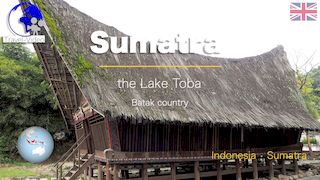
These beautiful large thatched roof houses are part of the Batak culture.
Unfortunately the cost of maintaining these beautiful buildings is considerable and we see more and more these thatched roofs replaced by corrugated iron roofs.
These very large houses house between 6 and 10 families and the intimacy in these houses is more than random ...
The space reserved for each family is delimited by carpets on the floor.
Lake Toba is the crater of a super volcano whose last eruption dates back 74,000 years.
It is the largest volcanic lake in the world with its 100 km long and 35 km wide.
After the last eruption the crater filled with water and later the bottom rose to form the island of Samosir which is in its center.

Music:
- - YouTube video library - Anamalie, (© Anamalie by Kevin MacLeod is licensed under a Creative Commons Attribution 4.0 license. https://creativecommons.org/licenses/by/4.0/
- Source: http://incompetech.com/music/royalty-free/index.html?isrc=USUAN1500007
- Artist: http://incompetech.com/)
- - YouTube video library - Argonne - Zachariah Hickman
- - YouTube video library - Carol of the Bells
- - YouTube video library - Clouds
Disclaimer: Despite its appropriateness, copyright issues prevent the use of indonesian traditional music in "Indonesia • Sumatra • Lake Toba, homeland of the Bataks ", hence the use of royalty-free music. Despite our careful selection, some might regret this decision, which is necessary to avoid potential lawsuits. Although difficult, this decision is the only viable solution.