Français (France)
  Nederlands (nl-NL)
 00:00 • intro | 00:24 • Borobudur | 04:44 • a batik workshop | 06:25 • gamelan | 07:52 • Ramayana | 08:49 • Blitar, a village | 09:55 • Penataran temple | 10:43 • Malang • Kampung Jodipan
Personal creation from visual material collected during my trip Indonesia • Sumatra, Java and Bali (2019)
• Use the markers to explore the content •
From Borobudur to Eastern Java: Buddhist Heritage, Performing Arts and Urban Landscapes
A journey through the cultural diversity of Java
This video explores several dimensions of Javanese culture through a route linking major religious monuments, artistic traditions, villages, and contemporary urban spaces. Moving from central Java toward the eastern part of the island, the film combines Buddhist architecture, traditional crafts, music, dance, and everyday scenes that together illustrate the cultural complexity of Indonesia’s most populated island.
The journey begins at Borobudur Temple, the largest Buddhist monument in Indonesia and one of the most significant Buddhist structures in the world. The video then shifts toward living traditions associated with Javanese identity, including batik production, gamelan music, and performances inspired by the Ramayana epic. Other sequences introduce village life, the Hindu temple complex of Penataran, and the urban environment of Malang, including the colorful district of Kampung Jodipan.
Rather than focusing on a single monument or city, the film presents Java as a cultural landscape shaped by centuries of religious change, artistic continuity, and urban transformation. The coexistence of ancient sanctuaries, traditional arts, and modern urban initiatives reflects the layered historical identity of the island.
Borobudur, Penataran and the architectural heritage of Java
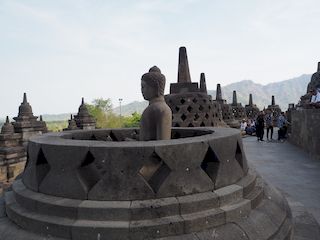
Borobudur occupies a central place in the video. Constructed during the eighth and ninth centuries under the Sailendra dynasty, the monument consists of a vast pyramidal structure formed by successive terraces covered with sculpted reliefs and crowned with stupas. Its architectural organization follows symbolic Buddhist concepts linked to spiritual progression and cosmological order. The galleries contain narrative reliefs illustrating religious stories, scenes of daily life, and elements of Javanese society during the early medieval period.
The film later introduces the Batik tradition through scenes filmed inside a workshop. Batik remains one of the most recognizable forms of Indonesian textile art, characterized by wax-resist dyeing techniques and complex decorative patterns. Historically associated with royal courts and urban craft communities, batik continues to occupy an important place in Indonesian cultural identity.
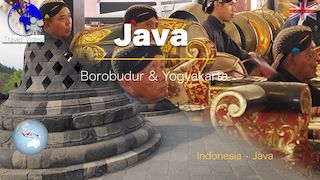
Another major cultural element shown in the video is the gamelan orchestra. Composed primarily of metallophones, gongs, drums, and other percussion instruments, gamelan music accompanies ceremonies, theatrical performances, and traditional dance throughout Java. The sequences inspired by the Ramayana demonstrate how Indian epics were integrated into Javanese culture and adapted through local artistic traditions over many centuries.
Further east, the Penataran temple complex illustrates another phase of Javanese religious and political history. Associated with the Majapahit kingdom, the site contains structures decorated with reliefs and sculptural elements reflecting the development of Hindu architecture in eastern Java. Its organization differs significantly from Borobudur while revealing another important stage in the evolution of monumental architecture on the island.
The final part of the video introduces Malang and the district of Kampung Jodipan. Originally a modest urban neighborhood, the area became known for its brightly painted houses and public art projects. These transformations illustrate how contemporary urban initiatives can reshape the visual identity of Indonesian cities while attracting new forms of local tourism.
Historical and cultural context of the sites and traditions
The monuments and traditions visible throughout the video belong to different historical periods of Java. Borobudur reflects a phase when Buddhism played a major political and religious role in central Java under the Sailendra dynasty. Centuries later, eastern Java became associated with Hindu kingdoms such as Majapahit, whose architectural legacy survives at Penataran.
The artistic traditions presented in the film also demonstrate the continuity of older cultural practices within modern Indonesia. Batik production continues to rely on techniques transmitted across generations, while gamelan music and Ramayana performances maintain ceremonial, educational, and artistic functions in many Javanese communities.
The village scenes shown near Blitar provide another perspective on Java beyond monumental architecture. Agricultural landscapes, local settlements, and everyday activities remain closely connected to the cultural traditions of the island. These sequences place the monuments within a broader human and geographic environment rather than isolating them as purely archaeological sites.
Urban scenes filmed in Malang reveal yet another aspect of contemporary Java. Rapid urban growth, local initiatives, and the reuse of older neighborhoods demonstrate how Indonesian cities continue to evolve while preserving visible traces of historical and cultural identity.
What the videos on this site make particularly easy to observe
The animated photographic sequences used throughout the video make it possible to examine architectural details, artistic objects, and urban environments with particular clarity. At Borobudur, gradual visual movements reveal the organization of the terraces, the alignment of stupas, and the density of sculpted reliefs more effectively than rapidly edited footage.
This visual approach is equally useful for observing the details of batik production, the instruments of the gamelan orchestra, and the decorative environments associated with Ramayana performances. Textures, patterns, colors, and sculptural details remain visible long enough to encourage careful observation.
The transitions between monuments, villages, workshops, and urban districts also create a progressive understanding of the diversity of Java. Instead of presenting isolated locations, the video establishes visual relationships between religious heritage, artistic traditions, and contemporary urban life.
Animated photography further emphasizes contrasts between different environments: the massive stone architecture of Borobudur, the open rural landscapes near Blitar, and the dense urban fabric of Malang. These transitions help viewers understand the geographic and cultural variety of the island.
A cultural portrait of Java between ancient monuments and living traditions
This journey through Borobudur, Yogyakarta, eastern Java, and Malang presents Java as a region where monumental heritage remains closely connected to artistic traditions and contemporary urban life. Buddhist and Hindu architecture, textile crafts, music, theater, village landscapes, and evolving cities together form a complex cultural landscape shaped by centuries of historical continuity and transformation.





Audio Commentary Transcript
Borobudur and its stupas are in reality a single large stupa. Seen from above, the site is also in the form of a giant vajrayana mandala representing both Buddhist cosmology and the nature of the soul. Its base is a square approximately 118 meters in length. It has nine platforms, the first six square and the top three circular. The top platform has a large stupa in its center surrounded by seventy-two other small ones. The stupas are in the form of bells and pierced with numerous decorative openings. Sitting Buddha statues can be seen through the openings.

Music :
- - YouTube video library - Argonne - Zachariah Hickman
- - YouTube video library - Beijaflor
- - YouTube video library - Deck the Halls
- - YouTube video library - Gamela - E's Jammy Jams
Disclaimer: Despite its appropriateness, copyright issues prevent the use of indonesian traditional music in "Indonesia • Java • Borobudur and Yogyakarta ", hence the use of royalty-free music. Despite our careful selection, some might regret this decision, which is necessary to avoid potential lawsuits. Although difficult, this decision is the only viable solution.