Français (France)
  Nederlands (nl-NL)
 00:00 • intro | 00:21 • Medan | 00:56 • Raya al Mashun mosque | 02:02 • Istama Maimun Palace | 02:55 • Bukit Lawang | 03:02 • Thomas' semnopithecus | 03:33 • the Sumatran orangutan | 06:29 • the village of Bukit Lawang | 08:18 • ... and palm oil
Personal creation from visual material collected during my trip Indonesia • Sumatra, Java and Bali (2019)
Map of places or practices featured in the video
• Use the markers to explore the content •
Medan and Bukit Lawang between Islamic Heritage and Tropical Forests
A journey through northern Sumatra between urban history and rainforest ecosystems
This video explores several dimensions of northern Sumatra, moving from the city of Medan to the forested landscapes surrounding Bukit Lawang. Urban heritage, Islamic architecture, tropical biodiversity, village life, and environmental pressures all appear throughout the journey, creating a broader portrait of a region shaped by trade, colonial history, and one of Southeast Asia’s richest natural environments.
The route connects two very different settings. Medan represents one of Indonesia’s major urban centers, historically linked to plantation economies and maritime trade networks. Bukit Lawang, by contrast, lies at the edge of dense tropical rainforest and is internationally known for its role in the protection of the Sumatran orangutan. The transition between these locations reveals the diversity of northern Sumatra, where rapidly developing cities coexist with some of the island’s remaining primary forests.
The video also introduces environmental issues closely tied to the region today. The presence of wildlife sanctuaries and protected forests contrasts with the expansion of palm oil plantations, illustrating the complex relationship between economic development, agriculture, tourism, and conservation.
Medan, the Sultanate of Deli, and urban heritage
The first part of the video focuses on Medan, capital of North Sumatra and one of Indonesia’s largest cities. Its development accelerated during the colonial period, when the surrounding region became an important center for tobacco, rubber, and plantation agriculture. The city gradually evolved into a commercial hub connected to international maritime trade routes through the Strait of Malacca.
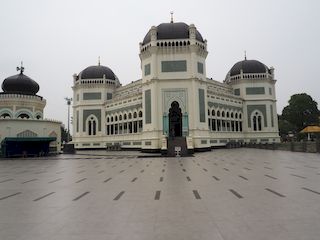
Among the principal monuments shown in the video is the Mosquée Raya al Mashun, one of Medan’s best-known religious buildings. Constructed during the early twentieth century under the Sultanate of Deli, the mosque combines several architectural influences visible in its domes, arches, interior decoration, and spatial organization. The building reflects both the political prestige of the sultanate and the importance of Islam in the historical identity of the region.
The nearby Istana Maimun palace represents another important legacy of the Sultanate of Deli. Built as a royal residence, the palace illustrates the interaction between Malay traditions, Islamic artistic forms, and European colonial influences. Its ceremonial halls and ornamental details demonstrate the role once played by local aristocratic elites in shaping the urban landscape of Medan.
Street scenes visible throughout the city also emphasize Medan’s multicultural character. Commercial districts, modern traffic, historical buildings, and dense urban neighborhoods reveal the coexistence of contemporary economic activity with older political and architectural heritage.
Bukit Lawang and the forests of northern Sumatra
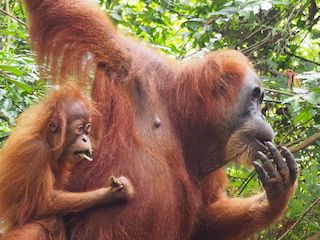
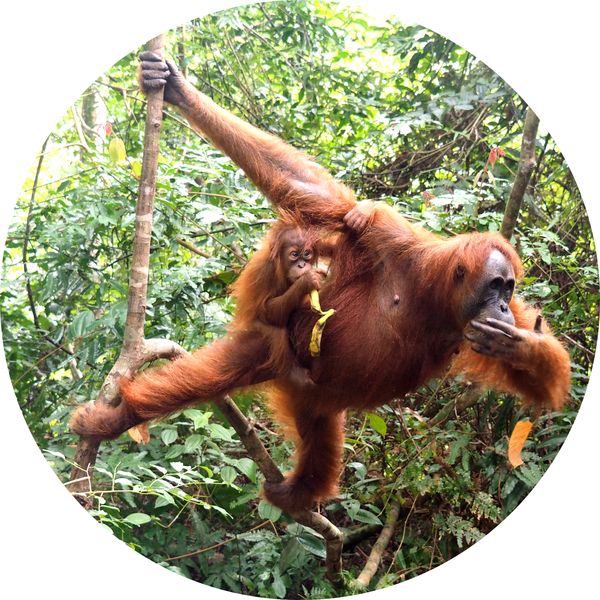
The second part of the video moves toward Réserve d’Orangs-Outans de Bukit Lawang, located near the Gunung Leuser National Park. This protected forest region is internationally recognized as one of the last natural habitats of the critically endangered Sumatran orangutan.
The sequences filmed in the rainforest allow close observation of the orangutans within a tropical environment characterized by dense vegetation, river valleys, and humid forest ecosystems. The video also shows the Thomas’s langur, a primate species endemic to Sumatra and recognizable by its contrasting coloration and highly social group behavior.
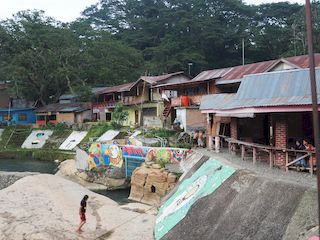
Bukit Lawang itself developed partly around orangutan rehabilitation and conservation programs. Over time, the village became an important center for ecotourism, attracting visitors interested in wildlife observation and rainforest trekking. The coexistence between tourism, local village life, and environmental protection forms an important aspect of the region visible throughout the film.
The final part of the journey briefly addresses the issue of palm oil production, which has transformed large areas of Sumatra over recent decades. Expanding plantations have contributed significantly to deforestation and habitat fragmentation across the island. By including both protected forest areas and references to agricultural expansion, the video highlights the environmental pressures affecting wildlife conservation in contemporary Indonesia.
Historical, environmental, and cultural context
Northern Sumatra has long occupied an important position within maritime trade networks linking the Indonesian archipelago to the Indian Ocean and the Malay world. The Sultanate of Deli emerged as a regional political power partly through its control of commercial activities and agricultural production during the colonial era. Medan itself expanded rapidly because of plantation economies supported by Dutch colonial administration and international export markets.
The forests surrounding Bukit Lawang belong to one of Southeast Asia’s most biologically diverse ecosystems. Gunung Leuser National Park shelters numerous endangered species, including orangutans, tigers, elephants, and rhinoceroses. The ecological importance of this environment extends far beyond Indonesia, since the remaining forests of Sumatra play a major role in regional biodiversity conservation.
At the same time, the rapid expansion of palm oil plantations has become one of the defining transformations of modern Sumatra. Palm oil production represents an important economic sector for Indonesia, yet it has also generated debates concerning deforestation, habitat destruction, and long-term environmental sustainability.
The coexistence of urban heritage in Medan and rainforest conservation around Bukit Lawang illustrates two very different but interconnected dimensions of northern Sumatra’s contemporary identity.
What the videos on this site make particularly easy to observe
The animated photographic sequences used in these videos make it possible to observe both urban monuments and rainforest environments with particular clarity. Slow transitions and carefully framed images reveal the architectural volumes of the Raya al Mashun Mosque and the ornamental details of Istana Maimun more effectively than rapidly edited footage.
This visual approach also improves the observation of wildlife behavior. The movements of orangutans through the forest canopy, the posture of Thomas’s langurs, and the density of tropical vegetation remain visible long enough to allow careful attention to detail.
The contrast between urban landscapes and forest ecosystems becomes progressively easier to understand through the rhythm of the transitions. Streets, mosques, palaces, villages, rivers, and rainforest paths are connected visually in a coherent progression that reflects the geographic diversity of northern Sumatra.
The use of animated photography also highlights the environmental contrast between protected jungle areas and landscapes transformed by agricultural development, reinforcing the broader themes explored throughout the journey.
Between urban expansion and endangered rainforest ecosystems
This journey between Medan and Bukit Lawang presents northern Sumatra as a region where historical heritage, urban growth, and environmental fragility remain closely interconnected. Between Islamic monuments, royal architecture, tropical forests, endangered primates, and the expansion of palm oil cultivation, the video offers a broader reading of Sumatra that combines cultural history with contemporary ecological realities.
Links to related pages





Audio Commentary Transcript
Medan is the capital and largest city of North Sumatra province and one of Indonesia's 4 main cities. The agglomeration of Medan has nearly 4.5 million inhabitants.
The city was founded by Guru Patimpus Sembiring Pelaw in the 16th century.
The economy of Medan was mainly based on the cultivation and production of tobacco, rubber, tea, palm and coffee, but the growing manufacturing sector like automobile, production of machinery, tiles, paper and pulp, etc., also currently contributes to the city's economy.
Bukit Lawang is a small village on the banks of the Bahorok River in the province of North Sumatra. The village has housed a rehabilitation center for orangutans since 1973. As the place was becoming too touristy, the center was closed in 2002 since it could no longer fulfill its rehabilitation task under these conditions.
In November 2003 catastrophic floods devastated the village causing great damage. This flood is believed to be due to illegal logging. Thanks to the support of numerous international organizations, the site was able to reopen its doors in June 2004.
Music:
- - YouTube video library - Anamalie, (© Anamalie by Kevin MacLeod is licensed under a Creative Commons Attribution 4.0 license. https://creativecommons.org/licenses/by/4.0/
- Source: http://incompetech.com/music/royalty-free/index.html?isrc=USUAN1500007
- Artist: http://incompetech.com/)
- - YouTube video library - Argonne - Zachariah Hickman
- - YouTube video library - Automn Day, (© Autumn Day by Kevin MacLeod is licensed under a Creative Commons Attribution 4.0 license. https://creativecommons.org/licenses/by/4.0/
- Source: http://incompetech.com/music/royalty-free/index.html?isrc=USUAN1100765
- Artist: http://incompetech.com/)
- - YouTube video library - Lurking Shadows
Disclaimer: Despite its appropriateness, copyright issues prevent the use of indonesian traditional music in "Indonesia • Sumatra • Medan and the orangutan sanctuary", hence the use of royalty-free music. Despite our careful selection, some might regret this decision, which is necessary to avoid potential lawsuits. Although difficult, this decision is the only viable solution.