Français (France)
  Nederlands (nl-NL)
 The fruit market in Berastagi is a well-established tradition that plays an important role in the town’s commercial and social life. This vibrant and active marketplace serves as a point of exchange between local farmers, traders, and visitors. The variety of tropical fruits available illustrates the agricultural richness of the region, supported by a climate suitable for growing many different crops. The market enables direct sales and promotes produce from surrounding areas. It also contributes to the local economy by supporting small-scale producers. This ongoing tradition links agricultural practices to everyday trade within an urban setting that continues to evolve.
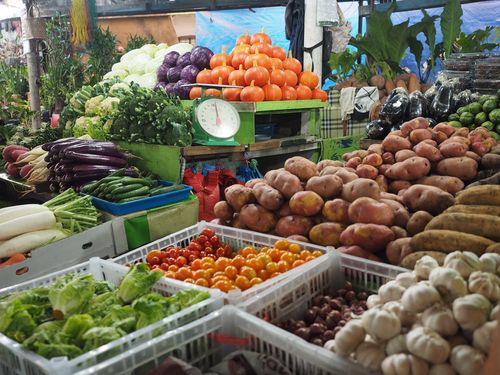
Berastagi • Fruit market

Berastagi • Fruit market
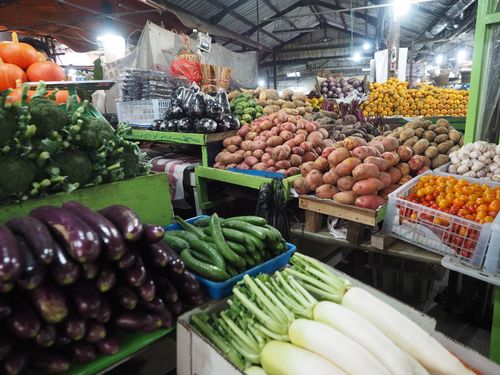
Berastagi • Fruit market
Tradition profile
Fruit market
Tradition category: Local market
Tradition family: Traditional markets and fairs
Tradition genre: Trade and Local Creativity
Geographic location: Berastagi • Sumatra • Indonesia
• Links to •
• List of videos about Toba Lake on this site •
Indonesia • Sumatra • Lake Toba, homeland of the Bataks
Tradition and Transformation: The Fruit Market of Lake Toba as a Cultural and Social Institution
Origins and political motivations behind the practice
The tradition of the fruit market around Lake Toba in North Sumatra, Indonesia, is rooted in both practical necessity and socio-political organization among the Batak Toba communities. Although exact records are scarce, the practice of exchanging agricultural products can be traced back to the late 18th or early 19th century, prior to formal colonial administration. In this context, markets were more than commercial gatherings; they functioned as tools of territorial cohesion, where clan leaders (raja) coordinated the timing and regulation of exchange as a way of reinforcing alliances and managing resource distribution among autonomous villages.
As Dutch colonial influence expanded in the 19th century, the establishment of transport routes and trading outposts significantly reshaped the nature of local markets. Colonial authorities saw value in stimulating local commerce, not only to facilitate the movement of agricultural produce like coffee and spices, but also to incorporate the Batak highlands into a wider economic and administrative network. This laid the groundwork for a more permanent, centralized market structure along the shores of Lake Toba, integrating traditional economic models with colonial expectations.
Historical turning points and cultural impact
Several events contributed to the transformation of the Lake Toba fruit market. During the early 20th century, missionary activities and the introduction of Western-style schooling began to alter the social landscape. These shifts affected traditional agricultural cycles and introduced new consumer habits. Later, in the post-independence period (after 1945), the Indonesian government promoted rural development through local cooperatives, further formalizing market activity.
By the 1970s and 1980s, with the rise of tourism to Lake Toba, the market adapted to a new demographic of buyers, offering fruits not only to locals but also to Indonesian and international visitors. The presence of non-native crops, new packaging methods, and tourist-friendly arrangements signaled a cultural hybridization, reflecting broader global trends in rural commerce.
On a social level, the market also contributed to a gendered economic dynamic, where women often served as primary vendors, reinforcing their role as economic agents within their households and communities.
A global comparison of market traditions
At the time of its emergence, the Lake Toba fruit market shared key characteristics with other agrarian exchange hubs worldwide. Like the ferias in Latin America, the weekly markets in Sub-Saharan Africa, or the bazars of Central Asia, the fruit market at Toba served as a multi-functional institution, blending economic exchange with social cohesion and ritualized interaction.
What distinguishes the Toba market, however, is its unique linkage to Batak clan identity, with local products often carrying embedded social value. The use of handwoven baskets (pudun) made from natural fibers, for instance, is both utilitarian and symbolic, often passed down through generations. Such items reflect a distinct cultural grammar surrounding production, value, and belonging.
Major transformations and cultural resilience
Over the past two centuries, the fruit market has undergone several transformations. The most significant include:
- The shift from barter to monetary exchange, particularly under colonial administration.
- The integration of external goods and measuring systems, adapting to broader Indonesian standards.
- The commercialization of local produce for tourism, which has altered the scale, rhythm, and presentation of the market experience.
These changes mirror shifts in political power, from clan-based leadership to colonial rule, and later to a centralized Indonesian state. Each regime brought its own set of economic expectations and regulatory frameworks, which the local tradition has absorbed, resisted, or adapted to.
Despite these shifts, the fruit market has retained its importance as a social and cultural anchor. It continues to serve as a point of convergence for neighboring villages and tourists alike, functioning as both a space of exchange and a performance of local identity.
Current status and preservation challenges
While the fruit market remains popular, particularly during peak tourist seasons, it faces several challenges:
- Urbanization and infrastructure development have reduced available space for traditional market layouts.
- The proliferation of supermarkets and imported goods threatens the dominance of local produce.
- Younger generations increasingly migrate to urban centers, leaving fewer successors to maintain agricultural production and market roles.
There is currently no formal recognition of the Lake Toba fruit market by UNESCO or other international heritage institutions. However, local NGOs and academic bodies in North Sumatra have initiated documentation and awareness campaigns aimed at preserving its intangible heritage value.
Efforts to sustain the market tradition may benefit from integrated strategies, including local policy support, cultural education, and possibly heritage tourism initiatives that highlight its unique role in the region’s history and daily life.
In this context, the fruit market of Lake Toba stands not only as an economic necessity but as a living tradition—one that continues to adapt while embodying the values, memory, and resilience of the communities it serves.
Berastagi’s Fruit Market: A Cultural Innovation Rooted in Exchange and Identity
A social innovation shaped by geography and need
The fruit market of Berastagi, located in the Karo Highlands of North Sumatra, Indonesia, emerged as a response to specific social and environmental conditions. Its development in the late 19th century illustrates a form of community innovation, where the abundance of agricultural production was channeled into an organized and recurring economic space. The highland climate, ideal for growing both tropical and temperate fruits such as passionfruit, mangosteen, oranges, and strawberries, necessitated a system for distribution beyond village boundaries.
Unlike sporadic trade or barter-based exchanges seen in more isolated contexts, the Berastagi market evolved into a structured gathering point, enabling both regular income and inter-village cooperation. The decision to anchor this commercial practice in a centralized town location reflected a conscious effort to consolidate regional identity while facilitating economic sustainability. In this sense, the market itself became a social institution, designed to answer agricultural surplus, transportation limitations, and the desire for communal interaction.
Symbols, rituals, and expressions of cultural values
The market is not only a space for economic transactions; it is also a site for the expression of cultural symbols and community values. Farmers and vendors transport their goods in woven bamboo baskets (rumbia), often made by hand and decorated with motifs specific to the Karo ethnic group. These baskets are not merely utilitarian—they represent continuity, craftsmanship, and familial identity.
Historically, the market was opened on special days aligned with local agricultural calendars, and market openings were sometimes marked by traditional music or the sounding of bamboo gongs to signal the arrival of rare goods or traders from distant villages. Oral accounts describe how young men would compete in arranging the most visually impressive fruit displays, with arrangements symbolizing abundance and harmony. Such practices reinforced the prestige of the family or village represented, highlighting how aesthetic presentation could become a form of social messaging.
The role of women in the market has long been central. Women often serve as both producers and vendors, which reflects broader Karo cultural norms of shared economic responsibility and underscores the market’s role in reinforcing gender-based economic agency.
Cultural blending and external influences
Berastagi’s location along a colonial-era trade route and its proximity to other ethnic regions encouraged early contact with Javanese, Chinese, and Batak Toba traders. This resulted in a hybrid commercial culture, where traditional Karo customs coexisted with foreign influences.
One notable example is the adoption of external pricing systems: while traditional units of measure were used for local buyers, metric weights and packaging were gradually introduced for external and urban customers. Vendors also began adopting new sales strategies, such as price incentives or bundled offerings—practices influenced by interaction with traders from Medan and beyond.
The language of the market itself reflects this hybrid identity, with a mix of Karo, Bahasa Indonesia, and even Hokkien terms used in daily interactions. These linguistic and economic adaptations helped ensure the survival of the market through political and technological changes over the 20th century.
Anecdotes and statistics illustrating community memory
While exact numbers fluctuate, estimates suggest that over 500 vendors operate at Berastagi’s main market during peak days, with thousands of visitors arriving on weekends and during the tourist high season. One frequently cited anecdote recounts the early 1980s, when a single giant durian, weighing nearly 10 kilograms, drew a crowd large enough to halt traffic in the town center. The fruit was eventually sold through a local auction, symbolizing both the economic and performative aspects of the market.
Another example of cultural resilience comes from the temporary revival of ritual music during the 2010 harvest festival, when local elders organized a reenactment of traditional fruit presentation ceremonies, attracting domestic and foreign visitors and renewing interest in market traditions among younger Karo generations.
International recognition and preservation efforts
Although Berastagi’s fruit market has not yet been listed as intangible cultural heritage by UNESCO, it has received national attention through cultural documentation programs led by Indonesian universities and local cultural institutions. The National Agency for Cultural Preservation (BPCB Sumatra) has conducted ethnographic studies on market practices, citing the site as a model for how traditional knowledge can coexist with modern economic systems.
Inclusion in international heritage lists would likely enhance protective policies and offer funding opportunities for infrastructure and education. Such recognition could also help standardize preservation efforts and promote cultural tourism in ways that respect local agency and environmental sustainability.
Yet, the path to recognition is not without challenges. The commercialization of heritage risks diluting authentic practices for the sake of tourist appeal. Moreover, urbanization and shifts in consumer habits threaten the long-term viability of traditional forms of selling and producing. The pressure to modernize can also reduce opportunities for intergenerational transmission of knowledge.
Cultural importance and future challenges
Today, Berastagi’s fruit market remains a pillar of local identity, blending commerce, symbolism, and shared memory. Its continued relevance depends not only on its economic function but also on its ability to adapt while safeguarding its intangible cultural elements.
To preserve this tradition in the face of modern threats—ranging from climate variability to digital retail platforms—local actors must balance economic modernization with cultural continuity. Initiatives such as community-run cooperatives, cultural education in schools, and partnerships with tourism bodies could offer a sustainable path forward.
Ultimately, the fruit market of Berastagi exemplifies how a practical need—selling surplus produce—can evolve into a vibrant cultural system, deeply embedded in both everyday life and the collective imagination of a region.
 Links to the main sections of the site