Français (France)
  Nederlands (nl-NL)
 Everyday life in Bhim offers a practical view of the rhythm of a small town in Rajasthan, where trade, movement, social contact and local services shape the urban environment. Streets are shared by vendors, artisans, residents and visitors in a setting driven by ordinary exchanges. This local life shows the coexistence of older practices and recent changes, visible in transport, consumption and social organisation. Observing Bhim helps explain the human dimension of India’s secondary towns, often less known than major tourist centres but essential to regional activity and daily life.
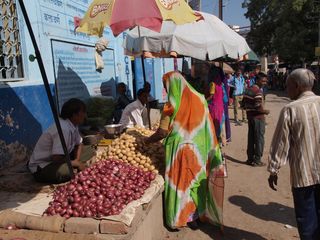
Bhim • Daily life
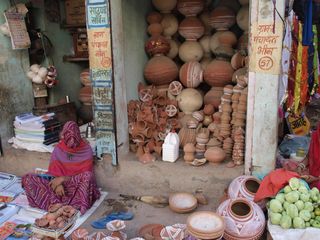
Bhim • Daily life
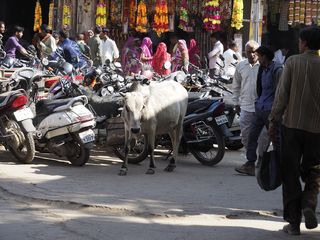
Bhim • Daily life
Tradition profile
Daily life
Tradition category: Small Retail Business
Tradition family: Traditional markets and fairs
Tradition genre: Trade and Local Creativity
Geographic location: Bhim • Rajasthan • India
• Links to •
• List of videos about Bhim on this site •
Bhim, an Indian village • Rajasthan, India
Everyday Life in Bhim: Historical Formation of a Small-Town Urban Tradition in Rajasthan
Origins in a Regional Exchange Centre
Everyday life in Bhim does not refer to a single codified ceremony, but to a long-established set of urban habits, commercial practices and social relationships that developed in the town of Bhim, in present-day Rajasthan. Its historical roots lie in the role of small market towns across western India, where settlements linked rural producers with traders, craftsmen, transporters and administrative authorities.
Bhim emerged within a semi-arid environment where agriculture depended on seasonal cycles, local trade and access to nearby markets. Town life therefore grew around practical needs: sale of grain, textiles, tools, animals and household goods, as well as services such as tailoring, food preparation, repair work and money lending. What later became the “tradition” of everyday life in Bhim was originally the ordinary social system required for survival and exchange.
Political and Social Framework
Historically, Rajasthan was shaped by Rajput states, local chiefs and merchant networks. In such settings, towns like Bhim prospered when roads were secure and regional authorities protected trade. Local elites, landholders and merchant communities often encouraged market activity because taxes, rents and commercial circulation benefited them directly.
Caste-based occupational groups also played an important role. Potters, blacksmiths, barbers, tailors, shopkeepers, grain dealers and transport workers formed the practical structure of daily life. Religious communities, especially Hindu and Jain groups active in commerce, influenced charitable giving, temple patronage and trust-based economic networks.
The social order was hierarchical, yet market streets created regular interaction between communities that might otherwise remain socially separated. This gave small towns a distinctive rhythm combining hierarchy with constant negotiation.
Dynastic Change and Colonial Transformation
Changes in regional power affected Bhim’s daily practices. Periods of warfare, drought or political instability could reduce trade, while stable rule encouraged fairs, road movement and investment in urban services. During the colonial era, indirect British control over princely Rajasthan gradually integrated local economies into wider systems of taxation, transport and commodity exchange.
Imported manufactured goods began to compete with local crafts. New roads altered mobility patterns, and administrative routines expanded the importance of towns as service centres. Yet traditional bazaars remained essential because they adapted quickly, combining old skills with new products.
This process resembled developments in many parts of the world during the nineteenth century, when local market towns in North Africa, the Ottoman world or Latin America also adjusted to industrial imports while preserving street-based commerce.
Global Parallels
The rise of Bhim as a functional market town can be compared with small urban centres elsewhere that mediated between countryside and larger cities. In medieval Europe, caravan towns in the Middle East, or county towns in East Asia, similar systems connected rural production with local demand.
The difference in Bhim lies in the stronger continuity of family enterprise, caste-linked professions and mixed-use streets where residence, trade and craftsmanship often remained physically close. While some industrial societies separated work and domestic space more sharply, Bhim retained an integrated urban model.
Change after Indian Independence
After 1947, Indian independence brought new administrative structures, public education, electoral politics and improved infrastructure. Bhim’s everyday life changed through motorisation, buses, motorcycles, electrification and wider access to manufactured goods. Traditional animal transport coexisted for a time with modern vehicles.
Economic diversification followed. Repair workshops, food stalls, mechanical services and retail shops expanded. Younger generations sought education and employment beyond hereditary occupations, reducing the rigidity of older professional structures.
At the same time, national food systems, government welfare schemes and mass media reshaped consumption patterns. Yet many small family businesses survived because they remained flexible and socially embedded.
Contemporary Meaning and Cultural Importance
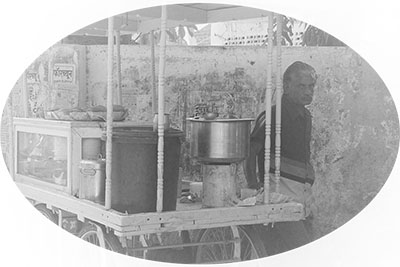
Today, everyday life in Bhim is still defined by street commerce, personal networks and local services. Markets, roadside stalls, tea shops and workshops continue to function as centres of social exchange. Residents often perceive these practices not as heritage, but as normal life. Yet precisely this ordinariness gives them cultural importance.
They preserve spoken languages, local forms of hospitality, bargaining customs, seasonal rhythms and practical cooperation between neighbours. For visitors or returning migrants, such scenes often symbolize continuity and belonging.
The tradition also has a civic dimension: local shops and public streets act as informal spaces where news circulates, disputes are discussed and communal relationships are maintained.
Preservation and Modern Challenges
The main threats are not ceremonial decline but structural transformation. Urban congestion, migration, supermarket-style retail, digital platforms and changing aspirations among younger generations may weaken traditional small-scale street economies. Some artisanal skills disappear when successors choose different careers.
However, Bhim’s everyday tradition remains resilient because it is rooted in utility. It continues whenever people buy locally, repair goods, meet in public spaces or maintain trust-based exchanges. Preservation therefore depends less on formal heritage listing than on balanced urban planning, support for small enterprise and recognition that ordinary daily practices can form an important part of intangible cultural heritage.
In this sense, everyday life in Bhim represents a living historical continuity: modest in appearance, but central to the social identity of the town and to the wider history of urban Rajasthan.
Everyday Life in Bhim: Characteristics of a Living Urban Tradition in Rajasthan
Origins and Social Context
Everyday life in Bhim refers to the customary patterns of trade, movement, neighbourhood interaction and small-scale services that shape the town’s daily rhythm. Rather than a formal ritual, it is a living urban tradition formed by the historical role of Bhim as a local market centre in Rajasthan. Small towns in this region traditionally connected surrounding villages with administrative services, craftsmen and merchants. As a result, public streets became spaces of exchange and social contact.
Its original function was practical: supplying goods, organising labour, enabling communication and sustaining local households. Within the wider culture of Rajasthan, where bazaars and roadside commerce have long been central, Bhim represents the model of a modest but active service town.
Constituent Practices and Daily Structure
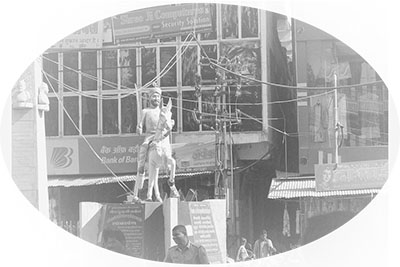
The tradition is visible through repeated daily actions. Shops open in the morning, street vendors arrange goods, artisans begin work, tea stalls receive early customers and transport activity increases through the day. Residents purchase vegetables, grains, textiles or household items while also using tailoring, barbering, repair and food services.
Objects associated with this environment include weighing scales, baskets, cloth awnings, hand tools, cooking vessels, motorcycles, bicycles and carts. Clothing varies between traditional garments and contemporary dress, reflecting both continuity and change.
Knowledge is transmitted informally through family businesses and apprenticeships. Skills include bargaining, product selection, food preparation, customer relations, craft repair, seasonal trade timing and management of small enterprises with limited resources.
Symbolism and Meanings
Although ordinary in appearance, this daily life conveys important social values. It reflects self-reliance, community interdependence and adaptation to climate and economy. The visibility of trade in open streets expresses transparency and accessibility. Regular greetings, respectful gestures toward elders and repeated customer relationships reinforce trust.
Colour also has symbolic presence. Bright textiles, produce displays and decorated vehicles echo wider Rajasthani visual culture. Sound plays a role through conversation, traffic, calls of vendors and devotional music heard from nearby homes or temples.
Local variations may appear according to neighbourhood, caste background, occupation or market day intensity, but the shared identity of Bhim remains rooted in familiar public interaction.
Evolution and External Influences
Over time, the tradition has adapted to political and economic change. Colonial trade networks introduced new goods, while post-independence development expanded roads, schooling and state administration. Motorcycles replaced older transport methods, packaged products joined handmade goods and mobile phones altered communication.
Yet Bhim retains similarities with market-town traditions found in North Africa, the Middle East or Southeast Asia, where streets still combine commerce, residence and social life. Its distinctiveness lies in the persistence of family-run microbusinesses and close ties between town and countryside.
Social Organisation and Community Impact
Daily life in Bhim helps structure relations between generations, occupations and communities. Shopkeepers often serve as information nodes, craftsmen as problem-solvers and tea stalls as informal meeting places. Women, men, elders, workers and students participate in overlapping but distinct ways throughout the day.
During festivals, wedding seasons or harvest periods, economic activity intensifies and streets gain additional ceremonial importance. Even without formal statistics, a significant share of local livelihoods depends directly or indirectly on this small-scale economy.
Preservation and Current Challenges
This tradition has no major UNESCO-style status, yet it represents valuable intangible heritage. Its main threats are traffic pressure, standardised retail chains, youth migration and declining interest in inherited trades. Some manual professions may disappear without successors.
Preservation depends on maintaining active streets, affordable small business space and respect for practical local knowledge. As long as residents continue to buy locally, meet publicly and sustain everyday exchanges, the living tradition of Bhim remains active and culturally significant.
 Links to the main sections of the site