Français (France)
  Nederlands (nl-NL)
 Minangkabau Dance refers to several dance traditions belonging to Minangkabau culture and performed in Bukittinggi. These dances accompany family ceremonies, community celebrations, and cultural performances. They are known for precise movements, sometimes influenced by local martial arts, and for strong group coordination. Costumes, music, and gestures express regional identity and shared social values. Today, Minangkabau dance remains an important form of cultural transmission, practiced in traditional settings as well as on stage and in artistic education.
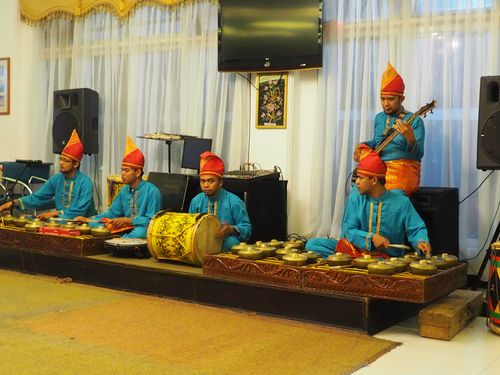
Bukittinggi • Minangkabau dance
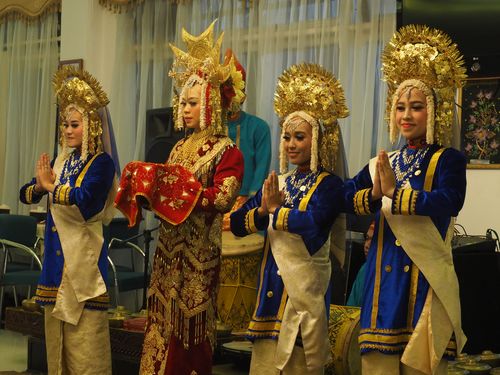
Bukittinggi • Minangkabau dance
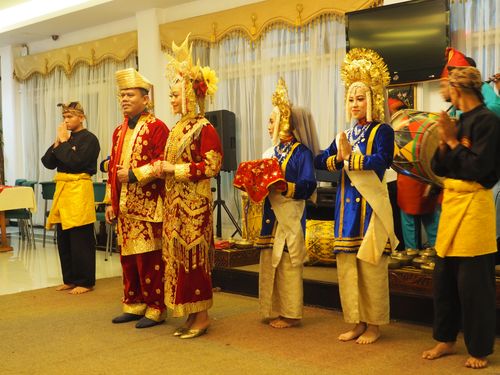
Bukittinggi • Minangkabau dance
Tradition profile
Minangkabau dance
Tradition category: Traditional Dance
Tradition family: Traditional dance
Tradition genre: Performing arts
Geographic location: Bukittinggi • Sumatra • Indonesia
• Links to •
• List of videos about Balige, Sipoholon, Angkola Timur, Bukittinggi on this site •
Indonesia • Sumatra • from Toba lake to Minangkabau land
Minangkabau Dance in Bukittinggi: history of a choreographic heritage of West Sumatra
Cultural origins and early formation
Minangkabau Dance belongs to the performing traditions developed by Minangkabau society in West Sumatra. In Bukittinggi, an important regional cultural centre, these dances remain closely associated with public ceremony and collective identity.
Their precise origins are difficult to date because transmission was largely oral and practical rather than written. The dance repertory emerged gradually from ceremonial gatherings, festive occasions, and communal customs. Many movement patterns also show the influence of silat, the regional martial art long practiced in Minangkabau communities.
As a result, dance developed as a physical language combining discipline, coordinated movement, and symbolic expression.
Historical development and social context
For generations, Minangkabau dances accompanied key moments of social life such as weddings, receptions, communal celebrations, and lineage-related ceremonies. In a society structured through extended family networks and customary institutions, performance helped reinforce cohesion.
Because Bukittinggi became a significant urban and commercial centre, it also encouraged exchanges between villages and districts. Choreographic styles, musical forms, and ceremonial practices circulated through markets, schools, and public events.
During the Dutch colonial period and later within modern Indonesia, these dances increasingly moved beyond strictly local ritual contexts. They began to appear in schools, civic ceremonies, and formal performances intended for wider audiences.
Symbolic meaning and regional identity
Minangkabau dance is more than entertainment. It communicates values such as respect for order, self-control, cooperation, and collective harmony. Group formations and synchronized gestures reflect an organized social ideal.
The visible influence of silat also links grace with readiness, showing that elegance and discipline are not treated as opposites. Strength is stylized rather than displayed aggressively.
In Bukittinggi, often seen as a cultural showcase of West Sumatra, these dances play an important role in presenting Minangkabau identity to visitors, institutions, and other Indonesian regions.
Modern transformation and wider diffusion
During the twentieth century, stage presentation, cultural festivals, tourism programs, and modern media changed the way these dances were performed. Shorter versions, clearer staging, and adapted choreography were developed for theatre and public events.
This did not necessarily replace older ceremonial forms, but it created a distinction between community practice and staged performance. Schools, universities, and arts organizations became increasingly important in teaching new generations.
Minangkabau migration to other Indonesian cities and abroad also helped spread this heritage beyond its original region.
Present importance and transmission challenges
Today, Minangkabau dance remains a strong cultural marker in Bukittinggi and throughout West Sumatra. It continues to appear in ceremonies while also occupying a place in artistic education and official celebrations.
Current challenges include balancing inherited styles with contemporary expectations, maintaining less frequently performed repertories, and training qualified instructors. As long as transmission remains active, Minangkabau dance continues to embody the social memory and cultural vitality of the Minangkabau people.
Performance Characteristics of Minangkabau Dance in Bukittinggi
General structure of the performance
Minangkabau Dance performed in Bukittinggi is marked by strong collective organization and carefully arranged movement patterns. Performances may take place during weddings, community ceremonies, cultural festivals, school events, or official receptions.
A presentation often begins with a formal entrance, followed by the arrangement of dancers into lines, circles, or diagonal formations. The choreography then develops through alternating sequences of measured movement and faster passages. Even when solo moments occur, the group usually remains the central visual element.
Use of space is disciplined and geometric, with performers moving in coordinated pathways.
Movement vocabulary and body technique
One of the most visible features is the precision of gesture. Arms move through clear trajectories, hands accent rhythm and direction, while the legs provide a stable base. Bent knees, low stances, pivots, and controlled turns are common.
Many dances show the influence of silat, the regional martial art. This appears in stylized defensive motions, balanced postures, sudden directional changes, and transitions between stillness and action.
Facial expression is generally restrained. Emphasis is placed on bodily control, concentration, and collective timing rather than dramatic theatrical display.
Costumes and visual identity
Costumes vary according to the dance type and occasion, but they often include coordinated garments in strong colours with decorative textiles or embroidery associated with Minangkabau aesthetics.
Headgear is especially significant. Some forms echo the upward-curving rooflines of traditional Minangkabau houses, creating an immediate visual connection with regional architecture and identity.
Belts, jewellery, shoulder cloths, or symbolic accessories may complete the costume. In certain choreographies, trays, scarves, parasols, or ritual objects are incorporated into the dance.
Music and rhythmic support
Minangkabau dance is usually accompanied by live music. Drums, percussion instruments, flutes, gongs, and regional ensembles establish the rhythmic framework. Tempo may begin slowly and build toward more energetic sections.
Changes in musical intensity often signal shifts in formation, pace, or movement style. In some contexts, singing or vocal calls accompany the instrumental texture.
The relationship between dancers and musicians is close, with movement responding directly to rhythmic cues.
Participants and transmission
Performers may be children, adolescents, or adults depending on the event. Some dances were traditionally associated with specific gender roles, while others are now adapted for mixed ensembles or modern stage settings.
Training usually takes place in families, community groups, schools, or arts centres. Learning depends on repetition, memorization of sequences, correction by instructors, and gradual mastery of posture and timing.
Public performances in Bukittinggi often serve both artistic and educational purposes by presenting this heritage to younger generations.
What makes this tradition distinctive
The most distinctive feature of Minangkabau dance is the combination of choreographic elegance with martial discipline. Few dance traditions integrate refined group aesthetics and silat-inspired movement so clearly.
In Bukittinggi, the dance is also notable for its ability to move between ceremonial settings and modern stages while retaining its essential regional markers. It remains immediately recognizable through precise formations, rhythmic clarity, and strong visual identity.
 Links to the main sections of the site