Français (France)
  Nederlands (nl-NL)
 00:00 • intro | 00:25 • Melli, Sikkim border | 01:47 • on the roads of Sikkim | 04:04 • nice meeting in Melli
Personal creation from visual material collected during my trip Buddhist India • Sikkim • Bihar • West Bengal (2017)
Map of places or practices in Melli on this site
• Use the markers to explore the content •
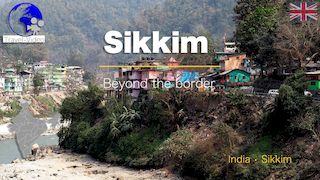
Sikkim: crossing the border and entering a changing Himalayan landscape
A gradual transition into a mountain territory
In the eastern Himalayas, Sikkim stands out as a region where geography directly shapes movement, settlement, and daily life. Entering the state at Melli marks more than an administrative boundary; it introduces a gradual shift from the plains into a mountainous environment defined by steep slopes, winding roads, and layered landscapes. The transition is immediate yet progressive, unfolding through changes in altitude, vegetation, and spatial organization.
The video focuses on this initial phase of discovery, where the first kilometres inside Sikkim reveal both the physical constraints of the terrain and the ways in which infrastructure and human activity adapt to it. Roads, settlements, and encounters form a coherent introduction to a region where environment and mobility are closely intertwined.
Melli and the threshold of Sikkim
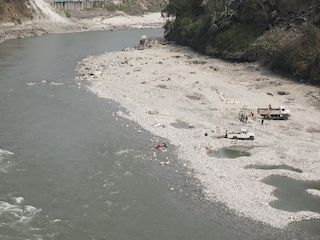
Melli appears as a key entry point into Sikkim, situated in a valley that acts as a gateway between different geographical zones. The images show a place shaped by circulation, where vehicles, travellers, and local activity converge. This transitional character gives Melli a strategic role, both practically and symbolically, as the first contact with the state.
A brief encounter with a group of local women travelling together adds an important human dimension to the sequence. Their presence reflects everyday mobility within the region and offers a glimpse into social life beyond the more formal structures of cities and monuments. Rather than an isolated moment, this scene highlights the lived reality of the territory, where travel, exchange, and community interactions are integral to daily life.
Roads under construction and the challenges of terrain
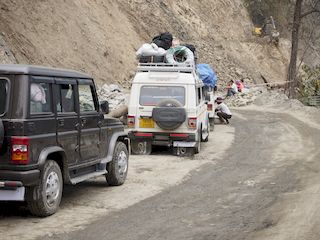
Beyond the border, the roads of Sikkim become a central element of the experience. They follow the contours of the mountains, often carved into steep slopes, revealing both the complexity of the terrain and the technical effort required to maintain connectivity. The video emphasizes the presence of major roadworks, which illustrate ongoing attempts to improve infrastructure in a demanding environment.
These construction sites are not incidental details; they reflect broader processes of development and adaptation. Maintaining and expanding road networks is essential for linking remote areas, facilitating trade, and supporting local communities. At the same time, the scale of the works highlights the constraints imposed by the landscape, where landslides, erosion, and limited space require continuous intervention.
Through these images, the viewer gains a clearer understanding of how infrastructure is both shaped by and constantly reshaping the Himalayan environment.
A region shaped by history and cultural influences
Sikkim’s contemporary landscape cannot be separated from its historical trajectory. Once an independent Himalayan kingdom, it became part of India in the twentieth century, a transition that influenced its administrative structure while preserving distinct cultural characteristics. This dual identity continues to shape the region today.
The influence of Tibetan Buddhism is a defining feature of Sikkim’s cultural landscape, visible in monastic institutions and religious practices across the state. Although the video focuses primarily on routes and transitional spaces, this spiritual dimension forms an underlying context that contributes to the identity of the region.
From a geographical perspective, the mountainous environment remains the dominant factor. Settlements, transport routes, and economic activities all adapt to the constraints and opportunities offered by the terrain. This relationship between environment and human organization is central to understanding Sikkim as a whole.
A progressive reading through images
The videos on this site are largely constructed from carefully selected and animated photographs, allowing for a gradual and structured exploration of complex environments. In the case of Sikkim, this method is particularly effective in conveying spatial relationships that are not immediately apparent.
The sequence of images follows the movement from the border into the interior, highlighting variations in landscape, road conditions, and human presence. Close-up views of construction work and daily life are combined with broader perspectives, creating a layered understanding of the territory.
This approach makes it possible to grasp both detail and context. The viewer can observe specific elements such as roadworks or encounters, while also perceiving their place within a wider geographical and social framework.
A concrete introduction to the Himalayan world
Crossing into Sikkim at Melli and travelling along its roads offers a direct and tangible introduction to a Himalayan region in transition. The combination of infrastructure challenges, evolving landscapes, and everyday human interactions provides a nuanced view of a territory that is both dynamic and deeply rooted in its environment.
This exploration highlights the interplay between natural constraints and human adaptation, revealing how movement, construction, and social life are interconnected. For those wishing to deepen their understanding, the detailed pages associated with this region provide further insight into its geography, culture, and ongoing transformations.
Links to related pages

Music:
- - YouTube video library - Reconciliation
Disclaimer: Despite its appropriateness, copyright issues prevent the use of indian traditional music in "Sikkim • Beyond the border • India", hence the use of royalty-free music. Despite our careful selection, some might regret this decision, which is necessary to avoid potential lawsuits. Although difficult, this decision is the only viable solution.