

 Français (France)
  Nederlands (nl-NL)
 00:00 • intro | 00:31 • Buddha Park or Tathagata Tsal
Personal creation from visual material collected during my trip Buddhist India • Sikkim • Bihar • West Bengal (2017)
Map of places or practices in Ravangla on this site
• Use the markers to explore the content •
Ravangla and Tathagata Tsal, a Buddhist Landmark in the Hills of Sikkim
A Contemporary Sacred Site in a Himalayan Setting
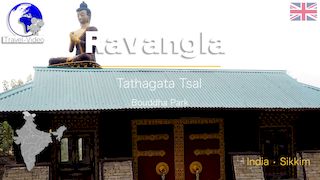
In southern Sikkim, the town of Ravangla is home to one of the most recognizable modern sites of the Indian Himalayas: Tathagata Tsal, often known as Buddha Park. This large complex combines a religious monument, landscaped public grounds and wide views over the surrounding mountains. The video introduces a place where monumental design and natural scenery are closely connected.
The site welcomes visitors, pilgrims and travellers interested in the Buddhist heritage of Sikkim. Its dominant feature is a large Buddha statue that has become one of the best-known visual symbols of the region.
Buddha Park and the Monumental Statue
The main focus of the site is the monumental seated image of Gautama Buddha, placed on a high architectural base. This central structure organizes the entire complex and naturally draws attention from paths, terraces and open spaces.
Around it are gardens, paved areas, walking routes and resting zones designed to create a gradual visual approach to the monument. From some viewpoints, the statue appears as a distant landmark rising above the hills. From others, it becomes an imposing presence experienced at close range.
The name Buddha Park reflects this dual character. It is both a public landscaped area open to many visitors and a place shaped by religious meaning and contemplative use.
Historical Background and Site Planning
Tathagata Tsal is a recent development, created in the early twenty-first century with support from the authorities of Sikkim. Its construction formed part of a broader effort to highlight the region’s Buddhist identity while strengthening the cultural appeal of Ravangla. The monument was linked to celebrations of the 2550th anniversary of the birth of the Buddha, commemorated in 2006.
The choice of Ravangla was significant. Located on an important route through South Sikkim, the town occupies elevated ground well suited to panoramic views. The park design uses this terrain through successive terraces, gentle circulation routes and open platforms facing the landscape.
Symbolically, the great statue expresses peace, stability and spiritual continuity. In a state shaped by several cultural traditions, the complex also recalls the historical role of Buddhism in the identity of Sikkim.
What the Video Makes Especially Clear
Videos created from carefully selected and animated photographs are particularly effective for understanding a site such as Tathagata Tsal. They allow viewers to observe the relationship between the statue and its pedestal, the way paths converge toward the central area, and the changing scale between distant views and close approaches.
Image transitions also clarify the overall composition of the complex. Viewers can see how terraces structure the hillside, how vegetation frames the perspectives, and how the monument stands within the Himalayan setting. Surface details, proportions and volumes become easier to read through this gradual visual rhythm.
The format is especially useful for an open-air site where movement, distance and changing viewpoints are essential parts of the experience.
A Modern Symbol of Sikkim
Ravangla and Tathagata Tsal illustrate the meeting point of living religious tradition, modern planning and mountain landscape. The video offers a clear introduction to a site that has become a major landmark of Sikkim. Visitors wishing to continue their exploration can also consult the related detailed pages devoted to its history, symbolism and architectural organization.
Links to related pages

Music:
- - YouTube video library - BTS Prologue, (© BTS Prolog by Kevin MacLeod is licensed under a Creative Commons Attribution 4.0 license. https://creativecommons.org/licenses/by/4.0/
- Source: http://freepd.com/Unclassified/BTS%20Prolog
- Artist: http://incompetech.com/)
Disclaimer: Despite its appropriateness, copyright issues prevent the use of indian traditional music in "Ravangla, Tathagata Tsal • Sikkim, India ", hence the use of royalty-free music. Despite our careful selection, some might regret this decision, which is necessary to avoid potential lawsuits. Although difficult, this decision is the only viable solution.


