

 Français (France)
  Nederlands (nl-NL)
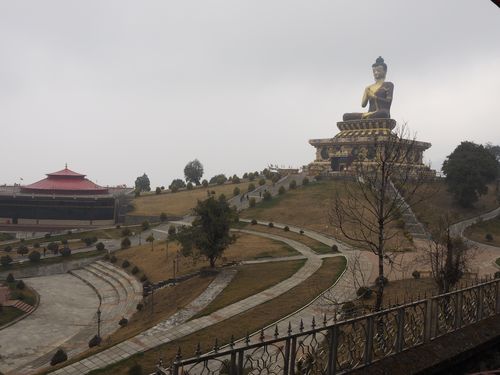
 Tathagata Tsal is a major cultural and spiritual site located in Ravangla, in the state of Sikkim. Known for its large Buddha statue visible from afar, the complex is an important landmark in the regional landscape and a place visited by travellers and pilgrims. It combines reflection, public space and cultural discovery. The site reflects the role of Buddhism in the contemporary identity of Sikkim and the value given to symbolic places accessible to visitors. Tathagata Tsal also appeals to those wishing to explore the religious and cultural heritage of the Indian Himalayas.

Ravangla • Tathagata Tsal
Ravangla • Tathagata Tsal

Ravangla • Tathagata Tsal
Monument profile
Tathagata Tsal
Monument categories: Pilgrimage site, Giant Statues
Monument families: Pilgrimage site or memorial • Giant statues or set of statues
Monument genres: Religious
Cultural heritage: Buddhist
Geographic location: Ravangla • Sikkim • India
Construction period: 21th century AD
• Links to •
• List of videos about Ravangla on this site •
Ravangla, Tathagata Tsal • Sikkim, India
Tathagata Tsal at Ravangla: Development of a Contemporary Buddhist Monument
Foundation of the Project and Commemorative Purpose
Tathagata Tsal is a religious and commemorative complex located at Ravangla in the Indian state of Sikkim. Its creation formed part of an early twenty-first-century programme aimed at strengthening the Buddhist cultural profile of Sikkim through visible public monuments. The site was conceived in connection with celebrations marking the 2550th anniversary of the birth of Gautama Buddha, commemorated in 2006 across several Buddhist regions.
The Government of Sikkim supported the project as both a cultural initiative and a regional development measure. Ravangla was selected for its growing importance in South Sikkim and for the commanding terrain that allowed the monument to become a prominent landmark.
Construction and Official Opening
Construction began around 2006 and focused on creating a large landscaped complex centred on a monumental seated Buddha statue. The project required coordinated civil engineering, site grading and the installation of large-scale sculptural components. Roads, terraces and visitor facilities were integrated into the design so that the monument could function as both pilgrimage destination and public attraction.
The completed complex was inaugurated in 2013 in the presence of Tenzing Namgyal and state authorities. The ceremony emphasized continuity between Sikkim’s historical Buddhist traditions and its contemporary civic identity. From the time of opening, Tathagata Tsal was presented as a place for contemplation, ceremonial gatherings and cultural tourism.
Public Use and Symbolic Role
Since inauguration, the site has served several overlapping purposes. It hosts Buddhist observances, receives domestic and international visitors, and functions as one of the most recognizable modern landmarks of Sikkim. Its large Buddha image has become widely used in promotional material representing the region.
The monument also carries political and cultural symbolism. In a state shaped by Lepcha, Bhutia and Nepali communities, Tathagata Tsal visually affirms the historical role of Buddhism within Sikkim’s identity while remaining open to a broad public. Its presence has increased the visibility of Ravangla and supported local economic activity linked to travel services, hospitality and retail.
Maintenance and Current Condition
As a recent monument, Tathagata Tsal has not undergone the cycles of abandonment, reconstruction or major historical damage associated with older sites. Its principal challenges concern maintenance of open-air structures, visitor circulation, drainage on sloping terrain and preservation of landscaped areas exposed to heavy rainfall and seasonal weather.
Periodic improvements to access routes, internal paths and visitor amenities have been carried out by local authorities. The long-term condition of the complex depends largely on regular upkeep and the continued balance between devotional use and tourist visitation.
Global Historical Context
During the final phase of development and inauguration in 2013, Pope Francis had recently been elected in Rome. In China, Xi Jinping consolidated national leadership. Nepal was continuing its republican political transition after the end of monarchy. Worldwide, rapid smartphone adoption was already reshaping tourism and public communication.
Monumental Layout and Site Design of Tathagata Tsal at Ravangla
Topographical Setting and Overall Composition
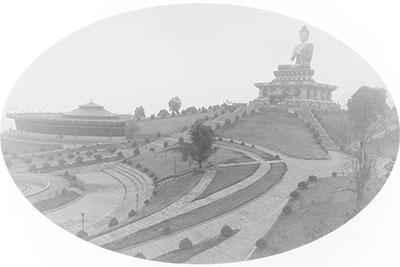
Tathagata Tsal occupies an elevated site above Ravangla in the mountainous terrain of Sikkim. The complex was planned to use natural relief as an architectural asset, allowing wide visual openings toward surrounding hills while giving the principal monument strong prominence from lower approach roads. Rather than forming a compact enclosed structure, the site functions as a composed open-air ensemble in which terraces, paved platforms and circulation routes are as important as built elements.
The general plan is axial without being rigidly symmetrical. Visitors advance through successive exterior spaces toward the monumental Buddha image, which acts as the focal point of the composition. Changes in level, retaining structures and planted margins organize movement while adapting the project to sloping ground. The result is an architecture of landscape ordering rather than dense construction.
Central Statue and Architectural Base
The dominant feature of the complex is the monumental seated figure of Gautama Buddha mounted on a high engineered plinth. This base performs structural, visual and ceremonial functions simultaneously. It provides a stable platform on uneven terrain, increases the visibility of the sculpture across long distances and creates a raised zone separated from ordinary circulation areas.
The proportions of statue and pedestal are calculated for dual perception. From afar, the silhouette reads as a single vertical landmark. At close range, the visitor experiences the mass of the substructure, broad stairways and elevated viewing platforms before the upper figure is fully perceived. This sequence transforms approach into an architectural event rather than a simple arrival.
The plinth also contains usable internal or service volumes typical of modern monumental platforms, allowing practical functions to be absorbed within the supporting mass rather than dispersed across the site.
Terraces, Paths and Controlled Movement
Circulation is arranged through a network of stepped paths, ramps and level terraces that negotiate the hillside. These routes are designed not merely for access but for controlled revelation of the monument. Each turn or change in elevation produces a modified relationship between visitor, statue and mountain background.
Large terraces serve as gathering zones for ceremonies, rest areas and panoramic viewpoints. Their geometric edges contrast with the irregular contours of the natural slope. Low walls, parapets and boundary elements define space without obstructing sightlines, preserving the open character of the complex.
Because built density remains limited, spatial experience depends heavily on measured distances between elements. Voids, paved expanses and framed views become active architectural components. The monument is therefore understood through movement across space rather than through enclosed rooms.
Materials, Surface Treatment and Visual Identity
The complex relies primarily on contemporary construction materials suitable for a large mountain site: reinforced concrete for structural components, masonry or rendered retaining walls, paved stone or concrete walkways, and metal elements for railings and protective details. These materials offer durability, manageable maintenance and resistance to heavy seasonal rainfall.
Surface treatment emphasizes clarity and legibility. Neutral-toned paving and platform areas support the brighter visual presence of the statue itself. Contrasts between ordered mineral surfaces, planted gardens and distant forested slopes are fundamental to the site’s appearance.
Decorative density is comparatively restrained in subsidiary elements so that visual emphasis remains concentrated on the central image. This hierarchy distinguishes ceremonial focus from circulation infrastructure.
Maintenance and Architectural Preservation
As a recent complex, Tathagata Tsal faces preservation issues linked less to historical fabric than to environmental exposure and visitor use. Drainage systems, retaining walls and paved routes require regular monitoring because of steep gradients, moisture and monsoon conditions. Surface wear on stairs and terraces is another practical concern.
Ongoing maintenance also involves vegetation control, repainting or cleaning exposed elements, and ensuring safe access standards for large numbers of visitors. The architectural integrity of the site depends on preserving the balance between monumental visibility, open circulation space and stable hillside engineering.