

 Français (France)
  Nederlands (nl-NL)
 00:00 • intro | 00:37 • bodhi tree and Mulagandhakuti Vihara temple | 03:05 • stupa Dhamek
Personal creation from visual material collected during my trip India • Rajasthan and Varanasi (2015)
Map of places or practices in Sarnath on this site
• Use the markers to explore the content •
Sarnath, One of Buddhism’s Foundational Sites
A Major Pilgrimage Centre Near Varanasi
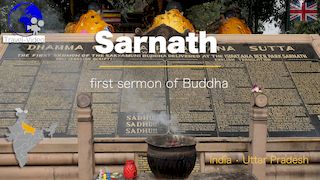
Located near Varanasi in the state of Uttar Pradesh, Sarnath is one of the most important sacred places in the history of Buddhism. According to Buddhist tradition, it was here that the Buddha delivered his first sermon after attaining enlightenment at Bodh Gaya. This event, often described as the “Turning of the Wheel of Dharma,” marks the beginning of Buddhist teaching and the formation of the first monastic community.
The video explores several monuments and religious spaces associated with this decisive moment in Buddhist history. Through stupas, temples and sacred trees, the images reveal a site that has remained an important centre of pilgrimage and spiritual memory for many centuries.
The Mulagandhakuti Vihara Temple and the Dhamek Stupa
Among the principal monuments visible in the video is the Mulagandhakuti Vihara temple, a modern Buddhist temple built during the twentieth century by the Maha Bodhi Society. The building reflects the revival of Buddhist pilgrimage activities in India and continues to attract monks, pilgrims and visitors from many Buddhist countries. Its architecture combines Indian influences with stylistic elements inspired by broader Buddhist traditions across Asia.
Near the temple stands a Bodhi tree connected symbolically to the sacred tree under which the Buddha is believed to have attained enlightenment at Bodh Gaya. Such trees hold deep religious significance within Buddhist traditions and often serve as places of meditation and pilgrimage.
The Dhamek Stupa is the most prominent historical structure shown in the video. This massive cylindrical monument traditionally marks the location where the Buddha delivered his first sermon. The stupa was enlarged and rebuilt during different historical periods, particularly under the Maurya and Gupta dynasties. The carved stone decorations visible on its lower sections illustrate the refinement of Buddhist art and architecture in ancient India.
A Centre of Buddhist Learning and Patronage
Sarnath became an important religious and intellectual centre during the reign of Ashoka in the third century BCE. The Mauryan emperor supported the spread of Buddhism by sponsoring monasteries, stupas and pillars throughout the Indian subcontinent. Sarnath developed into one of the principal Buddhist centres of northern India, attracting monks and scholars for many centuries.
Archaeological remains found throughout the site reveal the former presence of monasteries, temples and devotional structures that once formed a large religious complex. Although many ancient buildings disappeared over time, Sarnath continues to preserve an important architectural and spiritual legacy connected to the origins of Buddhism.
The atmosphere of the site today combines archaeological remains, active religious practice and landscaped gardens, creating a space where history and devotion remain closely linked.
What the Videos on This Site Make Easier to Observe
The videos published on travel-video.info are often constructed from carefully selected and animated photographs combined with gradual visual transitions. This approach allows viewers to observe architectural details, spatial organisation and decorative elements more progressively than through rapid moving footage alone.
At Sarnath, these visual movements help reveal the scale of the Dhamek Stupa, the textures of carved stone surfaces and the relationship between temples, sacred trees and open spaces. The gradual exploration of perspectives also makes it easier to understand the organisation of the religious complex and its role within the wider Buddhist world.
A Place Closely Linked to the Origins of Buddhism
Through its stupas, temples and sacred spaces, Sarnath remains one of the most significant Buddhist sites in India. The video offers an opportunity to approach this historic place not only as an archaeological site, but also as a living centre of pilgrimage and religious memory. The detailed pages dedicated to the monuments presented in the film allow visitors to further explore the history and architecture of this major Buddhist sanctuary.
Links to related pages






Audio Commentary Transcript
A few kilometers from Varanasi, in the state of Uttar Pradesh in northern India, is the place where Buddha gave his first sermon, the holy city of Buddhism, Sarnath. Tradition has it that this sermon was pronounced under a Bodhi tree, at the exact spot where this Buddhist temple was erected in the 1930s.
The first construction of this temple dates from the Gupta period between the 3rd and 5th century. This temple has been rebuilt many times. The interior is decorated with paintings relating the life of Buddha in Sarnath.
A côté du temple Mulagandhakuti Vihara se dresse un vieux stupa, le stupa Dhamek, datant du début de notre ère, quand Sarnath était à son apogée, le principal centre culturel et religieux du monde bouddhiste.
Music:
- - YouTube video library - Carol of the Bells
- - YouTube video library - Heavy Interlude, (© Heavy Interlude by Kevin MacLeod is licensed under a Creative Commons Attribution 4.0 license. https://creativecommons.org/licenses/by/4.0/
- Source: http://incompetech.com/music/royalty-free/index.html?isrc=USUAN1100515
- Artist: http://incompetech.com/)
Disclaimer: Despite its appropriateness, copyright issues prevent the use of indian traditional music in "Sarnath, Buddha's first sermon • India, Uttar Pradesh ", hence the use of royalty-free music. Despite our careful selection, some might regret this decision, which is necessary to avoid potential lawsuits. Although difficult, this decision is the only viable solution.


