

 Français (France)
  Nederlands (nl-NL)
 00:00 • intro | 00:22 • Santiago bay | 01:09 • el Castillo del Moro | 03:07 • St Iphigenia cemetery | 03:41 • Moncada barracks | 04:10 • some pictures of the city | 05:12 • La Casa de la Trova | 08:37 • El Cobre
Personal creation from visual material collected during my trip Cuba (2015)
• Use the markers to explore the content •
Santiago de Cuba, Historic City of Bay, Memory and Culture
A Major City in Eastern Cuba
Santiago de Cuba holds a distinctive place in the history of the island. Set around a broad natural bay framed by hills, it developed as an important port, a military stronghold, a cultural centre and one of Cuba’s principal urban settlements. Its influence extends well beyond the regional scale. Several decisive moments of Cuban history unfolded here, while its artistic traditions gave the city a reputation felt across the country.
This video offers a varied introduction to Santiago through maritime landscapes, major monuments, memorial places, urban scenes and expressions of local culture. The result is the portrait of a city where geography, architecture and history remain closely connected.
Few Cuban cities bring together coastal fortifications, monumental funerary heritage, sites of political significance, musical traditions and major pilgrimage destinations with such intensity. That concentration of themes makes Santiago especially rewarding to explore.
The Main Sites and Themes Visible in the Video
The Bay of Santiago is one of the essential keys to understanding the city. Protected by a narrow entrance and opening into sheltered inner waters, it encouraged maritime trade, naval activity and urban growth. It also explains the construction of defensive works intended to control access from the sea.
Among them, Castillo del Moro, formally known as Castillo de San Pedro de la Roca, dominates the entrance to the bay. This fortress ranks among the most important examples of Hispanic military architecture in the Caribbean. Its position on a rocky promontory, its successive terraces and its powerful defensive layout demonstrate how fortification design was adapted to coastal topography.
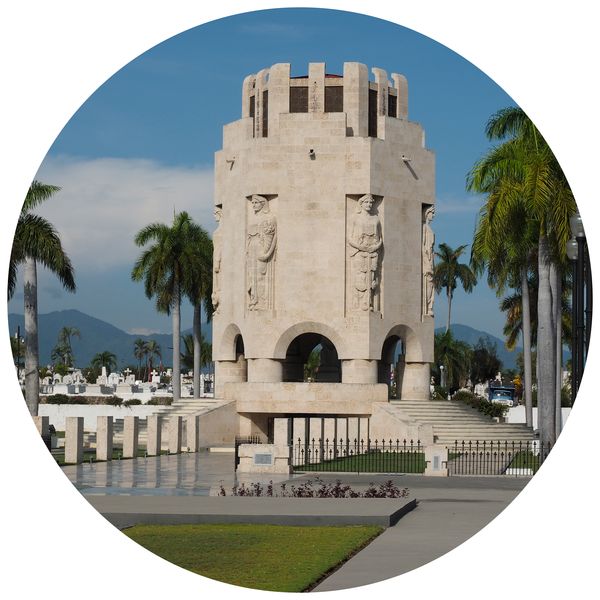
Santa Ifigenia Cemetery represents another aspect of Santiago’s heritage. It is not only a burial ground, but also a national memorial space where several important Cuban figures are buried. Monumental tombs, ceremonial areas and commemorative functions give the site a significance that goes beyond funerary use.
The Moncada Barracks belongs to a later historical chapter. This former military complex became internationally known after the 1953 assault that marked a turning point in Cuban political history. Today the site is associated with remembrance, education and public history.
Images of the city itself complete this monumental itinerary. Streets, façades, squares and everyday urban scenes remind viewers that Santiago is not merely a collection of landmarks, but a living city shaped by daily life as much as by historic events.
Music, Religion and Local Identity
La Casa de la Trova introduces one of Santiago de Cuba’s defining cultural dimensions: music. The city is widely regarded as one of the principal homes of important Cuban musical traditions. Venues linked to trova and other popular forms reflect a heritage expressed through performance, memory and social gathering rather than stone architecture.
A short distance from the city centre lies El Cobre, one of the most important religious destinations in Cuba. The basilica dedicated to Our Lady of Charity of El Cobre, patron saint of the country, receives pilgrims and visitors from across the island and beyond. Its inclusion in the video broadens the perspective from the city itself to the surrounding cultural landscape.
These musical and religious elements complete the image of Santiago. The city cannot be understood only through military or political history. It is equally shaped by enduring devotional practices and by artistic traditions that remain active today.
Historical Layers and Urban Character
Founded during the early Spanish colonial period, Santiago de Cuba served for centuries as a strategic Caribbean port. Its harbour, its connections to regional maritime routes and its surrounding hinterland made it an important commercial centre. Colonial conflicts, shifts in trade and later political transformations all left visible traces in the urban fabric.
The city’s architecture reflects these successive periods. Fortifications recall centuries of maritime rivalry. Religious buildings testify to the long presence of Catholic institutions. Civil and military structures from the nineteenth and twentieth centuries illustrate later phases of modernization. Streets often respond to changing levels of terrain, creating shifting perspectives between hillsides, built quarters and views toward the bay.
For that reason, Santiago has an urban character different from more regular colonial cities established on flatter ground. Relief, movement and changing viewpoints play a constant role in the experience of the city.
What the Videos on This Site Make Easier to Understand
The videos on travel-video.info, often created from carefully selected and animated photographs, are particularly well suited to a city such as Santiago de Cuba. This approach allows viewers to observe details of masonry, terraces, memorial sculpture, façades and urban alignments that may pass too quickly in conventional moving footage.
Transitions between images also help clarify relationships between places. Viewers can understand how the bay explains the location of the fortress, how historic monuments fit into the modern city, and how music and religion belong to the same wider urban identity.
This gradual visual construction encourages a calmer and more attentive discovery of the city.
A Cuban City of Many Dimensions
Santiago de Cuba brings together the sea, historical memory, fortifications, religious devotion and musical creativity within one urban landscape. That richness makes it one of the most compelling cities in Cuba. Visitors wishing to explore further can also consult the detailed pages devoted to the principal monuments featured here, where their history and architecture are examined in greater depth.







Audio Commentary Transcript
Santiago has been an important port in Cuba since the 16th century. Its strategically ideal location quickly made it one of the most important ports in the region. And despite its protected port in a bay with a narrow passage, Santiago was regularly the object of attacks by pirates who infested the Caribbean Sea.
After long years of insecurity, the Spanish crown ordered the construction of a fort to defend the port of Santiago. This fort is called "el castillo del moro".
Many important personalities of Cuba are buried in the Saint Iphigenia cemetery in Santiago. Among them, Compay Segundo and Fidel Castro.
Music :
- - YouTube video library - AchillesIn Memory of Jean Talon - The Mini Vandals, (© Alchemists Tower - Strings by Kevin MacLeod is licensed under a Creative Commons Attribution 4.0 license. https://creativecommons.org/licenses/by/4.0/
- Source: http://incompetech.com/music/royalty-free/index.html?isrc=USUAN1100632
- Artist: http://incompetech.com/)
- - YouTube video library - Alchemists tower, (© Alchemists Tower - Strings by Kevin MacLeod is licensed under a Creative Commons Attribution 4.0 license. https://creativecommons.org/licenses/by/4.0/
- Source: http://incompetech.com/music/royalty-free/index.html?isrc=USUAN1100632
- Artist: http://incompetech.com/)
- - YouTube video library - Dramatic Swarm
- - YouTube video library - For the Fallen, (© For the Fallen by Kevin MacLeod is licensed under a Creative Commons Attribution 4.0 license. https://creativecommons.org/licenses/by/4.0/
- Source: http://incompetech.com/music/royalty-free/index.html?isrc=USUAN1100704
- Artist: http://incompetech.com/)
- - YouTube video library - Ignosi, (© Ignosi by Kevin MacLeod is licensed under a Creative Commons Attribution 4.0 license. https://creativecommons.org/licenses/by/4.0/
- Source: http://incompetech.com/music/royalty-free/index.html?isrc=USUAN1100450
- Artist: http://incompetech.com/)
Disclaimer: Despite its appropriateness, copyright issues prevent the use of cuban traditional music in "Santiago, historical city • Cuba ", hence the use of royalty-free music. Despite our careful selection, some might regret this decision, which is necessary to avoid potential lawsuits. Although difficult, this decision is the only viable solution.


