

 Français (France)
  Nederlands (nl-NL)
 00:00 • intro | 00:26 • Galata bridge | 01:25 • market near Galata bridge | 04:26 • the Grand Bazaar | 06:36 • on the Bosphorus
Personal creation from visual material collected during my trip Turkey • Istanbul (2015)
Map of places or practices in Istanbul on this site
• Use the markers to explore the content •
Istanbul Between Markets and Waterways: From Galata Bridge to the Bosphorus
A city shaped by crossings and exchanges
Istanbul stands at a unique geographic and cultural crossroads, linking Europe and Asia across the waters of the Bosphorus. Its urban fabric reflects centuries of political power, commercial exchange, and cultural interaction, first under Byzantine rule and later as the capital of the Ottoman Empire. This layered history remains visible in the city’s streets, infrastructures, and marketplaces, where everyday life unfolds within a historically dense environment.
The video explores a selection of emblematic locations that illustrate this complexity. It moves from a major urban crossing to lively commercial areas, then into one of the world’s most renowned covered markets, before opening onto the maritime landscapes that define the city’s broader structure. Together, these scenes offer a coherent reading of Istanbul as a city shaped by circulation, trade, and its enduring relationship with water.
Key spaces of movement and commerce
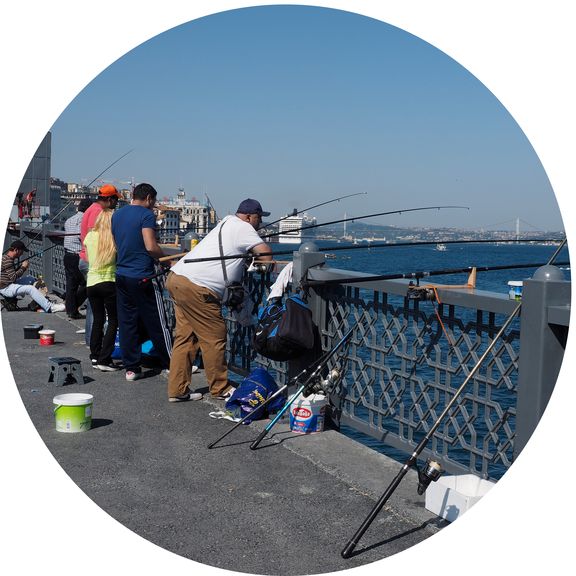
The Galata Bridge forms one of the central elements of this urban composition. Spanning the Golden Horn, it connects the historic peninsula with districts that developed more intensively in later periods. Far more than a simple crossing, the bridge functions as a shared urban space where transportation, daily routines, and informal activities intersect. Its constant flow of pedestrians and vehicles highlights its role as a vital connector within the city.
At the foot of the bridge, the surrounding market areas extend this sense of movement into spaces of exchange. These open-air settings reflect the continuity of local commerce, where goods circulate in close proximity to the waterfront and to major routes of passage. The interaction between sellers, buyers, and passersby contributes to a vivid urban atmosphere that contrasts with the more structured environment of the Grand Bazaar.
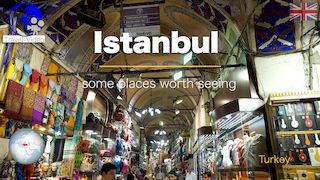
The Grand Bazaar represents a different scale and form of commercial organization. Enclosed within a complex network of covered streets and vaulted passages, it constitutes one of the oldest and largest marketplaces of its kind. Its spatial organization, based on specialized sections and interconnected corridors, reveals a highly developed system of trade. The architectural framework supports both functionality and visual richness, with repeating forms, controlled lighting, and a dense arrangement of shops.
Beyond these enclosed and terrestrial spaces, the Bosphorus introduces a broader geographical dimension. The waterway not only separates two continents but also unifies the city through its role as a major route of circulation. Views along its shores reveal the distribution of neighborhoods and the continuity of urban development shaped by maritime access. The presence of the Bosphorus is essential to understanding Istanbul’s scale and its openness toward surrounding regions.
Historical layers and urban organization
The elements presented in the video can be understood within the broader historical evolution of Istanbul. The city’s importance as a capital and trading hub led to the development of infrastructures designed to facilitate movement and exchange. The successive versions of the Galata Bridge illustrate this ongoing adaptation, responding to the need for efficient connections across the Golden Horn.
The Grand Bazaar emerged during the early Ottoman period, when Istanbul became a central node in long-distance trade networks linking Europe, Asia, and the Middle East. Its growth over time reflects both economic expansion and the institutional organization of crafts and commerce. The structure of the bazaar, with its specialization of spaces and its internal circulation, demonstrates a deliberate urban planning approach aimed at supporting sustained commercial activity.
The Bosphorus, in turn, has long played a strategic role in the city’s history. Control of this narrow strait meant access to maritime routes and influence over regional trade. As a result, its shores developed into areas of residence, transport infrastructure, and economic activity. The interplay between land and water has shaped the distribution of urban functions and continues to influence the city’s development.
A precise reading through visual sequencing
The videos on this site offer a particular way of engaging with such environments. Built largely from carefully selected and animated photographs, they allow for a gradual and detailed exploration of complex urban spaces. This approach makes it possible to observe architectural elements, spatial organization, and visual relationships that might otherwise remain unnoticed.
In the case of the Grand Bazaar, the progression of images helps clarify the internal structure of the market, guiding the viewer through its corridors and highlighting the repetition of architectural forms. Similarly, sequences focused on the Galata Bridge emphasize the interaction between structure, human activity, and surrounding landscapes, revealing how these components function together within the city.
The views along the Bosphorus provide a broader perspective, enabling a clear understanding of how Istanbul extends along its shores. The continuity of the waterfront, the arrangement of buildings, and the scale of the environment become more readable through this methodical visual unfolding.
A living urban heritage
The places presented in the video illustrate how Istanbul integrates its historical legacy into contemporary urban life. These are not static monuments but active spaces, where long-standing traditions coexist with present-day uses. The bridge continues to carry daily flows, the markets remain centers of exchange, and the Bosphorus still structures movement and perception of the city.
This combination of continuity and transformation defines much of Istanbul’s character. By observing these environments closely, it becomes possible to grasp both their historical significance and their current role within the urban system. For those wishing to deepen their understanding, the detailed pages dedicated to individual sites provide further insight into their architectural features and historical development.
Links to related pages



Audio Commentary Transcript
The idea of building a bridge over the Golden Horn in Istanbul dates from the time of Michelangelo and Leonardo da Vinci, who were asked by the sultan to draw plans for its construction. However, it was not until the middle of the 19th century that the first bridge appeared at this location. The current Galata Bridge, dating from the end of the 20th century, is the fifth. A link between two cultures, the bridge leads from the Istanbul of the sultans to that of generally non-Muslim traders and diplomats.
This bridge is very popular with anglers.
At the foot of the Galata Bridge, a small vegetable and fish market plunges the visitor into another universe. From there, charming alleys lead to the Galata tower, a medieval tower built by the Genoese in the 13th century, to protect the colony that Byzantium had authorized them to form in this district of Constantinople
The birth of the Grand Bazaar in Istanbul corresponds more or less to the capture of Constantinople by the troops of Mehmed II in the middle of the 15th century. The sultan made it one of the largest markets in the world, to make the European commercial centers of the time green with envy. The Grand Bazaar was not covered until years later.
This market still gives work to more than 26,000 people today.
A visit to Istanbul would not be complete without a short boat trip on the Bosphorus. It is a great opportunity to see the few fishing villages and the palaces built on its banks.
Music:
- - YouTube video library - For Originz, (© For Originz by Kevin MacLeod is licensed under a Creative Commons Attribution 4.0 license. https://creativecommons.org/licenses/by/4.0/
- Source: http://incompetech.com/music/royalty-free/index.html?isrc=USUAN1100700
- Artist: http://incompetech.com/)
- - YouTube video library - Lurking Shadows
- - YouTube video library - Searching for the Missing Piece
Disclaimer: Despite its appropriateness, copyright issues prevent the use of turkish traditional music in "Istanbul • Grand Bazaar, Galata Bridge, Bosphorus Treasures", hence the use of royalty-free music. Despite our careful selection, some might regret this decision, which is necessary to avoid potential lawsuits. Although difficult, this decision is the only viable solution.


