

 Français (France)
  Nederlands (nl-NL)
 The Grand Bazaar in Istanbul, Turkey, is one of the oldest and largest covered markets in the world. Established in the 15th century during the Ottoman Empire, it houses thousands of shops across numerous streets. Known for its wide variety of goods, including textiles, jewelry, and handcrafted items, it remains a vibrant hub of commerce and a landmark attracting visitors from around the globe.

Istanbul • Grand Bazaar: one of the entrances to the bazaar
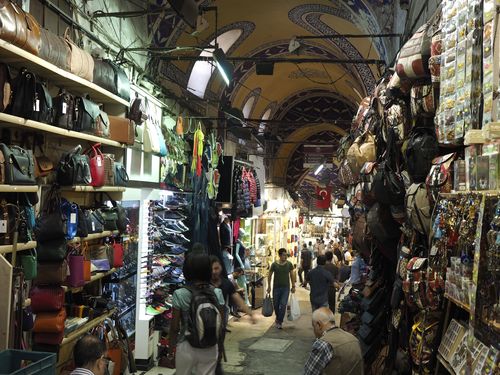
Istanbul • Grand Bazaar: in the galleries of the bazaar

Istanbul • Grand Bazaar: a spice merchant
Monument profile
Grand Bazaar
Monument category: Bazaar
Monument family: Market, souk, bazaar
Monument genre: Economic
Cultural heritage: Islamic
Geographic location: Istanbul • Turkey
Construction period: 15th century AD
• Links to •
• List of videos about Istanbul on this site •
Istanbul • Sultanahmet, the blue mosque, Turkey
Istanbul • Hagia Sofia, Turkey
Istanbul • Hagia Irene, Turkey
Istanbul • Cistern Basilica, Turkey
Istanbul • Topkapi palace, Turkey
Istanbul • Grand Bazaar, Galata Bridge, Bosphorus Treasures
The Grand Bazaar of Istanbul: A Historical Hub of Commerce and Culture
The Grand Bazaar, located in Istanbul, Turkey, is one of the oldest and largest covered markets in the world. Established in 1455 under the reign of Sultan Mehmed II, it became a cornerstone of the Ottoman Empire’s economic and social fabric. The bazaar reflects the empire’s ambition to centralize trade, integrate diverse cultures, and establish Istanbul as a global commercial hub. Over the centuries, it has witnessed significant historical events and undergone numerous transformations, which continue to shape its cultural and historical significance.
Political and Social Motivations Behind Its Construction
The Grand Bazaar was built shortly after the Ottoman conquest of Constantinople in 1453. Sultan Mehmed II envisioned the city as the empire’s economic and political epicenter, and constructing a grand marketplace was integral to this vision. The bazaar was strategically designed to centralize trade, secure revenue, and symbolize the power and prosperity of the newly established Ottoman rule.
Socially, the bazaar provided a space where merchants from various regions could converge, fostering interactions between different cultures and communities. This inclusivity promoted social cohesion within the diverse population of Istanbul, reflecting the Ottoman Empire’s multicultural character.
Historical Events and Their Impact
Throughout its history, the Grand Bazaar has endured numerous challenges, including fires, earthquakes, and political transitions. Major reconstructions, such as those following the devastating earthquake of 1894, reshaped its architecture and reinforced its resilience.
The bazaar’s role evolved over time, particularly with the decline of the Ottoman Empire and the rise of modern commerce. While it lost its status as the central trading hub during the 20th century, it retained its cultural and historical importance as a symbol of Istanbul’s heritage.
Global Context and Comparisons
In the 15th century, when the Grand Bazaar was established, other civilizations were also building major commercial centers. For instance, the Silk Road markets in Samarkand and the medinas of Marrakech served similar purposes, connecting regions through trade and culture. However, the Grand Bazaar stood out for its scale, organization, and integration into the capital of a powerful empire, making it a pivotal node in global trade networks.
Transformations and Cultural Influences
The Grand Bazaar has undergone significant transformations that reflect changes in power and external influences. Originally centered around the Bedesten, a fortified structure for storing valuable goods, the bazaar expanded over centuries to include more than 60 covered streets and around 4,000 shops.
The architectural features of the bazaar incorporate a blend of Ottoman, Byzantine, and Persian elements. Its vaulted ceilings and intricate designs showcase Ottoman craftsmanship, while its layout mirrors the organizational principles of earlier Islamic and Byzantine marketplaces. These influences highlight the bazaar’s role as a cultural melting pot.
State of Conservation and Modern Challenges
Today, the Grand Bazaar is both a historical monument and a bustling tourist destination, attracting millions of visitors annually. Its inclusion in Istanbul’s Historic Areas, a UNESCO World Heritage Site since 1985, underscores its global importance.
However, preserving the bazaar’s integrity poses significant challenges. Constant exposure to high visitor numbers, risks from earthquakes, and the effects of urban pollution threaten its structure. Restoration projects focus on stabilizing its foundations, maintaining its architectural details, and modernizing its infrastructure without compromising its historical character.
A Living Symbol of Heritage
The Grand Bazaar remains a vibrant testament to Istanbul’s historical and cultural legacy. Its enduring presence reflects the city’s evolution from a strategic Byzantine hub to the economic heart of the Ottoman Empire and, later, a global metropolis. Through ongoing preservation efforts, this iconic marketplace continues to bridge the past and present, serving as both a commercial space and a cherished cultural landmark that inspires admiration worldwide.
The Grand Bazaar of Istanbul: Architectural Innovation and Cultural Fusion
The Grand Bazaar in Istanbul, Turkey, stands as a remarkable testament to Ottoman engineering and artistic ingenuity. Constructed in 1455 under Sultan Mehmed II’s reign, it reflects the technological advancements and cultural amalgamation of its time. As one of the largest and oldest covered markets in the world, the bazaar is a vital piece of Istanbul’s historical and architectural heritage.
Technological Advancements and Materials
The Grand Bazaar’s construction demonstrates the Ottoman Empire’s expertise in creating durable and functional structures. Built primarily with stone and bricks, the bazaar’s framework employs mortar for increased stability. The covered streets are supported by arches and domes, which efficiently distribute weight and provide a spacious and airy interior.
The use of modular techniques allowed for incremental expansions over centuries, showcasing foresight in urban planning. Additionally, the vaulted ceilings and small openings for natural light and ventilation were innovative for the time, ensuring comfort and functionality in a bustling marketplace.
Architectural Features and Decorative Elements
The Grand Bazaar’s architecture is a blend of practicality and aesthetic beauty. Its layout comprises over 60 covered streets and approximately 4,000 shops, organized systematically to facilitate trade. Central structures, such as the Bedesten (the inner market), were fortified to safeguard valuable goods, highlighting its dual role as a commercial and secure facility.
The decorative motifs within the bazaar draw from Ottoman artistic traditions, with floral patterns, geometric designs, and calligraphy adorning the walls and ceilings. These elements illustrate a synthesis of regional influences, including Byzantine and Persian styles, reflecting the cultural diversity of the Ottoman Empire.
Notable Structure and Layout
The bazaar’s symmetrical layout is one of its defining features. Originally centered around the Bedesten, the Grand Bazaar expanded in a way that accommodated growing commercial needs while maintaining its cohesive structure. The centralization of luxury goods in the Bedesten and the allocation of specific streets for different trades (e.g., goldsmiths, leather workers) reflect meticulous planning and an efficient organization of commerce.
Statistics and Anecdotes
- Scale: The Grand Bazaar covers an area of approximately 30,700 square meters and attracts millions of visitors annually.
- Resilience: The bazaar has survived numerous fires and earthquakes, with significant restorations undertaken after events like the 1894 earthquake.
- Cultural Exchange: As a major trading hub, it facilitated interactions between traders from Europe, Asia, and the Middle East, fostering a rich cultural exchange.
International Recognition and UNESCO Status
Although the Grand Bazaar itself is not individually listed, it is part of Istanbul’s Historic Areas, recognized as a UNESCO World Heritage Site in 1985. This inclusion underscores its importance as a cultural and architectural symbol of Istanbul’s role as a global trading hub.
Efforts to preserve the bazaar focus on maintaining its structural integrity while accommodating modern needs. Restorations address issues such as seismic vulnerabilities, wear from high visitor traffic, and environmental factors, ensuring its longevity as a functional and historical site.
A Global Architectural Icon
The Grand Bazaar’s innovative design, cultural richness, and enduring functionality make it a globally recognized architectural masterpiece. Its fusion of engineering brilliance and artistic elegance embodies the Ottoman Empire’s achievements and Istanbul’s legacy as a crossroads of commerce and culture. Through ongoing preservation and its UNESCO designation, the bazaar continues to inspire awe and serve as a bridge between history and modernity.