Français (France)
  Nederlands (nl-NL)
 00:00 • intro | 00:49 • the arsenal and the fortifications | 01:42 • preparations and decoration for the Bonalu festival | 02:54 • Ramdas jail
Personal creation from visual material collected during my trip Unknown India • Ladakh, Karnataka, Telangana (2022)
• Use the markers to explore the content •
Golconda Fort: Fortifications, Power and Traditions near Hyderabad
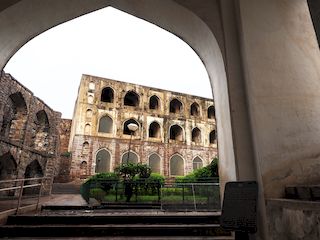
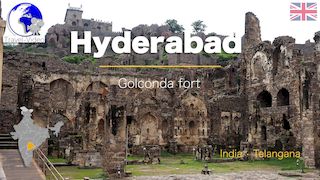
West of the historic centre of Hyderabad rises Golconda Fort, one of the most important fortified complexes of the Indian Deccan. Built across a granite hill dominating the surrounding landscape, this vast citadel reflects the military and political importance of the Golconda kingdom between the late medieval period and the early modern era. The video explores several sectors of the fort, including the fortifications, the former arsenal and spaces associated with local religious traditions that still remain active today in the Telangana region.
The scenes reveal a site where military architecture, dynastic history and contemporary cultural practices coexist within the same monumental environment. Massive defensive walls, fortified gates and military structures recall the strategic power of Golconda during the centuries when the fortress controlled a significant part of the Deccan. At the same time, the preparations and decorations associated with the Bonalu festival show that the site continues to play a role within the religious and cultural life of present-day Telangana.
The film also presents more specific locations such as the cell traditionally associated with Ramdas, a figure who remains important in regional religious memory. Through these different elements, the video portrays Golconda Fort not only as a historical monument but also as a place still connected to living traditions and collective memory.
Fortifications, Arsenal and Ceremonial Spaces
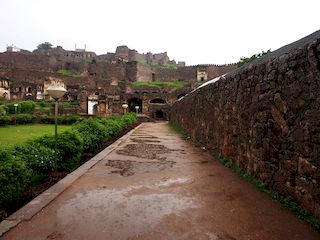
The defensive structures visible throughout the video are among the most impressive aspects of Golconda Fort. The fortress developed gradually from an earlier fortified settlement before becoming the capital of the Qutb Shahi dynasty. Its defensive system relied on multiple concentric walls adapted to the natural rocky terrain, integrating the enormous granite formations directly into the military architecture.
The ramparts, bastions and monumental gateways demonstrate a sophisticated defensive conception designed to resist sieges and artillery attacks. The former arsenal shown in the film recalls the military importance of the fortress during the period when Golconda was one of the principal political centres of the Deccan. The extensive interior spaces allowed not only the storage of weapons and ammunition but also the organisation of a fortified urban centre housing soldiers, officials and members of the royal court.
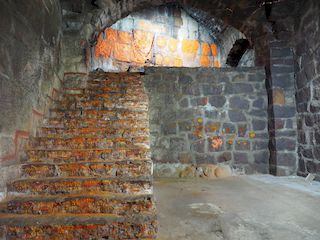
The video also captures preparations linked to the Bonalu festival. This Hindu celebration, particularly important in Hyderabad and Telangana, is dedicated to forms of the goddess Mahakali. The decorations and temporary structures visible inside the fort demonstrate how historical spaces continue to be incorporated into contemporary religious practices.
Another important place presented in the film is the cell associated with Ramdas. Kancherla Gopanna, better known as Bhakta Ramdas, was a seventeenth-century administrator, poet and devotee associated with the temple of Bhadrachalam. According to regional tradition, he was imprisoned at Golconda after using state funds to support religious activities. This episode remains deeply rooted in the cultural and devotional memory of Telangana.
Golconda and the Dynasties of the Deccan
The history of Golconda Fort is closely connected to the political transformations of the Deccan region. The site was initially occupied under the Kakatiya dynasty before becoming one of the principal centres of the Golconda Sultanate ruled by the Qutb Shahis from the sixteenth century onward.
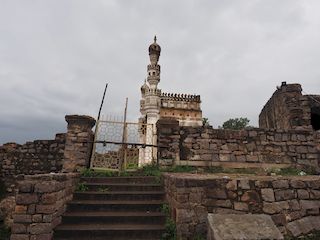
Under Qutb Shahi rule, Golconda expanded considerably thanks to its strategic location and its role within regional trade networks, particularly the diamond trade associated with the mines of the Deccan. The wealth of the kingdom financed the construction of monumental fortifications, palaces, mosques and administrative and military structures throughout the fortress.
Golconda also became known for several sophisticated defensive features. Certain acoustic systems reportedly allowed sound signals to travel between different parts of the citadel, while the adaptation of the architecture to the rocky landscape reinforced the defensive capacity of the site.
In 1687, after a prolonged siege, the Mughal emperor Aurangzeb conquered Golconda, bringing an end to Qutb Shahi rule. The fall of the fortress marked an important political turning point in the history of the Deccan, while Hyderabad gradually became the main urban centre of the region.
Today, Golconda Fort remains one of the major architectural testimonies to the Islamic history of the Deccan while continuing to participate in the cultural and religious life of Telangana.
Reading the Fortress Through Images
The videos presented on travel-video.info are largely constructed from carefully selected and animated photographs, allowing a more progressive observation of historical monuments and landscapes. This approach is particularly effective for a large and complex site such as Golconda Fort, where the organisation of the fortifications and the relationship between different architectural levels can easily be overlooked in conventional moving footage.
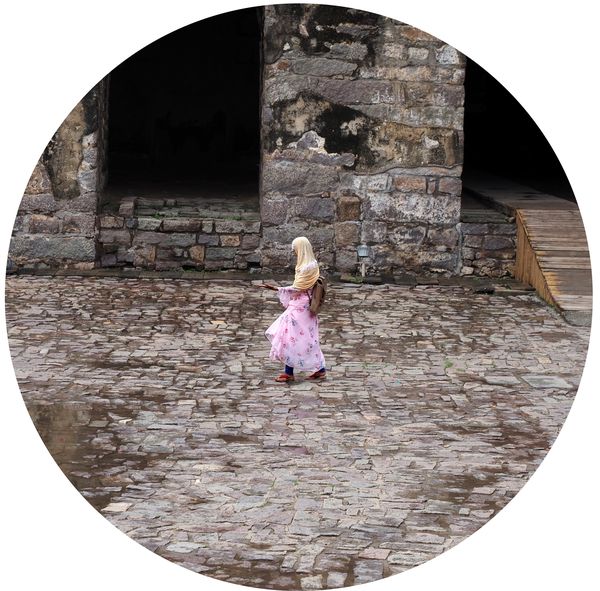
The gradual movement within the images makes it easier to observe the defensive walls, bastions and monumental gateways while highlighting the integration of the architecture into the rocky terrain. The slower visual rhythm also allows viewers to distinguish details of military structures and ceremonial spaces more clearly.
The sequences devoted to the Bonalu preparations make the coexistence between historical heritage and contemporary religious practices especially visible. Decorations, temporary installations and the presence of devotees show how ancient spaces continue to remain integrated into present-day cultural life.
This progressive visual construction also helps reveal the true scale of the fortress and the way military, residential and religious spaces were organised within the fortified complex.
A Major Witness to the History of the Deccan
Golconda Fort remains one of the most important fortified complexes of the Indian Deccan. Combining military architecture, dynastic heritage and living religious traditions, the site reflects several centuries of political and cultural history in the Hyderabad region. The video offers a detailed view of the fort while highlighting the fortifications, ceremonial spaces and contemporary practices that continue to give life to this former fortified capital of Telangana.




Audio Commentary Transcript
From its establishment in the 13th century by the Hindu Kakatiya dynasty until the fall of the Sultanate of Golconda in 1687 after invasion by Mughal troops with Emperor Aurangzeb at their head, Golconda Fort has been the seat of power and the center of political and military life in the region. Nowadays, this fort is partially in ruins, due to lack of maintenance over the last 3 or 4 centuries, but is still sporadically used for shows, due to its extraordinary acoustics.
We visited Golconda fort at the end of the Bonalu festival, a religious festival celebrated in the state of Telangana dedicated to the goddess Mahankali. This festival takes place every year during the month of Ashada (July-August in the Julian calendar). The purpose is to honor the goddess and to make her offerings carried in procession in decorated pots. These offerings are brought by dancing to a small temple, the Mahankali temple. On the occasion of the Bonalu, the stairs of the fort are decorated and painted orange.
A room of the fort is particularly visited, both by tourists and by the faithful. It is a room that served as the cell of a 17th century poet and tax collector. This man was accused of embezzling money to build a temple to the glory of Rama. And his miraculous release 12 years later made him a legend still revered today.
Golconda Fort, located on a height, offers a very beautiful overview of the city of Hyderabad.
Music:
- - YouTube video library - A Fallen Cowboy
- - YouTube video library - Ignosi, (© Ignosi by Kevin MacLeod is licensed under a Creative Commons Attribution 4.0 license. https://creativecommons.org/licenses/by/4.0/
- Source: http://incompetech.com/music/royalty-free/index.html?isrc=USUAN1100450
- Artist: http://incompetech.com/)
Disclaimer: Despite its appropriateness, copyright issues prevent the use of indian traditional music in "Hyderabad, Golconda fort • India, Telangana", hence the use of royalty-free music. Despite our careful selection, some might regret this decision, which is necessary to avoid potential lawsuits. Although difficult, this decision is the only viable solution.