

 Français (France)
  Nederlands (nl-NL)
 Of Islamic tradition, the Adil Shahi of Bijapur dynasty ruled for approximately 196 years, ± between 1490 and 1686 over all or part of South India and West India, during the Medieval Period.
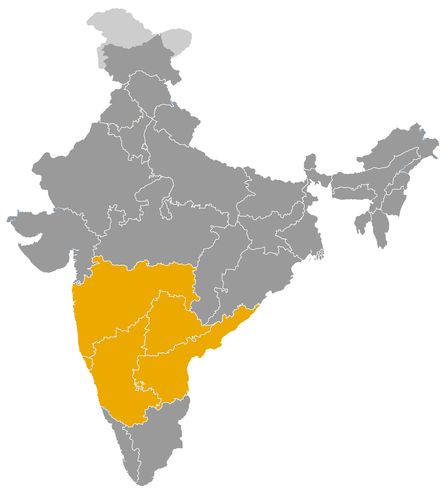
This map illustrates the maximum territory that the Adil Shahi of Bijapur Dynasty had reached at its height, covering the current regions of Andhra Pradesh, Goa, Karnataka, Maharashtra and Telangana in India. Its main purpose is to provide a visual aid to understand the geographical extent of this dynasty. However, it's important to note that the contemporary borders of these regions may not necessarily coincide with the historical territories.
The Adil Shahi Dynasty of Bijapur: A Major Political, Cultural and Economic Power in the History of India
The emergence of a powerful Deccan sultanate
The Adil Shahi dynasty ruled the Sultanate of Bijapur from 1490 until 1686, during a transformative period in the history of the Indian subcontinent. Founded by Yusuf Adil Shah following the fragmentation of the Bahmani Sultanate, the dynasty established one of the most influential Muslim kingdoms in the Deccan Plateau. From its capital at Bijapur, now Vijayapura in the Indian state of Karnataka, the dynasty developed a powerful regional state that played a decisive role in shaping the political, cultural and economic landscape of southern India.
Situated between the western coast and the interior of the Deccan, Bijapur occupied a strategic position that allowed it to control important trade routes while serving as a buffer between rival kingdoms. Throughout nearly two centuries of rule, the Adil Shahi sultans transformed their kingdom into a centre of administration, artistic achievement and commercial prosperity.
A major political force in the Deccan
The political importance of the Adil Shahi dynasty stemmed from its ability to establish a stable kingdom in one of the most contested regions of India. After gaining independence from the Bahmani Sultanate, the rulers of Bijapur gradually expanded their authority over much of present day northern Karnataka and neighbouring regions of Maharashtra and Telangana.
The dynasty maintained a careful balance between diplomacy and military power. Its rulers frequently formed alliances with neighbouring Deccan sultanates while competing with them for strategic territories and influence. These shifting political relationships reflected the complex balance of power that characterized the Deccan during the sixteenth and seventeenth centuries.
One of the defining moments in the dynasty's history occurred in 1565 during the Battle of Talikota. Bijapur joined the Sultanates of Ahmadnagar, Golconda and Bidar in a coalition against the powerful Vijayanagara Empire. The decisive victory of the allied sultanates led to the destruction of Vijayanagara's capital and permanently altered the political landscape of southern India. As one of the principal participants in this campaign, Bijapur emerged as one of the dominant powers of the Deccan.
During the seventeenth century, however, the political environment became increasingly challenging. The growing power of the Mughal Empire under Emperor Aurangzeb and the rapid rise of the Marathas under Shivaji gradually weakened the Sultanate of Bijapur. After a prolonged siege, Bijapur was conquered by the Mughals in 1686, bringing the Adil Shahi dynasty to an end.
Administration and government
The rulers of Bijapur governed a kingdom inhabited by people of diverse ethnic, linguistic and religious backgrounds. Their administration combined Persian political traditions with existing Indian systems of governance.
The kingdom was divided into provinces administered by governors responsible for taxation, military organization and law enforcement. Local officials supervised agricultural production, collected revenue and maintained public order, while the central court coordinated the overall administration of the state.
The Adil Shahi rulers adopted a pragmatic approach to government by employing both Muslim and Hindu officials in important administrative positions. This inclusive policy contributed to political stability and facilitated cooperation between different communities within the kingdom.
Military strength also formed an essential element of state administration. The rulers maintained large cavalry forces, infantry units and artillery, while investing heavily in the construction and maintenance of forts that protected strategic routes across the Deccan.
Cultural patronage and artistic achievement
The cultural legacy of the Adil Shahi dynasty represents one of its greatest contributions to Indian history. The rulers of Bijapur actively supported literature, music, architecture, painting and scholarship, transforming their capital into one of the leading artistic centres of the Deccan.
Persian served as the principal language of administration and courtly literature, but the dynasty also encouraged the development of Dakhani, an early literary form of Urdu that flourished in the Deccan. Poets, scholars and calligraphers from Persia, Central Asia and various regions of India found patronage at the Bijapur court.
Music occupied a particularly important place in court life. Several rulers were themselves accomplished patrons of the arts and encouraged exchanges between Persian and Indian musical traditions. These interactions enriched the cultural life of the kingdom and contributed to the emergence of distinctive artistic forms unique to the Deccan.
Religious life was similarly characterized by relative openness. Although the dynasty was Muslim, Hindu officials, artists and scholars continued to play important roles within the administration and cultural institutions. This environment encouraged artistic and intellectual exchanges that shaped the multicultural character of the region.
Monumental architecture
The architectural achievements of the Adil Shahi dynasty remain among the finest examples of Indo Islamic architecture in India.
The rulers commissioned mosques, palaces, gardens, fortifications, reservoirs and mausoleums that reflected both their political authority and artistic ambitions. These monuments combined Persian, Central Asian, Islamic and indigenous Indian architectural traditions into a distinctive regional style.
The most celebrated monument is the Gol Gumbaz, the mausoleum of Mohammed Adil Shah. Completed during the seventeenth century, it is renowned for its enormous masonry dome, one of the largest in the world, and for its remarkable Whispering Gallery, whose acoustics continue to attract visitors and researchers alike.
Other important monuments include the Jama Masjid of Bijapur, the Ibrahim Rauza funerary complex and numerous gateways, waterworks and defensive structures that illustrate the technical sophistication of Adil Shahi architecture.
These buildings continue to represent some of the most significant elements of India's architectural heritage.
Economic prosperity and commercial networks
The prosperity of the Sultanate of Bijapur rested on a diversified economy based on agriculture, trade and craftsmanship.
Agriculture formed the economic foundation of the kingdom. Farmers cultivated cereals, cotton, pulses and other crops on the fertile lands of the Deccan Plateau. The rulers invested in irrigation systems, reservoirs and canals that increased agricultural productivity and improved food security.
The kingdom also benefited from its position along major commercial routes linking the ports of the Arabian Sea with the interior of India. Merchants transported horses imported from the Persian Gulf, textiles, spices, precious stones and metal goods through Bijapur's territory.
Urban industries flourished alongside long distance commerce. Skilled artisans produced textiles, weapons, jewellery, ceramics and decorative objects that were traded throughout India and beyond. Revenue generated through agriculture and commerce enabled the rulers to finance ambitious architectural projects and maintain a powerful military establishment.
Historical significance and lasting legacy
Although the Adil Shahi dynasty disappeared following the Mughal conquest, its influence extended far beyond its political existence.
Politically, the dynasty shaped the balance of power in the Deccan for nearly two centuries. It played a decisive role in the decline of the Vijayanagara Empire, resisted Mughal expansion for decades and became one of the principal rivals encountered by the emerging Maratha state.
Its cultural achievements proved even more enduring. The monuments of Bijapur remain among the greatest masterpieces of Indo Islamic architecture, while the dynasty's patronage of literature, music and scholarship contributed significantly to the development of Deccan culture. The interaction between Persian, Islamic and Indian traditions under Adil Shahi rule created a rich cultural synthesis that influenced later artistic developments across southern India.
The Adil Shahi dynasty therefore occupies an important place in the history of India. Through its political influence, economic vitality and exceptional cultural patronage, it helped transform the Deccan into one of the principal centres of power, commerce and artistic creativity between the fifteenth and seventeenth centuries.
The Geographic Expansion of the Adil Shahi Dynasty of Bijapur and Its Influence on the Political Landscape of the Deccan
The emergence of a Deccan power
The Adil Shahi dynasty ruled the Sultanate of Bijapur from 1490 until its conquest by the Mughal Empire in 1686. Founded by Yusuf Adil Shah following the disintegration of the Bahmani Sultanate, the kingdom quickly emerged as one of the principal powers of the Deccan Plateau. From its capital at Bijapur, now Vijayapura in the Indian state of Karnataka, the dynasty gradually expanded its territory through military campaigns, diplomatic alliances and political opportunism.
The geographic evolution of the Sultanate was closely tied to the balance of power in southern India. Throughout nearly two centuries, the rulers of Bijapur competed with neighbouring Deccan sultanates, the powerful Vijayanagara Empire, the rising Marathas and eventually the Mughal Empire. Their territorial expansion not only increased the kingdom's resources but also reshaped political relations across the Indian peninsula.
The territorial core around Bijapur
The Sultanate initially controlled the territory surrounding Bijapur in what is now northern Karnataka. This region formed part of the former Bahmani Sultanate and occupied a strategic position between the fertile river valleys of the Deccan and the commercial routes leading to the western coast.
The first Adil Shahi rulers concentrated on consolidating their authority over neighbouring districts before launching broader campaigns of expansion. Control of agricultural lands, fortified towns and commercial routes became essential objectives of state policy. This consolidation established a stable territorial base from which later rulers could extend their influence.
The location of Bijapur also provided direct access to important inland trade networks connecting the Arabian Sea ports with the interior of the Deccan, giving the kingdom significant economic and military advantages.
Expansion across the western Deccan
During the sixteenth century, the Adil Shahi rulers steadily expanded their authority over much of the western Deccan. Their territories eventually covered large parts of present day northern Karnataka, southern Maharashtra and adjoining areas of Telangana.
The kingdom established control over the valleys of the Krishna and Bhima rivers, both of which were strategically important for agriculture, communication and military movement. These fertile regions increased agricultural production while supporting a growing population and a stronger army.
The Sultanate also secured numerous forts positioned along mountain passes and major transport routes. These fortifications protected the kingdom against invasions while enabling rapid military deployment across its territories.
At its greatest extent, Bijapur exercised authority over a broad region stretching from the western coastal hinterland to the central Deccan Plateau. In some frontier areas, its influence extended through tributary arrangements and alliances rather than direct administration.
Relations with the neighbouring Deccan sultanates
The expansion of Bijapur inevitably brought it into contact with the other successor states of the Bahmani Sultanate. These included the Nizam Shahi dynasty of Ahmadnagar, the Qutb Shahi dynasty of Golconda, the Barid Shahi dynasty of Bidar and the Imad Shahi dynasty of Berar.
Relations between these kingdoms constantly shifted between rivalry and cooperation. Competition centred on fertile agricultural districts, strategic fortresses and important commercial routes. Territorial disputes frequently resulted in military campaigns, but common political interests also encouraged temporary alliances.
The rulers of Bijapur demonstrated considerable diplomatic flexibility, recognizing that cooperation with neighbouring Muslim sultanates could be essential when facing stronger external threats.
The struggle with the Vijayanagara Empire
The greatest territorial rival of the Adil Shahi dynasty was the Vijayanagara Empire, which dominated much of southern India.
Both states sought control over the fertile lands situated between the Krishna and Tungabhadra rivers. These territories possessed exceptional agricultural productivity and occupied a strategic position between northern and southern India.
The rivalry culminated in the Battle of Talikota in 1565. Bijapur joined Ahmadnagar, Golconda and Bidar in a military coalition against Vijayanagara. The allied victory led to the destruction of the imperial capital and marked the beginning of Vijayanagara's irreversible decline.
This success significantly expanded Bijapur's sphere of influence and established the Sultanate as one of the dominant powers of the Deccan. Nevertheless, the former territories of Vijayanagara remained politically fragmented, and many local rulers retained varying degrees of autonomy.
Southern and eastern frontiers
Despite its military successes, the Sultanate of Bijapur never achieved complete domination over southern India.
The Nayaka kingdoms that emerged following the decline of Vijayanagara continued to control significant parts of the southern peninsula. Likewise, the eastern frontier remained fluid because of repeated conflicts with the Qutb Shahi rulers of Golconda.
As a result, the Adil Shahi kingdom functioned primarily as a major regional power rather than as a pan Indian empire. Its authority was strongest across the western and central Deccan, while influence beyond these areas often depended upon diplomacy, tributary arrangements or temporary military occupation.
Conflict with the Marathas
During the seventeenth century, the rise of the Marathas fundamentally altered the geopolitical landscape of the Deccan.
Shivaji initially served under nobles connected with the Sultanate of Bijapur before establishing his own independent kingdom. Many of the forts scattered across the Western Ghats became the focus of prolonged conflict between the Marathas and the Adil Shahi rulers.
The Marathas' superior knowledge of the mountainous terrain enabled them to wage highly effective guerrilla warfare. Gradually, Bijapur lost several strategically important forts and territories, weakening its ability to defend the kingdom against both Maratha attacks and Mughal expansion.
These territorial losses marked the beginning of the Sultanate's political decline.
Mughal conquest and the end of the Sultanate
While the Marathas expanded from the west, the Mughal Empire advanced steadily southward under Emperor Aurangzeb.
The strategic importance of Bijapur made it a principal target of Mughal expansion. The Sultanate resisted for several years, relying on its strong fortifications and extensive territory. Nevertheless, after a prolonged siege, Bijapur fell to Mughal forces in 1686.
Its territories were incorporated into the Mughal Empire, bringing the Adil Shahi dynasty to an end after nearly two centuries of independent rule.
Geography as the foundation of political influence
The history of the Adil Shahi dynasty demonstrates how geography shaped political power in the Deccan. Control of fertile river valleys, major fortresses and commercial corridors enabled Bijapur to become one of the leading regional powers of early modern India.
Its territorial expansion profoundly influenced relations with neighbouring dynasties. The rivalry with Vijayanagara reshaped southern India, cooperation and conflict with the other Deccan sultanates determined regional politics for generations, while later confrontations with the Marathas and the Mughal Empire reflected the emergence of new political forces.
The geographic reach of the Adil Shahi dynasty therefore represented far more than a sequence of military conquests. It created a political framework that influenced the balance of power across the Deccan for almost two centuries and left a lasting mark on the historical development of southern India.
The Adil Shahi dynasty ruled the Sultanate of Bijapur from 1490 to 1686. Several sultans succeeded to the throne as minors and initially ruled under regencies. The sultanate ended in 1686 when the Mughal emperor Aurangzeb conquered Bijapur and incorporated it into the Mughal Empire.
- Yusuf Adil Shah (1490–1510) • Founder of the independent Sultanate of Bijapur, he established the political and military foundations of the dynasty.
- Ismail Adil Shah (1510–1534) • He succeeded as a child and initially ruled under the regency of Kamal Khan before consolidating the sultanate.
- Mallu Adil Shah (1534–1535) • His brief reign ended when leading court dignitaries deposed him.
- Ibrahim Adil Shah I (1535–1558) • He reorganized the administration and increased the use of local languages and elites in government.
- Ali Adil Shah I (1558–1580) • He joined the coalition of Deccan sultanates that defeated the Vijayanagara Empire at Talikota in 1565.
- Ibrahim Adil Shah II (1580–1627) • He succeeded as a child and initially ruled under regency before becoming a major patron of art, music and religious tolerance.
- Muhammad Adil Shah (1627–1656) • He expanded the sultanate southward, reached an agreement with the Mughals and commissioned the Gol Gumbaz.
- Ali Adil Shah II (1656–1672) • His reign was marked by Mughal offensives, the rise of Maratha power and the weakening of central authority.
- Sikandar Adil Shah (1672–1686) • He succeeded as a child and ruled under competing regents until Aurangzeb conquered Bijapur.