Français (France)
  Nederlands (nl-NL)
 Of Hindu tradition, the Nayak of Gingee dynasty ruled for approximately 159 years, ± between 1490 and 1649 over all or part of South India, during the Medieval Period.
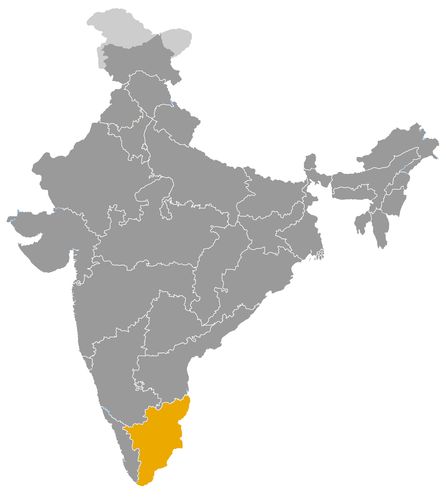
This map illustrates the maximum territory that the Nayak of Gingee Dynasty had reached at its height, covering the current regions of Tamil Nadu in India. Its main purpose is to provide a visual aid to understand the geographical extent of this dynasty. However, it's important to note that the contemporary borders of these regions may not necessarily coincide with the historical territories.
The Nayak Dynasty of Gingee and Its Role in the Political and Cultural History of South India
A regional power shaped by the legacy of Vijayanagara
The Nayak dynasty of Gingee occupied an important regional position in the history of South India, particularly between the sixteenth and seventeenth centuries. Its rulers were not imperial monarchs in the manner of the Mauryas, Guptas, Cholas or Mughals, but they played a significant role in the political fragmentation that followed the weakening of the Vijayanagara Empire. Their power was centred on Gingee, also known as Senji or Jinji, in the northern part of present-day Tamil Nadu.
The Nayaks of Gingee emerged within the administrative and military structure of Vijayanagara. Like other Nayak houses, they were initially provincial commanders or governors entrusted with the defence of strategic territories, the collection of revenue and the maintenance of local order. Over time, especially after the decline of effective imperial authority, they developed a more autonomous political identity. Their history illustrates the transition from imperial administration to regional state formation in South India.
Gingee as a fortified centre of political authority
The political importance of the Nayaks of Gingee was closely linked to the strength of their capital. Gingee Fort was one of the most formidable defensive sites in southern India, protected by rocky hills, walls, gateways, reservoirs and fortified enclosures. Control of this site gave the Nayaks a strong military position between the Tamil plains, the inland plateau and the routes leading towards the Coromandel Coast.
This geographical position allowed the dynasty to act as a northern Tamil counterweight to the Nayak states of Thanjavur and Madurai. Gingee was never the centre of a vast empire, but it controlled a strategic zone where military defence, agricultural revenue and access to trade routes converged. The dynasty therefore served as both a local power and a regional buffer between competing states.
The weakening of Vijayanagara after the Battle of Talikota in 1565 gave the Nayaks of Gingee greater freedom, but also exposed them to new pressures. They had to deal with neighbouring Nayak states, the later Vijayanagara rulers of the Aravidu line, the Deccan sultanates and, increasingly, European trading powers active on the coast.
Cultural patronage rooted in temple and court traditions
The cultural impact of the Nayaks of Gingee belonged to the broader world of post-Vijayanagara South India. Their legitimacy was expressed not only through military command, but also through patronage of temples, religious institutions and monumental architecture. Like other Nayak rulers, they inherited a political culture in which the protection of Hindu sacred sites and ritual traditions was a visible sign of royal authority.
Their contribution was especially connected with the architectural and religious landscape of Gingee and its surrounding region. The fort complex itself included not only military structures but also temples, granaries, water systems and ceremonial spaces. These elements reflected a conception of power in which defence, administration and sacred patronage were physically integrated.
The Nayak period also helped preserve and transmit artistic forms associated with Vijayanagara. Mandapas, temple enclosures, sculptural decoration and fortified sacred spaces formed part of this cultural continuity. Although the Nayaks of Gingee were less famous than those of Madurai or Thanjavur, they participated in the same regional pattern of temple-centred political expression.
A meeting point of Tamil, Telugu and Sanskritic influences
The dynasty governed a culturally mixed region. The Nayak elite was closely connected with the Telugu-speaking military and administrative circles of Vijayanagara, while Gingee itself lay in a predominantly Tamil environment. Sanskritic religious traditions also remained important in temple culture and royal legitimation.
This combination gave the Nayak state a composite character. It was neither purely Tamil nor simply an extension of Telugu power. Instead, it functioned as a bridge between the imperial traditions of Vijayanagara and the regional social world of northern Tamil Nadu. Such cultural mediation was one of the most important roles of the Nayak dynasties in South Indian history.
The courtly and religious culture of Gingee therefore reflected adaptation rather than rupture. The Nayaks reused imperial models, localised them and expressed them through architecture, ritual patronage and regional administration.
Economic foundations based on land, revenue and regional exchange
The economic role of the Nayaks of Gingee was founded primarily on agrarian revenue. Their power depended on control over villages, cultivated land, irrigation resources and tax collection. As in other South Indian states, agricultural income supported the army, the fort, the court, temple patronage and local administration.
Gingee’s location also gave the dynasty access to commercial networks linking the interior to the Coromandel Coast. Even if the Nayaks of Gingee were not principally maritime rulers, their territory lay within the economic hinterland of coastal trade. Textiles, agricultural products, horses, metals and other goods circulated through routes that connected inland centres with ports and markets.
This economic position increased the political value of the region. Control of roads and fortified points meant control of revenue, security and movement. It also made Gingee relevant to wider regional competition, especially as European commercial actors became more active along the coast from the sixteenth century onward.
A dynasty whose importance lies in regional transformation
The Nayak dynasty of Gingee is best understood as a regional power that reveals the changing structure of South Indian politics after the high point of Vijayanagara. Its rulers did not create a large empire, but they maintained a strategic principality, strengthened a major fortress, supported religious and architectural traditions, and participated in the economic networks of northern Tamil Nadu.
Their decline, marked by the conquest of Gingee by the forces of the Bijapur Sultanate in the seventeenth century, shows the vulnerability of regional Nayak states in a period of expanding Deccan and later Mughal influence. Yet their historical significance remained substantial. They formed part of the political mosaic that connected imperial Vijayanagara, Tamil regional powers, Deccan sultanates and coastal trade.
The Nayaks of Gingee therefore occupy a meaningful place in Indian history as defenders, administrators and cultural patrons of a frontier region. Their legacy is most visible in the enduring fortress of Gingee, whose architecture still reflects the military strength and regional ambition of a dynasty positioned between the Tamil country, the Deccan and the Coromandel world.
The Geographic Reach of the Nayak Dynasty of Gingee in South India
A fortified principality centred on Gingee
The Nayak dynasty of Gingee controlled a regional territory centred on Gingee, also known as Senji or Jinji, in the northern part of present day Tamil Nadu. Its power was not comparable to that of a large imperial dynasty, but its location gave it considerable strategic value. Gingee Fort stood among rocky hills and commanded routes between the Tamil plains, the inland plateau and the Coromandel Coast. This position made the dynasty important in the political geography of South India between the sixteenth and seventeenth centuries.
The territorial formation of the Gingee Nayaks must be understood within the framework of the Vijayanagara Empire. The Nayaks originally acted as military governors or provincial chiefs under imperial authority. Their role was to defend a frontier zone, collect revenue, maintain order and secure communications. As Vijayanagara weakened, especially after the Battle of Talikota in 1565, the Nayaks of Gingee acquired a greater degree of autonomy and their territorial control became more visibly regional.
Northern Tamil Nadu as the core of Nayak authority
The most stable area controlled by the Nayaks of Gingee corresponded to parts of northern Tamil Nadu. Their authority was strongest around Gingee itself and extended into surrounding agricultural plains and fortified settlements. Areas near Tiruvannamalai, Villupuram and the routes leading eastward toward the coast were closely linked to their sphere of influence.
This territory was valuable because it combined defensive strength with agricultural resources. The plains around Gingee supported revenue collection, while the fort protected the dynasty against rivals. Control of villages, irrigation systems and cultivated lands provided the economic base required to maintain soldiers, administrators, religious institutions and public works. The dynasty’s power therefore depended less on distant conquest than on the effective management of a compact and defensible region.
A wider sphere reaching toward the Coromandel Coast
Although Gingee itself was inland, its territory was connected to the economic world of the Coromandel Coast. Roads from the interior linked the fort and its surrounding lands to coastal markets, ports and trading settlements. This gave the Nayaks access to circuits through which textiles, agricultural products, horses, metals and other goods circulated.
The eastern extension of their influence did not necessarily mean direct control over major ports, but it placed Gingee within the hinterland of coastal trade. This mattered politically because rulers who controlled inland routes could influence the movement of goods and armies. It also meant that the Gingee Nayaks operated in a region increasingly affected by the arrival of Portuguese, Dutch and other European commercial interests along the coast. Their principality was not primarily maritime, yet it belonged to a landscape shaped by inland and coastal connections.
Northern connections with Vellore, Chandragiri and Andhra regions
The northern limits of the Gingee Nayak sphere were more fluid. Some traditions associate their authority, at least during certain phases, with territories extending toward Vellore, Chandragiri, Chittoor and parts of southern Andhra. These areas were strategically important because they linked Tamil country with the Telugu speaking zones of the former Vijayanagara realm.
Vellore in particular played a major role in the regional balance of power. Control or influence over Vellore gave access to major routes and strengthened any ruler’s position between Tamil Nadu and the Deccan. However, this northern zone was contested. The later Vijayanagara rulers of the Aravidu line, based at times in places such as Penukonda, Chandragiri and Vellore, also claimed authority over these regions. As a result, the northern frontier of Gingee was not fixed. It shifted according to military pressure, dynastic appointments and changing alliances.
Relations with the Nayaks of Thanjavur and Madurai
The geographic position of Gingee shaped its relations with the other major Nayak states of the Tamil region. To the south east and south lay the Nayak kingdom of Thanjavur, centred on the fertile Kaveri delta. Farther south, the Nayaks of Madurai controlled a larger territory linked to the former Pandya region. Gingee therefore formed the northern counterpart to these southern Nayak powers.
Relations among these dynasties were influenced by shared origins in the Vijayanagara political system, but also by rivalry. They competed for legitimacy, fortified places, revenue lands and influence over temples and local chiefs. Their boundaries were not always sharply defined, and their political behaviour depended on opportunity as much as on formal hierarchy. Gingee’s northern location gave it a different strategic role from Thanjavur and Madurai, since it was more directly exposed to pressure from the Deccan and from the remaining centres of Vijayanagara power.
The pressure of Deccan sultanates on the Gingee frontier
The territorial history of the Nayaks of Gingee was also shaped by the expansion of the Deccan sultanates. As Vijayanagara authority declined, the sultanates of Bijapur and Golconda increased their influence in southern India. Gingee’s fort and its surrounding territory became attractive because they offered control over a major military position between the Deccan, Tamil country and the coastal plain.
This pressure culminated in the seventeenth century, when Bijapur forces captured Gingee in 1649. The conquest ended the effective sovereignty of the Nayak dynasty of Gingee and incorporated the region into a broader pattern of Deccan expansion. The fall of Gingee showed that even a strong fortress could not permanently resist the combined pressures of regional fragmentation and larger military powers.
A regional territory with strategic importance beyond its size
The geographic extension of the Nayak dynasty of Gingee was limited when compared with the great empires of India, but its importance was greater than its size suggests. The dynasty controlled a fortified zone in northern Tamil Nadu, influenced routes toward the Coromandel Coast and participated in the contested frontier between Tamil, Telugu and Deccan political worlds.
Its territorial history explains its relations with neighbouring dynasties. Gingee negotiated the weakening authority of Vijayanagara, rivalled other Nayak houses, interacted with coastal commercial networks and faced the military expansion of the Deccan sultanates. Its legacy lies in the role of Gingee as a strategic stronghold whose geography shaped the politics of South India during a period of regional transformation.
The dominant title was Nayaka or Nayak, first under Vijayanagara suzerainty and later with increasing autonomy after the weakening of the empire. Available chronologies differ considerably: the following list follows a cautious and indicative sequence, based on the rulers most commonly mentioned for the Gingee line.
- Vaiyappa Nayak (c. 1490) • Nayak chief associated with the establishment of Vijayanagara authority in the Gingee region.
- Tubaki Krishnappa Nayaka (c. 1509–1521) • Generally recognised as the founder of the Gingee Nayak line. His rule is linked with the development of the fortress and several religious buildings.
- Chennappa Nayaka (c. 1521–1540) • Nayak ruler or governor mentioned as the probable successor of Krishnappa. His reign remains poorly documented.
- Achyuta Vijaya Ramachandra Nayak (c. 1520–1540) • Figure preserved in some Gingee chronologies. His exact place in the succession remains debated.
- Muthialu Nayak (c. 1540–1550) • Nayak of Gingee known from later chronological traditions. His authority still belonged to the political framework of Vijayanagara.
- Gangama Nayaka (mid-16th century) • Ruler mentioned in the Gingee Nayak line. The precise dates of his reign are not secure.
- Venkata Krishnappa Nayaka (second half of the 16th century) • Nayak associated with the regional consolidation of Gingee. Sources sometimes distinguish him with difficulty from other rulers bearing the name Krishnappa.
- Venkatappa Nayak (c. 1570–1600) • Nayak ruler recorded in a Gingee chronology. His reign corresponds to a period of growing autonomy from the weakened Vijayanagara power.
- Venkata Rama Bhupala Nayaka (late 16th century) • Ruler cited in the dynastic tradition of Gingee. His name suggests royal titulature, but his chronology remains uncertain.
- Thriyambaka Krishnappa Nayaka (late 16th or early 17th century) • Nayak mentioned in the Gingee succession. The details of his reign are little known.
- Varadappa Nayak (c. 1600–1620) • Ruler of Gingee during a phase of regional rivalries. His reign belongs to the context of conflicts among Nayak states and neighbouring powers.
- Ramalinga Nayani Vaaru (early 17th century) • Dynastic figure cited in the Gingee line. The sources do not allow the extent of his effective power to be fixed with certainty.
- Venkata Perumal Naidu (first half of the 17th century) • Ruler or dynastic chief mentioned before the last Nayaks of Gingee. His Naidu title reflects a social or political form distinct from strict royal titulature.
- Periya Ramabhadra Naidu (first half of the 17th century) • Chief of the Gingee line cited in succession traditions. His reign remains difficult to date precisely.
- Ramakrishnappa Naidu (until 1649) • Last Nayak ruler generally associated with the fall of Gingee to the forces of the Bijapur Sultanate. After this conquest, the line’s effective sovereignty came to an end.
 Links to the main sections of the site