Français (France)
  Nederlands (nl-NL)
 Of Hindu tradition, (with additional Jain influence), the Saluva dynasty ruled for approximately 18 years, ± between 1485 and 1503 over all or part of East India, South India and West India, during the Medieval Period.
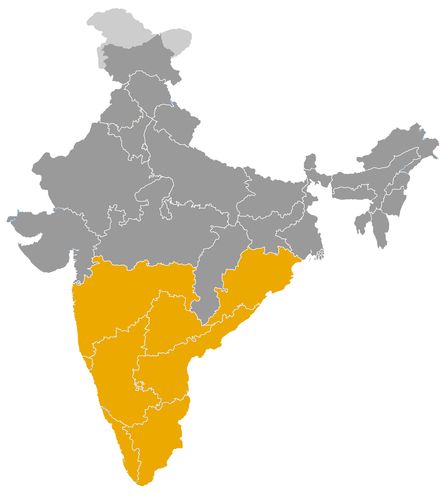
This map illustrates the maximum territory that the Saluva Dynasty had reached at its height, covering the current regions of Andhra Pradesh, Goa, Karnataka, Kerala, Maharashtra, Odisha, Tamil Nadu and Telangana in India. Its main purpose is to provide a visual aid to understand the geographical extent of this dynasty. However, it's important to note that the contemporary borders of these regions may not necessarily coincide with the historical territories.
The Saluva Dynasty and the Continuity of the Vijayanagara Empire
A transitional dynasty in South Indian history
The Saluva dynasty occupies a specific and important place in the history of medieval India. It was not the founding house of the Vijayanagara Empire, a role associated with the Sangama dynasty, nor was it the dynasty of the empire’s greatest splendour, which is usually linked to the Tuluva period. Its significance lies instead in its transitional function. The Saluvas ruled at a moment when the imperial structure of Vijayanagara was weakened by succession problems, military pressure and growing regional autonomy.
The dynasty ruled from about 1485 to 1505. Although this period was short, it helped preserve the continuity of the Vijayanagara state at a critical time. Saluva Narasimha Deva Raya, the founder of the dynasty, came to power after the decline of the last Sangama rulers. His accession should not be understood as the creation of a new empire, but as an attempt to preserve and restore an existing imperial framework centred on Vijayanagara, now identified with Hampi in Karnataka.
The restoration of weakened imperial authority
By the late fifteenth century, the Vijayanagara Empire faced serious internal and external difficulties. The authority of the late Sangama rulers had declined, succession conflicts weakened the court, and several provincial chiefs had gained greater autonomy. At the same time, the Deccan sultanates and the Gajapati rulers of Odisha exerted pressure on the northern and eastern frontiers of the empire.
Saluva Narasimha rose in this unstable context. He had already been an influential military and administrative figure before taking power. His main role was political and military: he sought to restore central authority, defend strategic territories and preserve the cohesion of the imperial state. The Saluva dynasty therefore represents an internal response to crisis, rather than a complete break with the earlier Vijayanagara order.
A territorial framework inherited from the Sangamas
The Saluvas inherited the broad territorial framework created by the Sangama dynasty. The empire continued to exercise direct or indirect authority over large parts of South India, especially Karnataka, Andhra, parts of the Tamil regions and frontier zones toward the Deccan. The capital at Vijayanagara remained the political, symbolic and ceremonial centre of the state.
This territorial continuity did not mean that control was equally strong everywhere. In many regions, imperial authority depended on military governors, local chiefs and regional elites. The Saluva rulers had to maintain loyalty among these power holders while also resisting external enemies. This fragile balance explains why the Saluva period is often seen as a phase of preservation rather than expansion. The dynasty maintained the imperial structure long enough for the later Tuluva rulers to reconsolidate it.
A political impact greater than its architectural legacy
The Saluva dynasty did not leave an architectural legacy as visible as that of the Sangama or Tuluva dynasties. At Hampi, many monuments belong to long phases of construction, use and transformation, which makes precise dynastic attribution difficult. The short and unstable nature of Saluva rule also limited the possibility of large building programmes clearly associated with the dynasty.
Its historical impact was therefore primarily political. The Saluvas preserved the institutions of Vijayanagara, maintained the capital, continued the administrative networks and protected the military structure of the empire. Their importance lies less in the construction of new monuments than in the survival of the imperial system during a dangerous period. Without this transitional phase, the later Tuluva revival might have been more difficult or even impossible.
Religious continuity and cultural stability
In religious matters, the Saluva rulers continued the general orientation of the Vijayanagara Empire. They mainly patronised Hinduism, supporting temples, Brahmanical institutions and sacred centres linked to royal legitimacy. Jain communities, especially in parts of Karnataka, remained present and may have benefited from tolerance or limited patronage, but Hindu institutions clearly remained central to imperial ideology.
Culturally, the Saluva period maintained the multilingual environment of Vijayanagara. Kannada, Telugu, Tamil and Sanskrit continued to play important roles in administration, temple culture, literature and courtly life. The period was not as famous for literary brilliance as the reign of Krishnadevaraya under the Tuluvas, but it preserved the social and institutional conditions that later allowed such cultural flowering.
Economic networks preserved during a time of crisis
The economy of Vijayanagara depended on agriculture, irrigation, taxation, craft production and trade. Under the Saluvas, the main economic challenge was not the creation of new systems, but the protection of existing networks. Inland routes connected Karnataka, Andhra, Tamil regions and coastal areas, allowing the movement of agricultural products, textiles, metals, spices, precious stones and other goods.
The horse trade remained especially important. Imported horses from Arabia and Persia were essential for cavalry warfare, particularly in conflicts with the Deccan sultanates. Access to coastal trade routes was therefore a strategic necessity as well as an economic advantage. By maintaining these commercial circuits, the Saluvas helped sustain the fiscal and military foundations of the empire.
A bridge between Sangama foundations and Tuluva revival
After Saluva Narasimha, the dynasty weakened rapidly. Thimma Bhupala ruled only briefly, and Narasimha Raya II held power largely in name. Real authority increasingly passed to Tuluva Narasa Nayaka, a powerful general and regent whose family would later establish the Tuluva dynasty.
The Saluva dynasty should therefore be understood as a bridge between two more prominent phases of Vijayanagara history. The Sangamas had founded and expanded the empire; the Tuluvas would bring it to one of its greatest political, military and cultural heights. Between them, the Saluvas preserved the imperial framework during a period of crisis. Their role in Indian history is that of a stabilising dynasty that maintained the continuity of one of the major powers of medieval South India.
The Geographical Expansion of the Saluva Dynasty in South India
A transitional dynasty within the Vijayanagara imperial framework
The Saluva dynasty ruled the Vijayanagara Empire from about 1485 to 1505. Its geographical extent must be understood within a specific political context. The Saluvas did not create a new territorial empire from the beginning. They inherited the broad imperial framework established by the Sangama dynasty and attempted to preserve it during a period of instability. Their rule was short, and their main historical role was not expansion, but the maintenance of Vijayanagara’s territorial and strategic structure.
The capital remained Vijayanagara, now identified with Hampi in Karnataka. This city continued to serve as the political, religious and symbolic centre of the empire. However, the authority of the Saluva rulers over distant provinces was not as secure as it had been during the stronger phases of Sangama rule, nor as consolidated as it would later become under the Tuluvas. Their empire was therefore extensive, but unevenly controlled.
Karnataka as the secure centre of Saluva power
Karnataka remained the heartland of the Saluva dynasty. The imperial capital, the royal enclosures, major temples, fortifications, markets and administrative structures were concentrated in this region. Control over Karnataka was essential because it provided the dynasty with military resources, symbolic legitimacy and access to the main routes of the southern Deccan.
The areas around Hampi, Anegundi, Hospet, Ballari and Raichur were particularly important. They linked the capital to the northern frontier, the eastern territories and the routes toward the western coast. The Raichur region also had strategic value because of its position near the contested frontier with the Deccan powers. For the Saluvas, preserving control over this heartland was the first condition for maintaining the empire as a functioning political entity.
Andhra and the importance of Chandragiri
The Andhra region played a major role in the history of the Saluva dynasty. Saluva Narasimha Deva Raya had strong links with Chandragiri before he became ruler of Vijayanagara. This connection made southern Andhra, especially the area around Chandragiri, Tirupati and Chittoor, particularly significant for the rise of the dynasty.
Under the Saluvas, Vijayanagara retained influence over parts of Rayalaseema, inland Andhra and some eastern territories. Regions associated with Nellore, Udayagiri, Kondavidu and the broader Andhra frontier remained strategically important. These lands connected Karnataka with Tamil regions and the eastern coast. They also formed a zone of rivalry with the Gajapati rulers of Odisha, who sought influence over parts of coastal and eastern Andhra.
Saluva authority in Andhra was not always direct or stable. In many areas, control depended on military officers, regional chiefs and local elites. Nevertheless, the region remained central to the survival of Vijayanagara and to the political legitimacy of the Saluva rulers.
Telangana and the northern Deccan frontier
To the north and northeast, the Saluva dynasty faced the frontier zones of present-day Telangana and the southern Deccan. These territories were politically sensitive because of the rivalry between Vijayanagara and the successor powers of the Bahmani Sultanate. The regions near the Krishna and Tungabhadra rivers remained especially contested.
The Raichur Doab, situated between these two rivers, continued to be one of the most important frontier zones. It was agriculturally valuable, strategically placed and militarily exposed. Control over this area influenced the balance of power between Vijayanagara and the Deccan sultanates. The Saluvas had to defend inherited positions rather than pursue major new conquests. Their northern policy was therefore largely defensive and restorative.
Tamil regions within the Vijayanagara sphere
The Saluva dynasty also inherited Vijayanagara’s influence over parts of the Tamil country. Present-day Tamil Nadu contained older political and religious centres that had been shaped by the Chola, Pandya and other regional powers. For Vijayanagara, these territories were valuable because of their agricultural wealth, temple networks, trade routes and strategic position in the far south of the peninsula.
Centres such as Kanchipuram, Srirangam, Gingee, Madurai and Thanjavur remained within the wider Vijayanagara sphere to varying degrees. Saluva control in these regions was often indirect. It relied on governors, military commanders, temple institutions and local elites. This system allowed the empire to maintain influence, but it also increased dependence on regional intermediaries. The later rise of more autonomous Nayaka powers in the Tamil region can be partly understood in relation to this structure.
Coastal zones and commercial interests
The geographical reach of the Saluvas also included important links with coastal areas. On the western coast, the ports of Kanara, Goa and the Malabar region were significant for trade across the Indian Ocean. The importation of horses from Arabia and Persia was particularly important, since cavalry remained essential in warfare against the Deccan sultanates.
On the eastern side, routes toward the Bay of Bengal connected the empire to Andhra coastal trade. Textiles, agricultural goods, metals, precious stones, spices and luxury items moved through these networks. For the Saluvas, maintaining access to commercial routes was a matter of fiscal survival as well as military strategy. Their period was not marked by major economic expansion, but by the preservation of networks inherited from earlier Vijayanagara rule.
Relations shaped by contested frontiers
The territorial position of the Saluva dynasty shaped its relations with neighbouring powers. To the north, the Deccan sultanates remained the principal rivals. To the east, the Gajapati rulers of Odisha competed with Vijayanagara for influence in Andhra. To the south, older Tamil centres and regional chiefs had to be kept within the imperial framework.
These relations were not exclusively military. Borders also functioned as zones of diplomacy, trade, movement of soldiers and exchange of political practices. The Saluva dynasty ruled over a large but fragile imperial space, where control had constantly to be reaffirmed.
A preserved territory rather than a newly expanded empire
At its height, the Saluva dynasty maintained the essential territorial framework of Vijayanagara, including Karnataka, Andhra, southern Telangana and parts of the Tamil regions, with contacts or partial influence toward Goa, Kerala and the southern margins of Maharashtra. Its importance lies not in a dramatic territorial expansion, but in preserving a wide imperial geography during a period of crisis.
This continuity was decisive. By maintaining the core of the Vijayanagara Empire, the Saluvas enabled the later Tuluva dynasty to inherit and reconsolidate a functioning imperial structure. Their geographical role was therefore one of preservation, defence and transition.
The Saluva dynasty ruled the Vijayanagara Empire during a short transitional phase between the Sangama and Tuluva dynasties. Its rulers generally bore the title raya or maharaya; the designation of emperors is used here for the imperial framework of Vijayanagara. The reign dates are indicative and may vary according to historical chronologies. Under Narasimha Raya II, effective power was largely exercised by the regent Tuluva Narasa Nayaka.
- Saluva Narasimha Deva Raya (1485–1491) • Founder of the Saluva dynasty, he seized power after the weakening of the late Sangama rulers and attempted to restore imperial authority.
- Thimma Bhupala (1491) • His reign was very brief and belongs to an unstable succession after the death of Saluva Narasimha.
- Narasimha Raya II (1491–1505, largely nominal reign) • He retained the imperial title, while real power gradually passed to the regent Tuluva Narasa Nayaka.
 Links to the main sections of the site