

 Français (France)
  Nederlands (nl-NL)
 00:00 • intro | 00:33 • the village | 01:14 • the Albanian Byzantine church
Personal creation from visual material collected during my trip Italy: Seductive Sicily (2022)
Map of places or practices in Contessa Entellina on this site
• Use the markers to explore the content •
Contessa Entellina, an Albanian Heritage in Sicily
A Sicilian Village with a Distinct Identity
In inland western Sicily, Contessa Entellina stands out for a cultural identity rarely found elsewhere in Italy. The village belongs to the Arbëreshë world, communities descended from Albanians who settled in southern Italy between the late Middle Ages and the early modern period. Their presence shaped language, religious traditions, and local customs that still survive today.
The setting combines rural Sicilian landscapes with a memory rooted in the Balkans. Streets, modest squares, clustered houses, and religious buildings together create a place where several Mediterranean histories meet. The video offers an introduction to this lesser-known side of Sicily, where continuity and diversity remain visible.
The Village and Its Urban Character
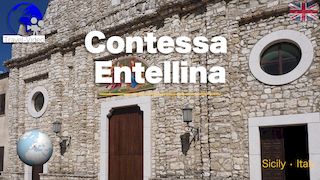
The sequences devoted to the village reveal the fabric of a traditional inland Sicilian settlement. Buildings follow the relief of the terrain, with narrow streets, compact housing blocks, and public spaces designed for everyday life rather than monumental display. Balconies, façades, doorways, and shaded corners all contribute to a sense of lived continuity.
Like many historic Mediterranean villages, Contessa Entellina developed gradually over time rather than according to a formal urban plan. Its importance lies less in grand architecture than in the preservation of a community identity over centuries.
Walking through the village also means observing how architecture adapts to climate, terrain, and social life. Streets encourage proximity, while the compact layout reflects practical responses to heat and rural living conditions.
The Albanian Byzantine Church
One of the central themes of the video is the Albanian Byzantine church tradition, represented here by the Chiesa Madre SS. Annunziata. This monument reflects the survival of Byzantine rite communities in Sicily that remained in communion with the Catholic Church while preserving Eastern liturgical traditions.
Such churches often differ from standard Latin churches in their internal arrangement, ceremonial practices, and symbolic emphasis. The role of icons, the separation of liturgical spaces, and a distinct visual language all form part of this heritage.
The church is therefore more than a parish building. It represents the historical continuity of a transplanted community that maintained elements of its original culture while integrating into Sicilian society.
Historical and Cultural Background
Albanian migrations toward southern Italy intensified during the fifteenth and sixteenth centuries, especially after Ottoman expansion in the Balkans. Groups settled in Calabria, Basilicata, Apulia, and Sicily, where some founded new villages and others repopulated existing settlements.
Contessa Entellina belongs to this broader historical movement. Over time, its inhabitants became fully connected to Sicilian political and economic life while preserving linguistic and religious traditions of Arbëreshë origin.
This dual inheritance explains the village’s present-day value. It is neither an isolated enclave nor a museum-like survival, but a living community shaped by multiple historical layers.
What the Videos on This Site Make Especially Clear
Places such as Contessa Entellina are often best understood through gradual visual exploration rather than through a single panoramic view. Videos built mainly from carefully selected and animated photographs allow viewers to move from the overall village setting to precise architectural and cultural details.
This approach highlights relationships between streets and public spaces, between ordinary houses and religious monuments, and between local life and inherited tradition. It also helps reveal features that can be missed during a rapid visit: proportions, textures, urban rhythm, and subtle signs of identity.
The result is a clearer reading of how history remains present in everyday surroundings.
A Different Face of Sicily
Contessa Entellina shows that Sicily’s history was shaped not only by great capitals and famous monuments, but also by smaller communities carrying their own traditions across centuries. Through its village streets and Byzantine Albanian church, it offers a rich and distinctive perspective on the island. Readers wishing to explore further can continue with the detailed page devoted to the Chiesa Madre SS. Annunziata.
Links to related pages



Audio Commentary Transcript
In the 15th century, the Ottoman conquests pushed many Albanian Christians into exile. Some of them settled in Sicily, where for many years mercenaries from their region of origin served under the flags of the city-states of the Italian peninsula. The culture and traditions as well as the Orthodox religion are still very much alive today in villages like Contessa Entellina.

Music:
- - YouTube video library - A Revelation
Disclaimer: Despite its appropriateness, copyright issues prevent the use of italian traditional music in "Contessa Entellina, Albanian oasis in Sicily • Italy", hence the use of royalty-free music. Despite our careful selection, some might regret this decision, which is necessary to avoid potential lawsuits. Although difficult, this decision is the only viable solution.
Due to Vimeo's copyright control system, which does not correctly filter content, and their rigid policy, we have decided to transfer all our videos to YouTube. While we have appreciated our collaboration with Vimeo for many years, this decision is necessary to ensure the continuous and uninterrupted availability of our content. Thank you for your understanding and continued support.


