

 Français (France)
  Nederlands (nl-NL)
 00:00 • intro | 00:49 • the temple of Hera Lacinia (or of Juno) | 02:19 • the city walls | 03:31 • The temple of Concord | 05:00 • the temple of Heracles ( or of Hercules) | 06:02 • the temple of Zeus
Personal creation from visual material collected during my trip Italy: Seductive Sicily (2022)
Map of places or practices in Agrigento on this site
• Use the markers to explore the content •
Agrigento and the Valley of the Temples, Monumental Heritage of Greek Sicily
A Historic Landscape Between Archaeology and the Mediterranean Sea
On the southern coast of Sicily, Agrigento preserves one of the most remarkable archaeological landscapes of the ancient Mediterranean. Known as the Valley of the Temples, this celebrated site contains a series of Greek sanctuaries, defensive remains and traces of a city that once ranked among the richest and most influential centres of classical Sicily. Despite its traditional name, the area is not a narrow valley but an elevated ridge overlooking open countryside and the distant sea.
The site corresponds to ancient Akragas, founded in the 6th century BCE. Its prosperity, supported by agriculture, trade and strategic position, allowed the construction of monumental temples whose outlines still dominate the landscape today. This video offers an introduction to several of the most important remains and helps place them within their wider historical and geographical setting.
The Main Monuments Featured in the Video
The Temple of Hera Lacinia, often referred to as the Temple of Juno, stands at the eastern end of the sacred ridge. Its commanding position gives it strong visual presence and suggests its symbolic importance within the sanctuary area. The surviving columns still convey the elegance and discipline of Greek Doric architecture.
The ancient fortifications shown in the video remind visitors that Akragas was not only a religious centre but also a defended city. These walls protected a prosperous territory and formed part of a wider urban system designed for security and control. Their presence adds an important dimension to the understanding of the site.
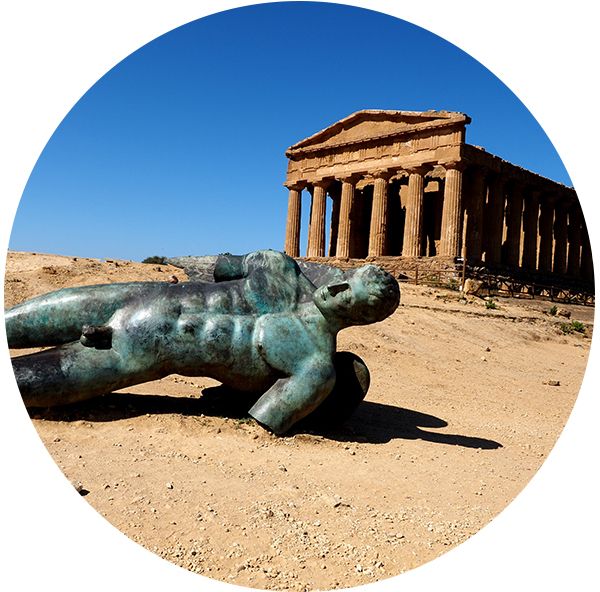
The Temple of Concordia is widely regarded as one of the best preserved Greek temples in the world. Much of its exceptional condition results from its later conversion into a Christian church, which helped ensure its survival. Today it remains one of the clearest examples of classical temple design, with balanced proportions and a remarkably intact structure.
The Temple of Heracles, older and more fragmentary, nevertheless retains considerable power. Its partially re-erected columns give a sense of the original scale of the building and of the importance attached to this sanctuary in antiquity.
The Temple of Zeus was conceived on a grand scale and reflects the political ambitions of Akragas at the height of its power. Though now largely ruined, it still suggests the monumental character of one of the most ambitious temple projects in the Greek western world.
Historical and Cultural Background
Akragas was founded around 580 BCE by Greek settlers connected to Gela, themselves linked to traditions from the Aegean world. Like several other Greek cities in Sicily, it developed rapidly through fertile agriculture, maritime exchange and regional influence.
The city enjoyed periods of wealth and expansion but also faced conflict. It became involved in struggles between the Greek poleis of Sicily and Carthage for control of the island. In 406 BCE, Akragas suffered severe destruction during a Carthaginian campaign. Although later reoccupied and rebuilt in part, it never entirely recovered its former position.
Most of the temples visible today belong to the 6th and 5th centuries BCE, the city’s great age of civic confidence. Their placement along the ridge was not only religious in purpose. Together they formed a monumental skyline visible from afar, projecting prestige to travellers, allies and rivals alike.
Under Roman rule, the city continued in altered form. Later centuries brought adaptation, reuse of stone, gradual decline and eventual rediscovery. The present archaeological park therefore reflects both ancient achievement and the long afterlife of these monuments.
What the Videos on This Site Make Especially Clear
The videos presented on this site are often built from carefully selected photographs arranged in a thoughtful sequence. In the case of Agrigento, this approach allows viewers to observe architectural details with particular clarity while also understanding the broader layout of the sacred ridge.
Alternating wide views and closer images helps reveal the proportions of the temples, the rhythm of their colonnades and the relationship between each structure and the surrounding terrain. The monuments appear not as isolated ruins, but as elements of a coherent ceremonial and urban landscape.
Closer visual attention also highlights construction features such as the size of stone blocks, weathering of surfaces, steps, column bases and surviving fragments. Details that may pass quickly during a physical visit can become easier to appreciate through a carefully composed visual presentation.
Light and atmosphere also play an important role. The warm tones of local stone vary according to season, weather and hour of day, sometimes emphasizing mass and shadow, at other times revealing the precision of lines and edges. The sequence of images helps make these subtle changes more noticeable.
Finally, the gradual progression from one monument to another gives a stronger sense of distance and scale. The Valley of the Temples emerges not as a compact group of ruins, but as a large and carefully structured historical environment.
An Essential Legacy of Ancient Sicily
Agrigento and the Valley of the Temples preserve one of the most impressive testimonies to Greek civilisation in the western Mediterranean. Their combination of architecture, history and landscape gives the site lasting significance far beyond Sicily itself.
The detailed pages linked to this video offer the opportunity to explore each monument more closely, from architectural design and historical context to the wider story of ancient Sicily and the Mediterranean world.




Audio Commentary Transcript
Sicily was a land of welcome for many Greeks fleeing the overpopulation of their country from the 5th century BC. Among the most important cities of the island at that time, Agrigento still testifies today to the past splendours of Greek cities. During its heyday, 2500 years ago, Agrigento saw the construction of many temples on a hill overlooking the city, known today as the Valley of the Temples.
This temple, built in 450 BC, was dedicated to the Greek goddess Hera (whose Roman equivalent is Juno). It was destroyed for the first time by Carthage during the invasion of -406 and rebuilt by the Romans much later, when Sicily became a Roman province.
At the beginning of our era the enormous ramparts around the temples of the city had lost their strategic importance. The wealthiest early Christians transformed them into a necropolis, digging niches in the thick walls to receive the bodies of their deceased.
These tombs extend from the temple of Juno to that of Concord built around -430. The Temple of Concordia is the largest and best preserved of the Doric temples in Sicily. This exceptional state of conservation is mainly due to the fact that it was transformed into a Christian basilica in the 6th century, which required reinforcements and protected the temple from stone hunters. It is not known to which deity it was dedicated.
Built in the 6th century BCE, the Temple of Heracles (or its Roman equivalent Hercules) was the largest and finest temple in ancient Akragas. The temple had 38 columns of which only 9 were raised during a restoration at the beginning of the 20th century, preventing the current visitor from realizing the dimensions of this Greek temple.
Zeus, the supreme god of the Greek pantheon, should have had the largest temple on the site, and that was the intention of the builders at the time. But this temple, also known as the Olympéion, was never completed, probably because of the Carthaginian invasion of the island in -406.
This temple has lost the vast majority of its stones as these have been reused over the centuries for various constructions.
The temple of Zeus was adorned with telamons, statues of giants supporting a cornice. One of these telamons is kept in the museum of Agrigento and a replica has been placed in the middle of the ruins of the temple.
Music:
- - YouTube video library - Argonne - Zachariah Hickman
- - YouTube video library - Clouds
- - YouTube video library - Sneaky Snooper
Disclaimer: Despite its appropriateness, copyright issues prevent the use of italian traditional music in "Agrigento, the Valley of the Temples, Sicily • Italy", hence the use of royalty-free music. Despite our careful selection, some might regret this decision, which is necessary to avoid potential lawsuits. Although difficult, this decision is the only viable solution.


