

 Français (France)
  Nederlands (nl-NL)
 Belur Math is a religious complex located on the western bank of the Hooghly River, opposite the city of Kolkata in the state of West Bengal, India. It serves as the headquarters of the Ramakrishna Mission and is one of the principal spiritual centers associated with the teachings of Ramakrishna and Swami Vivekananda. The site includes several temples, monastic buildings and open areas used for prayer, meditation and community activities. Belur Math receives visitors from India and abroad throughout the year. The complex also supports educational, social and cultural initiatives conducted by the religious organization based at this location.

Kolkata • Belur Math
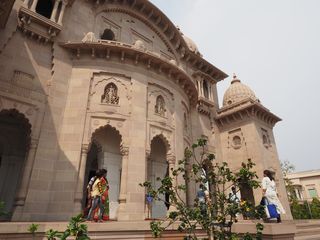
Kolkata • Belur Math

Kolkata • Belur Math
Monument profile
Belur Math
Monument categories: Hindu Temple, Monastery
Monument families: Temple • Monastery
Monument genres: Religious
Cultural heritage: Hindu
Geographic location: Kolkata • West Bengal •
Construction period: 19th century AD
• Links to •
• List of videos about Kolkata on this site •
Kolkata • Urban Life and Trading Traditions
Kolkata • Colonial Heritage and Legacy of the Raj
Kolkata • Religious Diversity and Urban Traditions
History of Belur Math
Belur Math, located on the western bank of the Hooghly River near Kolkata in the Indian state of West Bengal, serves as the headquarters of the Ramakrishna Math and the Ramakrishna Mission. Established at the end of the nineteenth century, the complex emerged during a period of profound social, intellectual and political transformation in colonial India. Its foundation was closely connected with the life and work of Ramakrishna (1836–1886), a Bengali mystic, and with the efforts of his disciple Swami Vivekananda to organize a religious and social movement inspired by his teachings. The history of Belur Math therefore reflects not only the development of a religious institution but also the broader cultural and political dynamics of late colonial India.
Political and social context of the foundation
The creation of Belur Math occurred within the historical context of British colonial rule in India and the intellectual movement often described as the Bengal Renaissance. During the nineteenth century, Kolkata—then known as Calcutta—served as the capital of British India until 1911 and functioned as one of the principal administrative, cultural and intellectual centers of the subcontinent. The city was home to reform movements, educational institutions and debates concerning religion, social reform and national identity.
Ramakrishna, who served as a priest at the Kali temple of Dakshineswar, attracted a circle of disciples drawn from various social and intellectual backgrounds. His spiritual teachings emphasized direct religious experience and the idea that different religious traditions could lead to the same ultimate reality. After his death in 1886, his disciples sought to preserve and organize his teachings within a structured monastic community.
Swami Vivekananda emerged as the leading figure among these disciples. After several years of travel across India, he represented Hinduism at the World’s Parliament of Religions held in Chicago in 1893. His speeches attracted international attention and contributed to a broader recognition of Indian spiritual traditions outside the subcontinent. Vivekananda subsequently returned to India with the ambition of creating a permanent institution capable of combining spiritual practice with social service and educational work.
The establishment of Belur Math in 1898 was therefore both a religious and institutional project. It provided a stable headquarters for the monastic order founded in Ramakrishna’s memory and became the central administrative base of the Ramakrishna Mission. In the context of colonial India, the creation of such an institution also carried symbolic significance, representing a form of cultural affirmation and intellectual renewal rooted in Indian religious traditions.
Establishment of the monastic center
The land for Belur Math was acquired in the late 1890s on the western bank of the Hooghly River, opposite the expanding metropolis of Kolkata. The location was chosen for both practical and symbolic reasons. While close enough to the city to maintain contact with intellectual and social networks, the site offered a relatively tranquil environment suitable for monastic life.
In 1898 Vivekananda formally established the monastic community at Belur. Initially, the complex consisted of modest structures used to house monks and organize daily religious activities. The early community followed a disciplined monastic routine that combined meditation, study and participation in charitable work. This combination reflected Vivekananda’s interpretation of Ramakrishna’s teachings, which emphasized both spiritual realization and active engagement with society.
Belur Math quickly became the administrative and spiritual center of the Ramakrishna Mission, founded in 1897 to coordinate the movement’s educational, charitable and religious activities. From this headquarters, the organization gradually expanded its presence across India and later established centers in several countries.
Global context of the late nineteenth century
The foundation of Belur Math coincided with a period of global interest in comparative religion and spiritual traditions beyond Europe. The late nineteenth century witnessed the emergence of international forums devoted to interreligious dialogue, alongside increasing Western scholarly interest in Asian philosophies and religious texts.
In this broader context, Vivekananda’s participation in the Parliament of Religions in Chicago played a significant role in introducing aspects of Vedanta philosophy and Hindu spirituality to Western audiences. The institutional development of Belur Math can therefore be understood as part of a wider historical movement in which religious traditions from Asia were being reinterpreted and presented on a global stage.
At the same time, religious reform movements were emerging across India, often seeking to reconcile traditional beliefs with modern intellectual currents and social reform. The Ramakrishna movement formed part of this broader landscape, though it distinguished itself by emphasizing spiritual experience and religious harmony rather than doctrinal reform alone.
Development during the twentieth century
Following Vivekananda’s death in 1902, the leadership of the Ramakrishna Math and Mission passed to other disciples of Ramakrishna. Under their guidance, Belur Math gradually evolved from a modest monastic residence into a major religious complex.
Over the first decades of the twentieth century, additional buildings were constructed to accommodate the growing number of monks, students and visitors associated with the movement. The temple dedicated to Ramakrishna, completed in 1938, became the central architectural feature of the site and reinforced Belur Math’s role as the symbolic heart of the Ramakrishna tradition.
During the late colonial period and after India’s independence in 1947, the Ramakrishna Mission expanded its network of educational institutions, hospitals and charitable programs. Belur Math continued to function as the headquarters of this expanding organization, coordinating its spiritual and administrative activities.
Transformations and urban context
The physical and institutional evolution of Belur Math has been shaped by the growth of the surrounding metropolitan region. Although the site maintains an atmosphere of relative calm compared with the dense urban districts of central Kolkata, the expansion of the city and the development of transportation networks have made the complex increasingly accessible.
As the number of visitors grew, the infrastructure of the site was gradually adapted to accommodate pilgrims, tourists and participants in religious ceremonies. Pathways, gardens and open spaces were organized to manage large gatherings during major religious festivals and commemorative events.
Despite these changes, the leadership of the Ramakrishna Mission has sought to preserve the contemplative atmosphere of the site. Careful planning of the landscape and building layout has allowed Belur Math to retain a sense of spatial openness and visual harmony.
Cultural role and contemporary significance
Today Belur Math is widely regarded as one of the most important centers of modern Hindu spiritual life. The complex serves as the headquarters of the Ramakrishna Math and Mission and remains the residence of a large monastic community.
The site attracts visitors from across India and from many other countries. Religious ceremonies, commemorations of Ramakrishna and Vivekananda, and annual festivals draw large numbers of devotees. These events reinforce the symbolic status of Belur Math as a focal point of spiritual continuity within the Ramakrishna tradition.
Beyond its religious role, the institution has also contributed to educational and humanitarian initiatives. Schools, colleges and social service programs associated with the Ramakrishna Mission have played a significant role in various regions of India. Belur Math thus represents both a religious center and the administrative headquarters of a network of institutions engaged in social and educational work.
Conservation and contemporary challenges
Belur Math remains well maintained by the Ramakrishna Mission, which oversees the preservation of its buildings, gardens and religious spaces. The organization places strong emphasis on maintaining the dignity and order of the site while accommodating the growing number of visitors.
Environmental factors pose some challenges for long-term conservation. The proximity of the Hooghly River exposes the site to humidity and seasonal climatic variations. Urban expansion in the greater Kolkata region also raises concerns regarding pollution, transportation pressure and visitor management.
Although Belur Math is not included on the UNESCO World Heritage List, it is widely recognized in India as an important religious and cultural landmark. Its preservation depends largely on the ongoing stewardship of the Ramakrishna Mission, which continues to balance the needs of conservation, religious practice and public access.
Through its historical development, Belur Math has become both a symbol of the Ramakrishna movement and a reflection of the religious and intellectual transformations that shaped India during the transition from the colonial era to the modern period.
Architecture of Belur Math
Belur Math, located on the western bank of the Hooghly River near Kolkata in the Indian state of West Bengal, forms the headquarters of the Ramakrishna Math and the Ramakrishna Mission. The architectural identity of the complex is defined primarily by the temple dedicated to Ramakrishna, completed in 1938, which serves as the visual and symbolic center of the site. The design of the temple reflects a deliberate synthesis of architectural traditions drawn from Hindu, Islamic and Christian forms. This synthesis was intended to express the universal spiritual philosophy associated with Ramakrishna and Swami Vivekananda. The architecture of Belur Math therefore occupies a distinctive position within the development of modern religious architecture in India during the early twentieth century.
Architectural conception and symbolic program
The temple of Ramakrishna at Belur Math was designed under the supervision of Swami Vijnanananda, a disciple of Ramakrishna who had received technical training in civil engineering before entering monastic life. His familiarity with modern construction techniques allowed him to combine structural reliability with a symbolic architectural language intended to convey spiritual ideas.
The fundamental concept guiding the design was the visual expression of religious harmony. Ramakrishna had taught that all religions ultimately lead to the same spiritual truth. In architectural terms, this principle was translated into a building whose appearance evokes elements associated with different religious traditions. Depending on the observer’s viewpoint, the structure can resemble a Hindu temple, a Christian church or an Islamic monument. This effect results from the deliberate blending of architectural motifs rather than the replication of any single style.
The building’s overall composition emphasizes balance and clarity. Its central axis is strongly defined, and the main volumes are arranged symmetrically. This geometric order contributes to the monumentality of the structure while maintaining visual coherence despite the diversity of stylistic references incorporated into the design.
Materials and construction techniques
The construction of the main temple relied on a combination of traditional masonry and modern engineering methods. Reinforced concrete was used in the structural framework, providing stability and allowing the creation of large interior spaces. This material was increasingly common in Indian architecture during the early twentieth century, particularly in buildings requiring structural durability and resistance to climatic conditions.
The exterior surfaces are clad in stone, chosen for both structural protection and visual effect. The light-colored stone contributes to the monument’s monumental character and enhances the clarity of its architectural forms. Stone cladding also provides durability in the humid climatic environment of the Hooghly River basin.
Foundations were designed to address the challenges posed by the alluvial soils typical of the lower Ganges delta. Engineers ensured adequate load distribution in order to prevent settlement or deformation of the structure. This attention to geotechnical conditions was essential in a region where fluctuating water levels and soft soils can affect the stability of large buildings.
Construction methods combined modern structural systems with traditional craftsmanship in stone carving and surface finishing. The resulting architecture reflects a transitional period in Indian building practice in which modern materials and engineering were integrated with long-established artistic traditions.
Structural organization and spatial layout
The temple stands at the center of the Belur Math complex and forms the principal focus of the monastic compound. The building is surrounded by landscaped grounds that create a wide visual buffer between the temple and the surrounding environment. This arrangement reinforces the monument’s prominence within the complex and allows clear views of the structure from multiple directions.
The plan of the temple is organized around a large central prayer hall that accommodates religious gatherings and devotional activities. The hall is designed to allow unobstructed views toward the main shrine, which contains the image of Ramakrishna. Side aisles and peripheral corridors facilitate circulation for visitors and monks, particularly during major religious festivals when large numbers of devotees gather at the site.
The structural system combines load-bearing masonry walls with interior columns and arches supporting the upper portions of the building. These structural elements distribute the weight of the roof and upper structures while creating a rhythm of vertical supports that contributes to the architectural articulation of the interior space.
The temple’s elevation consists of several horizontal tiers culminating in a central superstructure that dominates the skyline of the complex. This vertical progression emphasizes the spiritual symbolism of ascent commonly associated with religious architecture.
Architectural influences and stylistic synthesis
One of the most distinctive features of Belur Math is the deliberate synthesis of architectural traditions. The temple incorporates elements reminiscent of classical Hindu temple architecture, such as the axial orientation and the emphasis on a central shrine. At the same time, certain forms evoke architectural features associated with Islamic monuments, including arches and domed elements that recall the architectural vocabulary of Mughal buildings.
The influence of European architectural traditions is also visible in aspects of the façade composition and spatial arrangement. Certain proportions and structural rhythms resemble those found in Western ecclesiastical architecture. These references do not replicate specific buildings but rather contribute to the overall impression of stylistic convergence.
This architectural synthesis reflects the ideological program of the Ramakrishna movement. The building’s appearance communicates the idea that multiple religious traditions can coexist within a unified spiritual framework. Architecture thus becomes a symbolic medium expressing philosophical principles.
Ornamentation remains relatively restrained compared with the elaborate sculptural programs typical of many traditional Hindu temples. Decorative elements emphasize geometric patterns, carved moldings and subtle sculptural details rather than extensive narrative reliefs. This restraint contributes to the clarity of the architectural composition and aligns with the contemplative character of the monastic environment.
Climatic adaptation and functional design
Architectural design at Belur Math also reflects careful consideration of climatic conditions in eastern India. Kolkata experiences a humid subtropical climate characterized by high temperatures, seasonal monsoon rains and elevated humidity levels. The temple incorporates several features that improve thermal comfort and ventilation.
Large openings and arcaded galleries facilitate the circulation of air through the building. Cross-ventilation reduces the accumulation of heat within interior spaces, an important factor in a region where temperatures can remain high for extended periods. High ceilings and spacious interiors also contribute to natural cooling by allowing warm air to rise away from occupied areas.
Wide overhanging elements protect the walls and entrances from direct sunlight and monsoon rains. The elevated plinth on which the temple stands provides additional protection against seasonal flooding and ground moisture.
These architectural solutions reflect a long tradition of climatic adaptation in Indian architecture while integrating structural methods made possible by modern engineering.
Dimensions and notable features
The temple of Ramakrishna at Belur Math is notable for its substantial dimensions and carefully proportioned volumes. The length of the building exceeds one hundred meters, and the height of the central structure creates a distinctive silhouette visible from the Hooghly River and from the surrounding grounds.
The interior prayer hall is designed to accommodate several hundred worshippers at a time. The open layout ensures that visitors have a direct visual connection to the central shrine. This spatial arrangement reinforces the building’s role as a communal place of worship rather than a series of compartmentalized ritual spaces.
Observers often remark that the architectural appearance of the temple changes depending on the angle from which it is viewed. From certain perspectives the structure resembles a traditional Hindu temple, while from others it may evoke a church or a mosque. This visual ambiguity was intentionally incorporated into the design as an architectural expression of religious inclusiveness.
Conservation and architectural significance
Belur Math is carefully maintained by the Ramakrishna Mission, which oversees both the physical preservation of the complex and its continued religious use. The buildings are regularly inspected and maintained to ensure the stability of structural components and the integrity of exterior surfaces.
The principal conservation challenges arise from environmental conditions and the increasing number of visitors. Humidity, monsoon rains and atmospheric pollution can gradually affect stone surfaces and structural materials. Preventive maintenance and controlled visitor management are therefore important aspects of the site’s long-term preservation.
Although Belur Math is not included on the UNESCO World Heritage List, it is widely regarded as one of the most significant examples of twentieth-century religious architecture in India. The temple’s architectural synthesis, symbolic program and structural design contribute to its recognition as a distinctive monument within the broader history of modern Indian architecture.
Through the integration of multiple stylistic influences, modern engineering techniques and a carefully planned spatial layout, Belur Math represents a notable example of how architectural form can embody philosophical ideas. Its design reflects both the religious vision of the Ramakrishna movement and the broader architectural transformations occurring in India during the early twentieth century.