

 Français (France)
  Nederlands (nl-NL)
 The streets of Kolkata provide a vivid illustration of daily life in a major metropolis of eastern India. In the capital of West Bengal, wide avenues and narrow lanes host constant urban activity shaped by traffic, neighborhood markets, and numerous commercial exchanges. Street vendors, small shops, and various forms of transport contribute to a dynamic cityscape typical of large Indian cities. These public spaces also serve as places of social interaction where residents, traders, and visitors meet throughout the day. The streets of Kolkata therefore reflect the intensity, diversity, and movement that characterize one of the largest urban centers of the region.
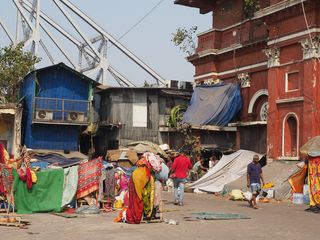
Kolkata • in the streets of the metropolis
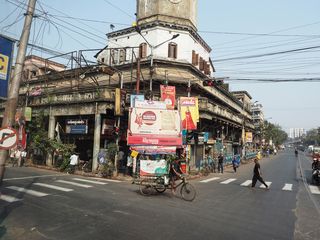
Kolkata • in the streets of the metropolis
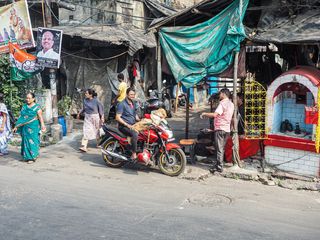
Kolkata • in the streets of the metropolis
Monument profile
in the streets of the metropolis
Monument category: Historic urban landscape
Monument family: Historic or traditional habitat
Monument genre: Residential
Geographic location: Kolkata • West Bengal •
Construction period: 18th century AD
• Links to •
• List of videos about Kolkata on this site •
Kolkata • Urban Life and Trading Traditions
Kolkata • Colonial Heritage and Legacy of the Raj
Kolkata • Religious Diversity and Urban Traditions
History of the Streets of Kolkata and the Evolution of a Major Metropolis in Bengal
Political Context and Formation of the Urban Fabric
The history of the streets of Kolkata is closely connected to the very origin of the city. Located on the eastern bank of the Hooghly River in the Ganges delta, Kolkata did not develop as an ancient city founded by medieval Indian dynasties. Instead, it emerged in the late seventeenth century within the context of European commercial expansion in Asia. During this period, the British East India Company established a trading settlement in an area composed of several riverside villages, notably Sutanuti, Govindapur, and Kalikata.
The early development of the city was organized around port activities, warehouses, and Fort William, which was built to protect British commercial interests in the region. The first streets therefore appeared as practical routes connecting the riverbanks, storage areas, and administrative quarters. Their layout reflected the needs of a trading city closely linked to maritime and river commerce.
At that time the region remained formally under the authority of the Mughal Empire, which still governed Bengal. However, the growing influence of the East India Company gradually altered the regional balance of power. After the Battle of Plassey in 1757, which marked the beginning of British control over Bengal, Kolkata became one of the most important administrative centers of colonial India.
The streets of the city were progressively incorporated into an urban structure designed to organize the colonial capital. Administrative districts, commercial zones, and residential neighborhoods expanded around a network of lively streets linking markets, institutions, and the river port.
Historical Events and Urban Transformation
During the eighteenth and nineteenth centuries Kolkata evolved into the capital of the British Raj and one of the most significant cities of the colonial world. Rapid growth led to the expansion of streets, markets, and transport routes. Major avenues connected European administrative districts with Indian commercial neighborhoods and the docks along the Hooghly River.
The city attracted a diverse population including merchants, artisans, administrators, dockworkers, and migrants from different parts of the Indian subcontinent. The streets therefore became spaces of economic exchange and cultural interaction where languages, religions, and traditions met.
Several historical developments also shaped the city’s streets. Nineteenth-century administrative reforms, improvements in transportation infrastructure, and the partial industrialization of the region intensified urban activity. Even after the transfer of the capital of British India to New Delhi in 1911, Kolkata remained an important economic center in eastern India.
The twentieth century brought further changes. Political upheavals linked to the Indian independence movement and the Partition of Bengal in 1947 had a profound impact on the city. Large numbers of refugees arriving from what is now Bangladesh increased population density and reinforced the intensity of street life.
Global Context and the Rise of Colonial Port Cities
The development of Kolkata during the eighteenth and nineteenth centuries was part of a broader global phenomenon linked to expanding international trade networks. Across Asia, colonial powers established port cities that served as administrative and commercial centers.
Cities such as Bombay, Singapore, and Hong Kong underwent similar transformations, where streets and markets became the central spaces of urban life. Kolkata formed an integral part of this global network of trade and governance, contributing to the cosmopolitan character visible in its public spaces.
Urban Transformation and Contemporary Evolution
Over time, the streets of Kolkata have experienced numerous transformations. The introduction of tramways in the nineteenth century and the expansion of motorized transport during the twentieth century reshaped urban mobility and the organization of public space. Despite these changes, streets remain essential locations for commerce and social interaction.
Street markets, small shops, and mobile vendors continue to play a significant role in the city’s local economy. These activities contribute to the image of Kolkata as a densely populated metropolis characterized by constant movement.
In older districts, some streets still preserve an urban structure inherited from the colonial period. Historic buildings, traditional markets, and public spaces reflect the gradual evolution of the city since the seventeenth century.
Cultural Role and Urban Identity
Today the streets of Kolkata remain central to the city’s cultural identity. They serve as stages for a wide variety of social, commercial, and religious activities. Markets and public spaces frequently host gatherings linked to major Bengali festivals, particularly those associated with the worship of the goddess Durga.
Street life is also a defining element of Kolkata’s urban culture. Interactions among residents, traders, and visitors reflect the social diversity of the metropolis.
In the contemporary context, municipal authorities face the challenge of balancing modernization with the preservation of historic neighborhoods. Maintaining urban infrastructure while protecting cultural heritage remains an important issue in a city with several million inhabitants.
The streets of Kolkata therefore illustrate the transformation of a trading settlement of the colonial period into a major South Asian metropolis. They embody both the historical legacy of Bengal and the vibrant daily life of one of the principal cities of eastern India.
Urban Architecture and Spatial Organization of the Streets of Kolkata
Urban Planning Innovations and Formation of the Street Network
The architecture of the streets of Kolkata reflects an urban model shaped by the encounter between European colonial planning and traditional Indian urban practices. Unlike many historic cities of the Indian subcontinent that developed gradually around royal capitals or religious centers, Kolkata owes much of its spatial organization to planning initiatives introduced during the British colonial period beginning in the late seventeenth century.
The earliest structural routes were created to serve the needs of a rapidly expanding trading port. Major streets linked the docks along the Hooghly River with administrative districts and warehouse areas. This circulation system facilitated the movement of goods between ships, markets, and residential neighborhoods.
During the eighteenth and nineteenth centuries, the urban planning of Kolkata incorporated several features typical of colonial cities. British authorities introduced relatively wide streets intended to facilitate transportation and improve ventilation in a tropical climate characterized by high humidity. This layout differed significantly from the narrow, irregular streets common in older Indian cities.
These main axes were gradually complemented by a complex network of secondary streets and narrow lanes where daily commercial activities developed. The coexistence of broad avenues and densely occupied alleys remains one of the defining characteristics of Kolkata’s urban landscape.
Materials and Construction Techniques
The buildings lining the streets of Kolkata reflect the materials available in the Bengal region as well as construction methods influenced by colonial architectural practices. Fired brick became the predominant building material due to the abundance of clay in the alluvial plains of the Ganges and the limited availability of stone in the region.
Brick structures were frequently coated with lime plaster or protective render to improve resistance to heavy monsoon rains and persistent humidity. Balconies, verandas, and covered galleries were widely incorporated to protect façades from direct sunlight while creating transitional spaces between buildings and the street.
In commercial districts, the ground floors of many buildings were designed to accommodate shops or workshops. This functional organization contributed to an urban environment where economic activity and public space remain closely interconnected.
Street infrastructure itself evolved to support increasing traffic. Drainage systems were introduced to manage rainwater during monsoon seasons, an essential adaptation for a city located in a river delta prone to heavy rainfall.
Architectural Influences and Stylistic Diversity
The architectural environment framing the streets of Kolkata reflects the interaction of multiple cultural traditions. Administrative buildings and certain residential structures constructed during the colonial era display European neoclassical influences, recognizable through columns, symmetrical façades, and pedimented entrances.
Alongside these structures appear residential houses inspired by regional Bengali architectural traditions. Many of these dwellings incorporate interior courtyards designed to enhance natural ventilation in the hot and humid climate.
This stylistic diversity contributes to the distinctive visual character of the city’s streets. Decorative façades frequently combine floral motifs, geometric patterns, and European ornamental elements. Cast-iron balconies introduced during the nineteenth century also became a recognizable feature in several neighborhoods.
Markets and commercial streets often display more functional architectural forms. Open structures, awnings, and covered arcades allow commercial activity to take place while maintaining constant interaction with public space.
Spatial Organization and Urban Dynamics
The spatial organization of Kolkata’s streets combines elements of planned development with gradual organic growth. Major avenues function as primary transport routes connecting different districts of the metropolis. These roads are typically lined with administrative buildings, commercial establishments, and residential structures.
Surrounding these main arteries is a dense network of secondary streets where neighborhood markets and small craft activities concentrate. These spaces represent the core of everyday urban life.
Street markets form an essential component of this spatial arrangement. They often occupy entire sections of streets or intersections and contribute to the intense atmosphere characteristic of the city. Temporary stalls, small kiosks, and improvised structures create a constantly changing urban environment.
This dynamic contributes to the perception of Kolkata as a metropolis marked by continuous movement of pedestrians, vehicles, and goods. The coexistence of formal infrastructure and informal economic activity produces a complex urban structure where spatial uses are constantly evolving.
Notable Statistics and Characteristics
The metropolitan area of Kolkata now extends over several hundred square kilometers and hosts a population of many millions. Within this context, streets remain fundamental to the circulation of people and economic activity.
The city maintains one of the oldest operational tram networks in Asia, originally introduced in the nineteenth century. This infrastructure reflects the historical importance of public transportation in the organization of the urban environment.
Traditional markets, some of which date back to the colonial period, continue to play an important role in the local economy. Their presence helps sustain the vibrant commercial activity visible throughout the city’s streets.
Contemporary Preservation Challenges
The architecture of Kolkata’s streets constitutes an important element of the city’s urban heritage. It reflects several centuries of historical development, from the colonial era to the modern expansion of the metropolis.
However, preserving this urban landscape presents several challenges. Rapid population growth, real-estate pressure, and increasing traffic are gradually transforming traditional neighborhood structures.
Local authorities and heritage organizations are working to protect historic buildings and urban layouts that illustrate the city’s past. These efforts seek to balance urban modernization with the preservation of architectural and cultural heritage.
The architecture of Kolkata’s streets therefore extends beyond the individual buildings that line them. It represents a complex urban system where infrastructure, markets, housing, and public spaces interact. This organization illustrates the transformation of a colonial trading settlement into one of the major metropolitan centers of eastern India while preserving a distinctive and vibrant street life.