

 Français (France)
  Nederlands (nl-NL)
 Prambanan Temple is one of Indonesia’s most significant religious complexes and an important symbol of Javanese Hindu culture. Located near Yogyakarta in the Prambanan area, the site includes a large group of temples arranged according to the traditional layout of major sacred compounds in Java. Recognized as a UNESCO World Heritage Site, Prambanan is widely known for its cultural importance and its role in illustrating the historical development of religion and society in Indonesia. Today, the complex remains a major cultural landmark, attracting visitors interested in Indonesian heritage, Southeast Asian civilizations, and the diversity of the archipelago’s historical traditions.

Prambanan • Prambanan temple: overview
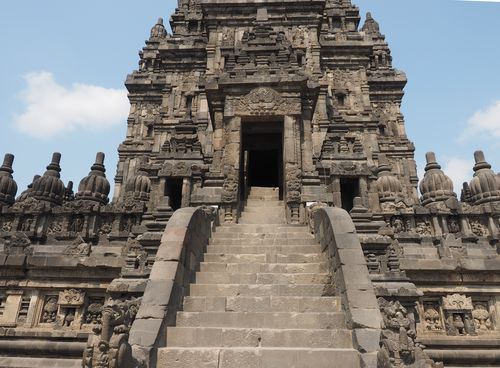
Prambanan • Prambanan temple: stairway to a temple
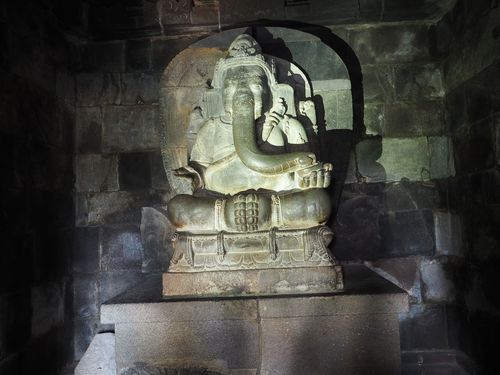
Prambanan • Prambanan temple: Ganesh
Monument profile
Prambanan temple
Monument category: Hindu Temple
Monument family: Temple
Monument genre: Religious
Cultural heritage: Hindu
Geographic location: Prambanan • Java • Indonesia
Construction period: 9th century AD
This monument in Prambanan is inscribed on the UNESCO World Heritage List under the name Prambanan Temple Compounds since 1991.See the UNESCO monuments featured on this site
• Links to •
• List of videos about Prambanan on this site •
Indonesia • Java • By train from Bandung to Yogyakarta and Prambanan Temple
• References •
Wikipedia FR: Temple de Prambanan
Wikipedia EN: Prambanan
UNESCO: Ensemble de Prambanan
Prambanan and the Consolidation of Hindu Royal Power in Central Java
Foundation of the Complex and Dynastic Context
The Prambanan Temple was constructed during the second half of the ninth century in the fertile plain of central Java, a region that concentrated important political and religious centers of the period. The complex is generally associated with the Sanjaya dynasty, whose rulers promoted Hinduism, particularly the cult of Shiva. Its construction followed a period marked by the influence of the Buddhist Sailendra dynasty, responsible for major religious monuments elsewhere in central Java.
Most historians associate the foundation of Prambanan with Rakai Pikatan or his immediate successors. The monument reflected a political reassertion of Hindu royal authority after decades of strong Buddhist patronage in the region. The decision to construct a monumental Shivaite sanctuary on such a scale had both religious and dynastic significance. The complex functioned as a visible expression of royal legitimacy, political prestige, and ritual authority.
The main sanctuary dedicated to Shiva occupied the central position within the sacred compound, emphasizing the primacy of Shivaite worship in court ideology. The surrounding temples dedicated to Vishnu and Brahma reinforced the representation of the Hindu Trimurti. Inscriptions associated with the complex indicate the existence of lands and resources allocated for ritual maintenance, confirming that the site operated as both a ceremonial and institutional center linked directly to royal administration.
Prambanan was not designed as an isolated structure but as an extensive religious compound integrating ritual movement, hierarchy of sacred spaces, and controlled ceremonial access. Its arrangement reflected the organization of royal religious practices in central Java during the ninth century.
Expansion, Decline, and Transformation of the Site
Construction and expansion continued under subsequent rulers. Additional shrines and secondary structures were incorporated into the complex, increasing its ceremonial importance. Historical evidence suggests that Prambanan remained active for several generations and served as a major religious center connected to the royal court.
During the tenth century, political authority gradually shifted from central Java to eastern Java. The reasons for this relocation remain debated and may have involved volcanic activity, political rivalries, or economic changes affecting regional power structures. As the royal courts moved eastward, Prambanan progressively lost its administrative and ceremonial prominence.
The decline of the site appears to have been gradual rather than abrupt. Religious activity diminished over time, while maintenance of the large stone structures became increasingly difficult. Earthquakes affecting the region contributed significantly to the deterioration of the temples. Several buildings partially collapsed, and sections of the compound were abandoned.
Despite the decline of its institutional role, Prambanan remained present in Javanese cultural memory. Local traditions and legends became associated with the ruins, particularly the story of Roro Jonggrang, which linked the monument to mythical royal narratives. These traditions contributed to the continued recognition of the site long after its original religious function had weakened.
The spread of Islam across Java between the fifteenth and sixteenth centuries transformed the island’s religious landscape. Hindu and Buddhist temple complexes ceased to function as major centers of worship. Prambanan survived primarily as an archaeological and symbolic site rather than an active religious institution.
Rediscovery, Archaeological Research, and Restoration
European reports describing the ruins of Prambanan began to appear during the colonial period under Dutch administration. Eighteenth-century officials and travelers documented large stone structures emerging from vegetation and collapsed debris. More systematic archaeological investigations started during the nineteenth century.
Early excavations revealed the scale of the original compound and the extensive damage caused by centuries of abandonment and seismic activity. Many sculptural elements had been displaced, reused locally, or buried beneath accumulated material. Archaeologists gradually catalogued surviving stones and attempted to reconstruct the layout of the sanctuary.
Restoration projects intensified during the twentieth century. The reconstruction of the main Shiva temple became one of the largest archaeological conservation operations undertaken in Indonesia. Restoration teams used anastylosis techniques, reassembling structures with original stones whenever possible. Several secondary temples, however, remain incomplete because too many original architectural elements had disappeared.
The complex suffered additional structural damage during the earthquake of 2006, which affected numerous sections of the site and forced temporary closures for safety reasons. New stabilization and conservation programs were implemented afterward to reinforce weakened structures and monitor seismic risks.
Prambanan was inscribed on the UNESCO World Heritage List in 1991 as part of the property officially designated “Prambanan Temple Compounds.” This international recognition strengthened preservation efforts and increased the monument’s role within Indonesia’s national cultural heritage policies.
Prambanan in the Ninth-Century World
The principal construction phase of Prambanan coincided with important political and religious developments elsewhere in the world. In mainland Southeast Asia, early Khmer centers were expanding before the Angkorian period. In India, the Rashtrakuta and Pallava dynasties continued large-scale temple construction projects. In China, the Tang dynasty was entering its final century. In western Europe, the Carolingian Empire was fragmenting after the reign of Charlemagne.
Religious Function, Cultural Role, and Present Condition
Today, Prambanan remains one of Indonesia’s most important historical and cultural monuments. Although no longer functioning as a major state sanctuary, the site continues to host certain Hindu ceremonies and cultural events connected to Javanese traditions.
The complex occupies an important place in Indonesian national identity and cultural tourism. Ongoing archaeological work continues to document secondary structures and refine understanding of the site’s historical development. Conservation programs focus on structural stabilization, stone preservation, and management of environmental and seismic threats.
The preservation of Prambanan faces continuous challenges linked to earthquakes, tropical weather conditions, biological erosion of volcanic stone, and heavy visitor traffic. Indonesian authorities and conservation specialists continue to balance public access with the long-term protection of the monument’s architectural integrity.
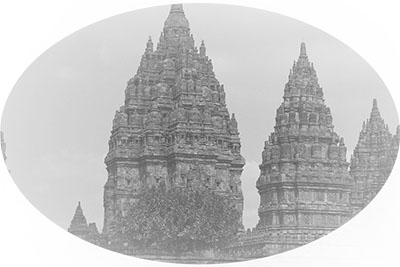
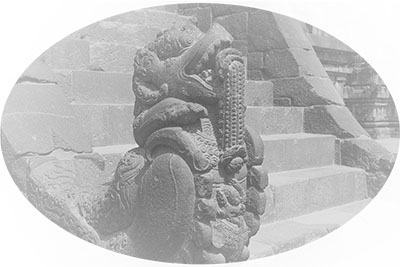
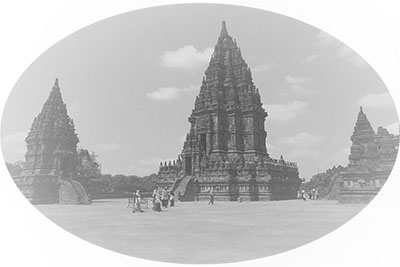
Spatial Organization and Monumental Architecture of the Prambanan Temple Complex
Site Layout and Overall Spatial Composition
The Prambanan Temple occupies a broad plain in central Java between volcanic landscapes and the Opak River basin. The sanctuary was established on level terrain that allowed the builders to organize the complex according to a controlled geometric plan. The monument was conceived as a hierarchical sacred compound structured through successive enclosures and aligned circulation axes.
The central area consists of a raised square platform surrounded by concentric courtyards. The innermost enclosure forms the ceremonial core of the complex and contains the principal temples arranged according to a symmetrical orthogonal plan. The east-west orientation determines the placement of entrances, stairways, and ritual movement throughout the site.
The main courtyard originally contained eight principal temples and more than two hundred subsidiary shrines. The three largest sanctuaries are dedicated to Shiva, Vishnu, and Brahma, with the Shiva temple occupying the central and dominant position. Opposite each temple stands a smaller sanctuary dedicated to the divine mount associated with the deity. Additional temples near the entrances complete the composition.
The surrounding perwara temples formed concentric rows around the central sanctuary. Although many are now ruined, their arrangement demonstrates the scale of the architectural program. The repetitive placement of these smaller shrines reinforced the visual centrality of the main temples while creating a gradual transition from outer areas to the sacred core.
The circulation system emphasizes ritual hierarchy. Visitors entering the complex pass through multiple gates before ascending the elevated central platform. Staircases positioned along the cardinal axes create direct visual approaches toward the principal sanctuaries and guide ceremonial movement through elevation and spatial restriction.
Vertical Structure and Architectural Configuration of the Main Temples
The Shiva temple constitutes the largest and tallest structure within the complex, rising to approximately forty-seven meters. Its proportions dominate the surrounding buildings and establish the vertical emphasis characteristic of the sanctuary. The temple stands on a high substructure accessed by a monumental eastern staircase, reinforcing its symbolic and spatial supremacy.
The structure is organized through successive vertical tiers decreasing in scale toward the summit. The resulting silhouette combines stepped massing with projecting elements that create a strongly articulated profile. Recesses, miniature towers, and decorative vertical bands produce pronounced shadow contrasts across the stone surfaces.
The temple plan combines a central chamber with four projecting vestibules extending toward the cardinal directions. The main chamber originally housed a statue of Shiva Mahadeva, while secondary chambers contained associated divine figures. An interior ambulatory system allows ritual circumambulation around the sanctuary core. Corridors and staircases integrate ceremonial circulation directly into the architectural structure.
The temples dedicated to Vishnu and Brahma reproduce the same architectural concept on a smaller scale. Their vertical composition, elevated bases, and internal organization maintain proportional consistency with the Shiva temple. This repetition establishes visual coherence throughout the courtyard while preserving the dominance of the main sanctuary.
The subsidiary temples associated with divine mounts display more compact volumes but follow similar compositional principles. Their placement opposite the principal sanctuaries contributes to the symmetrical organization of the ensemble. Structures near the gateways reinforce the axial balance of the courtyard.
Roof structures consist of superimposed levels crowned by elongated pyramidal upper elements. These upper sections contain decorative replicas of miniature shrines, creating an impression of architectural multiplication toward the summit. This fragmentation reduces the visual heaviness of the stone masses despite the scale of the buildings.
Construction Techniques and Stone Engineering
The complex was constructed primarily from andesite, a dense volcanic stone available locally in central Java. The material provided structural durability while allowing precise carving of decorative details. Its dark grey coloration contributes significantly to the appearance of the sanctuary.
The builders employed dry masonry techniques without mortar. Stone blocks were assembled using interlocking systems involving joints, grooves, and recessed connections. This method provided structural stability while accommodating limited seismic movement. The precision of the stone cutting remains visible in the alignment of walls, staircases, and decorative bands.
The temple platforms contain internal fill composed of smaller stones and compacted material surrounded by dressed masonry. This method reduced the amount of finely worked stone required while supporting the heavy upper structures. Foundation systems distributed the vertical loads generated by the central towers.
Drainage systems were integrated into the architecture. Water channels and carved spouts direct rainwater away from terraces and staircases, reducing erosion and structural weakening. Some gargoyle-like elements perform both ornamental and hydraulic functions.
The progressive reduction of mass toward the upper sections also served structural purposes. Higher levels become narrower and lighter, decreasing pressure on the lower walls and foundations. The stepped organization therefore combines symbolic verticality with practical engineering considerations.
Modern restoration campaigns revealed the complexity of the original construction system. Archaeologists undertaking reconstruction work had to identify thousands of displaced stones and determine their original positions within collapsed structures. Anastylosis methods allowed surviving architectural elements to be reassembled using original materials whenever possible.
Sculptural Decoration and Architectural Ornamentation
The external surfaces of Prambanan are densely covered with sculptural decoration integrated directly into the architectural framework. Relief panels, niches, pilasters, cornices, and miniature towers create a continuous decorative layer across much of the complex. The carvings form part of the structural articulation of the buildings rather than isolated ornamental additions.
Narrative reliefs occupy galleries surrounding the principal sanctuaries. The Shiva temple preserves extensive scenes from the Ramayana arranged sequentially along circumambulatory pathways. These reliefs were intended to be viewed while moving ritually around the temple, linking narrative progression to architectural circulation.
The reliefs display representations of human figures, courtly costumes, jewelry, vegetation, animals, and architectural structures. Variations in carving depth create strong visual contrast under natural light. Decorative frames separate narrative scenes while maintaining continuity across the walls.
Numerous niches contain statues of deities, guardians, and celestial beings. Their placement reinforces the vertical organization of the temples. Large dvarapala guardian figures positioned near entrances emphasize thresholds between architectural zones of differing ritual importance.
The façades are articulated through repeated vertical projections resembling engaged pilasters and miniature shrines. False windows, ornamental recesses, and layered cornices increase the complexity of the wall surfaces. Decorative motifs occupy transitional spaces between structural elements, producing an impression of architectural density.
Kala motifs positioned above entrances form one of the most recognizable decorative features of the complex. These carved faces function as symbolic protective elements while framing portals and stairways. Makara elements near staircases and water outlets further integrate ornament into structural components.
Restoration, Structural Damage, and Architectural Conservation
The architectural history of Prambanan has been shaped by seismic destruction. Earthquakes over several centuries caused the collapse of many secondary shrines and damaged portions of the principal temples. Large numbers of stones became scattered across the site, and some architectural sections disappeared entirely.
Twentieth-century restoration campaigns transformed the appearance of the complex visible today. Reconstruction teams concentrated first on the Shiva temple before addressing additional structures. The restoration process involved documentation, classification of surviving stones, and rebuilding of collapsed walls and towers.
Not all temples could be reconstructed completely. In several cases, too few original elements survived to allow reliable reassembly. Many subsidiary shrines therefore remain visible only through their foundations or partially restored lower sections.
The earthquake of 2006 caused additional structural fractures and destabilized upper sections of the temples. Emergency stabilization measures were implemented afterward, and engineers reinforced weakened areas while attempting to preserve original materials and construction techniques.
Current conservation efforts focus on structural monitoring, protection against biological growth on volcanic stone, management of water infiltration, and mitigation of visitor-related deterioration. The volcanic and seismic environment of central Java continues to require continuous architectural assessment and maintenance of the restored structures.